
癌症免疫疗法

Search documents
Cell子刊:浙江大学金勇丰/毛圆辉合作,通过mRNA-LNP介导的线粒体凋亡,增强过继T细胞疗法
生物世界· 2026-03-31 04:07
Core Viewpoint - The article discusses a promising new strategy to enhance the efficacy of adoptive T cell therapy (ACT) for solid tumors by regulating mitochondrial apoptosis (mtApoptosis) in cancer cells, which has shown limited clinical effectiveness in this area [2][5]. Group 1: Research Findings - The research team developed an mRNA-based strategy that utilizes mRNA-lipid nanoparticles (LNP) to trigger strong mitochondrial apoptosis, thereby enhancing the anti-tumor immune response of ACT [5][7]. - This combined approach preferentially induces immunogenic cell death in cancer cells and reshapes the immunosuppressive microenvironment, leading to synergistic effects when used alongside ACT [5][7]. - The study revealed that this combination therapy enhances the cytotoxicity of endogenous T cells and alleviates T cell dysfunction induced by ACT, ultimately improving treatment outcomes [5][7]. Group 2: Mechanistic Insights - The core findings indicate that mRNA encoding BH3 activators can trigger mitochondrial apoptosis and enhance anti-tumor immunity [7]. - The combined strategy promotes the migration and multifunctionality of effector T cells, reprogramming them into a memory-like state and expanding T cell receptor (TCR) diversity [7][8]. - Overall, the research provides mechanistic insights into how activating mitochondrial apoptosis can enhance ACT [8].


Nature子刊:北医三院开发抗癌大肠杆菌,持续产生一氧化氮,重塑肿瘤微环境并增强免疫治疗效果
生物世界· 2026-03-19 10:18
Core Viewpoint - The article discusses a study published in Nature Biotechnology that highlights the development of engineered E. coli (ECN-NO) capable of sustained nitric oxide production, which remodels the tumor microenvironment and enhances the effectiveness of cancer immunotherapy [2][4]. Group 1 - The research team engineered the E. coli Nissle 1917 strain to create ECN-NO, which continuously produces nitric oxide by modifying the arginine synthesis pathway [4]. - The mechanism involves knocking out the arginine repressor protein ArgR to relieve feedback inhibition on arginine biosynthesis, while co-expressing arginine succinate synthase/lyase (ArgG/ArgH) and Bacillus subtilis nitric oxide synthase (BsNOS) to enhance arginine regeneration [4]. - ECN-NO significantly improves the anti-tumor effects of anti-PD-L1 (αPD-L1) immunotherapy in various solid tumor mouse models, achieving durable tumor regression [4]. Group 2 - Mechanistic studies indicate that ECN-NO induces vascular normalization and recruits dendritic cells (DCs), alleviating tumor immune suppression [4]. - It synergistically amplifies functional CD8+ T cells, reverses T cell exhaustion, and promotes the formation of memory T cells, establishing sustained anti-tumor immune memory for at least 120 days [4].

美国希望之城国家医疗中心Feng lab诚聘博士后
生物世界· 2026-03-16 10:30
Core Viewpoint - City of Hope National Medical Center is seeking talented Postdoctoral Fellows for Dr. Mingye Feng's laboratory, which focuses on cancer immunotherapy and macrophage research, highlighting the center's prestigious status and research capabilities [1][6]. Group 1: Laboratory Overview - Dr. Feng's lab employs advanced techniques to explore macrophage mechanisms in cancer immunosurveillance and develop novel immunotherapies targeting metastatic cancer cells [2][7]. - The lab has established high-throughput screening platforms and collaborates with clinicians to translate laboratory findings into clinical applications [3][4]. Group 2: Research Focus - The research emphasizes macrophage-based cancer immunotherapy, which is considered a promising field in cancer immunology and represents the next generation of cancer treatment [2][9]. - Recent publications from the lab include notable journals such as Advanced Science, Nature Communications, and Blood, showcasing the lab's active contribution to the field [2][9]. Group 3: Position Requirements - Candidates should have a strong background in cell biology, cancer biology, and/or immunology, and be proficient in various biological assays and high-throughput screening methods [3][10]. - The position offers a competitive salary starting at $70,000 per year, with a focus on candidates who possess excellent communication skills and a strong work ethic [5][10]. Group 4: Institutional Background - City of Hope is a founding member of the National Comprehensive Cancer Network and is recognized as one of the top cancer centers in the U.S., ranking 5th nationally and 1st in the West [6]. - The institution is known for its pioneering work in cancer radioimmunotherapy and CAR-T therapy for solid tumors, with a strong emphasis on translational research [6][9].

长江生命科技(00775) - 就成立顺谱医药科技有限公司以全力推进治疗性癌症疫苗研发之自愿性公告
2026-03-10 08:53
香港交易及結算所有限公司及香港聯合交易所有限公司對本公告的內容概不負責,對其準 確性或完整性亦不發表任何聲明,並明確表示,概不對因本公告全部或任何部分內容而產 生或因倚賴該等內容而引致的任何損失承擔任何責任。 誠如先前公告所述,於二零二四年,本公司與一家專注研發舒緩痛楚及神經痛症藥物之納 斯達克上市公司 Dogwood Therapeutics, Inc.(「Dogwood」)完成交易。本公司現時持有 Dogwood 之多數股權。於二零二五年,本公司將處於後期研發階段之黑色素瘤疫苗 seviprotimut-L出售予另一家納斯達克上市公司 TransCode Therapeutics, Inc.(「TransCode」) 以獲取其股權。 隨 著 本公司持有 Sequencio 、 TransCode 及 Dogwood , 本公司 已建立 研發平台, 其多元化研發組合涵蓋早期及後期項目,聚焦於當前醫療需求尚未得到充分滿足之領域。 承董事會命 長江生命科技集團有限公司 公司秘書 (於開曼群島註冊成立之有限公司) (股份代號:0775) 就成立順譜醫藥科技有限公司 以全力推進治療性癌症疫苗研發之 自願性公告 長江 ...
新方法可“改造升级”,T细胞显著提升清除癌细胞能力
Xuan Gu Bao· 2026-02-25 15:18
Group 1 - The research team from the Chinese Academy of Sciences has developed a "histidine scanning method" that can quickly locate key sites on T cell receptors (TCR) responsible for recognizing cancer cells and initiating clearance programs [1] - The modified TCR molecules act as highly sensitive enhanced "security scanners," significantly improving T cells' ability to eliminate cancer cells [1] - This method does not rely on the three-dimensional structural information of TCR molecules, allowing for simultaneous modification of multiple key sites to enhance the ability of TCRs to capture cancer cells [1] Group 2 - The modified T cells exhibit higher activation levels and stronger killing power, with the ability to accurately distinguish between cancerous and healthy cells, thus avoiding collateral damage [1] - The research has shown significant efficacy in animal models, providing a new approach for developing the next generation of efficient and precise cancer immunotherapies [1] - Related A-share concept stocks include Hanyu Pharmaceutical and New Source [2]


【中国新闻网】科研人员开发新方法 提升T细胞清除癌细胞能力
Zhong Guo Xin Wen Wang· 2026-02-24 02:27
Core Viewpoint - A research team led by Zhao Xiang from the Chinese Academy of Sciences has developed a new method to significantly enhance the ability of T cells to eliminate cancer cells, with results published in the journal Cell on February 19 [1] Group 1: Research Methodology - The research utilized a mouse model to test the new method for improving T cell function [1] - The team identified specific T cell receptor (TCR) molecules capable of accurately recognizing cancer cells and engineered them into the T cells of cancer patients [1] Group 2: Innovation and Findings - The natural sensitivity of TCR molecules is limited, allowing some cancer cells to evade detection [1] - The team developed a "histidine scanning method" to quickly locate key sites within TCR molecules responsible for recognizing cancer cells and initiating clearance [1] - After modifying these key sites, the TCR molecules were transformed into high-sensitivity enhanced "security devices," significantly improving T cell efficacy in eliminating cancer cells [1] Group 3: Implications for Cancer Therapy - The research has shown promising results in mouse experiments, providing new insights for the development of next-generation efficient and precise cancer immunotherapies [1]
【科技日报】我科学家开发出T细胞改造新方法
Ke Ji Ri Bao· 2026-02-24 02:27
Group 1 - The research team from the Chinese Academy of Sciences has developed a method called "histidine scanning" to enhance the sensitivity of T-cell receptors (TCRs) in identifying and eliminating cancer cells [1][2] - The study reveals that histidine can accurately locate the "key button" sites on TCRs responsible for recognizing cancer cells, thereby strengthening the interaction between TCRs and pMHC antigen molecules [1] - Enhanced TCRs significantly improve T-cell activation and their ability to capture cancer cells, preventing cancer cells from escaping detection [1][2] Group 2 - The method does not rely on the three-dimensional structural information of TCRs, allowing for simultaneous modification of multiple "key buttons" to boost TCRs' ability to target cancer cells [2] - Modified T-cells exhibit higher activation levels and killing power, while accurately distinguishing between cancerous and healthy cells [2] - The research shows significant efficacy in animal models, providing a new approach for developing next-generation cancer immunotherapies [2]
科研人员开发新方法 提升T细胞清除癌细胞能力
Xin Lang Cai Jing· 2026-02-19 06:34
Core Viewpoint - A research team from the Chinese Academy of Sciences has developed a new method to significantly enhance the ability of T cells to eliminate cancer cells, with results published in the journal Cell [1] Group 1: Research Development - The research utilized a mouse model to demonstrate the effectiveness of the new method [1] - The team identified specific T cell receptor (TCR) molecules that can accurately recognize cancer cells and modified them to improve their sensitivity [1] - The newly developed "histidine scanning method" allows for the rapid identification of key sites within TCR molecules that are responsible for recognizing cancer cells [1] Group 2: Implications for Cancer Treatment - The modifications made to the TCR molecules resulted in a high-sensitivity version that significantly enhances T cell capabilities in clearing cancer cells [1] - The study has shown promising results in mouse experiments, paving the way for the development of a new generation of efficient and precise cancer immunotherapies [1]
打造消灭癌细胞的“超级守护者”,中国科学家最新成果为癌症免疫疗法提供新思路
Yang Shi Xin Wen· 2026-02-19 01:34
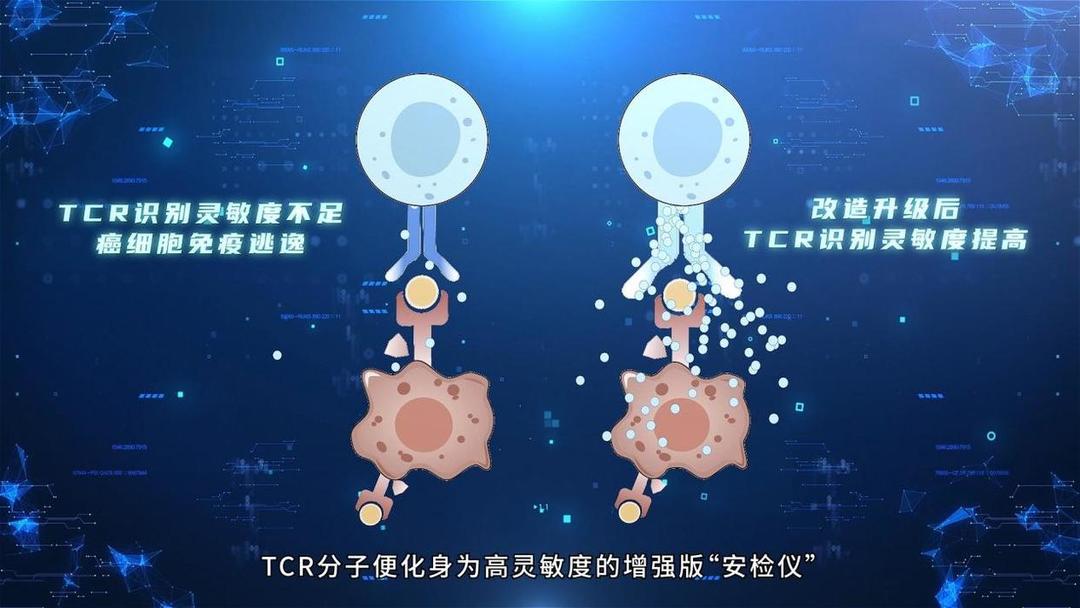
Group 1 - The research team from the Chinese Academy of Sciences has developed a method called "histidine scanning" to enhance the sensitivity of T cell receptors (TCRs) in identifying and eliminating cancer cells [1][3] - The modified TCRs act as high-sensitivity "security checks," significantly improving T cells' ability to clear cancer cells, as demonstrated in mouse experiments [1][3] - This method does not rely on the three-dimensional structural information of TCRs, allowing for simultaneous modification of multiple "key points" to enhance their ability to capture cancer cells [1][2] Group 2 - The study provides a new approach for developing a next-generation, efficient, and precise cancer immunotherapy, showing significant efficacy in animal models [3]
打造消灭癌细胞的“超级守护者” 中国科学家最新成果为癌症免疫疗法提供新思路
Jing Ji Guan Cha Wang· 2026-02-18 16:47
Core Viewpoint - The research team from the Chinese Academy of Sciences has developed a method called "histidine scanning" to enhance the sensitivity of T cell receptors (TCRs) in identifying and eliminating cancer cells, significantly improving T cell efficacy in cancer treatment [1][2]. Group 1 - T cells act as a specialized defense unit in the immune system, responsible for conducting safety checks on body cells [1]. - The natural sensitivity of TCRs is limited, allowing some cancer cells to evade detection [1]. - The "histidine scanning" method allows for the rapid identification of key sites on TCRs that are responsible for recognizing cancer cells, leading to enhanced TCR capabilities [1]. Group 2 - The modified TCRs exhibit higher activation levels and stronger killing power, while also being able to distinguish between cancerous and healthy cells, thus minimizing collateral damage [1]. - The research has shown promising anti-cancer effects in mouse models, paving the way for the development of new, efficient, and precise cancer immunotherapies [2].