碳经济

Search documents
越南永隆省大力发展绿色、循环农业
Shang Wu Bu Wang Zhan· 2026-02-02 16:01
Core Insights - The article discusses the efforts of Vinh Long Province in Vietnam to promote agricultural modernization through technology and digital transformation, aiming for sustainable and green development in agriculture [1][2] Group 1: Technological and Digital Transformation - Vinh Long Province is implementing the 57th Resolution of the Central Committee of the Communist Party regarding technological innovation and digital transformation in agriculture [1] - The province aims for 15%-20% of agricultural production area to utilize high-tech by 2030, creating smart production areas and traceability systems throughout the value chain [1] - Advanced technologies such as variety improvement, biotechnology, mechanization, automation, and smart management are increasingly applied, reducing costs and enhancing resource efficiency [1] Group 2: Agricultural Development and Sustainability - The province is focusing on green agriculture and circular economy development, emphasizing reduced chemical fertilizer use and increased application of organic fertilizers and bioproducts [2] - Vinh Long's main agricultural products are rice and coconuts, with over 9,200 households registered in the "1 Million Hectares of Quality Low-Carbon Rice Sustainable Development Plan," aiming for at least 50,000 hectares by 2030 [2] - The coconut industry targets an area of approximately 132,000 hectares by 2030, with 50% being organic coconuts, leveraging the carbon credit potential of coconut trees [2]
首批24所相关院校参加,这一联盟成立!
Xin Lang Cai Jing· 2026-01-31 14:19
Core Viewpoint - The establishment of the "Carbon Economy" discipline autonomous knowledge system alliance aims to support China's dual carbon goals and enhance academic influence in global climate governance [1][3]. Group 1: Alliance Formation - The "Carbon Economy" discipline autonomous knowledge system alliance was officially established, led by the School of Applied Economics at Renmin University of China, with participation from 24 initial institutions [3]. - The alliance focuses on addressing the systemic economic and social transformation needs driven by the dual carbon goals, refining the core categories and research paradigms of the "Carbon Economy" discipline [3]. Group 2: Objectives and Activities - The alliance will deepen collaboration in areas such as discipline construction, academic research, talent cultivation, and industry-academia-research cooperation [3]. - It aims to continuously promote the construction of an autonomous knowledge system for the "Carbon Economy" discipline and enhance China's academic influence and voice in global climate governance and green low-carbon development [3][5]. Group 3: Academic Contributions - Chen Hao, the project director of the "Carbon Economy" at Renmin University, released the "Carbon Economy Discipline Development Report" and a textbook on carbon neutrality economics [5]. - Experts and scholars from various universities discussed the construction of the "Carbon Economy" discipline system, core category refinement, innovative talent cultivation models, and alliance operational mechanisms during the forum [5].

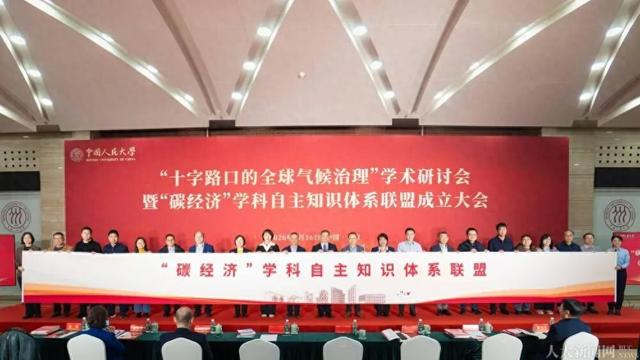
传播全球气候治理的中国声音,“碳经济”学科自主知识体系联盟成立
Xin Lang Cai Jing· 2026-01-23 05:30
Core Insights - The "Carbon Economy" discipline's independent knowledge system alliance was established to address the systematic economic and social transformation needs driven by the "dual carbon" goals [2][3] - The alliance aims to refine the core categories and research paradigms of the "Carbon Economy" discipline, promoting theoretical innovation and practical application [3] - The initiative is positioned as a crucial academic support for the national "dual carbon" strategy, high-quality development, and participation in global climate governance [3] Group 1 - The "Carbon Economy" independent knowledge system alliance was initiated by the School of Applied Economics at Renmin University of China, with participation from 24 related institutions [3] - The alliance will focus on academic research, talent cultivation, and industry-academia-research cooperation to enhance China's academic influence and voice in global climate governance and green low-carbon development [3] - The establishment of the "Carbon Economy" discipline is seen as a response to the demand for theoretical innovation and the dissemination of China's perspectives on climate issues [2][3]
3%股权,100%转型,中石油牵手国家电网下了一步大棋
Tai Mei Ti A P P· 2026-01-05 03:52
Core Viewpoint - The collaboration between China National Petroleum Corporation (CNPC) and State Grid Corporation of China represents a strategic shift in the energy sector, moving from traditional oil and gas reliance to a comprehensive energy ecosystem that integrates electricity, hydrogen, carbon, and financial tools [1][7]. Group 1: Transaction Insights - CNPC transferred 3% of its stake in China Oil Capital to State Grid's subsidiary, establishing a deeper partnership that transforms their relationship from mere cooperation to a shared interest [1][2]. - China Oil Capital's acquisition of 100% of Yingda Futures for 1.129 billion yuan is crucial for CNPC's entry into the electricity market, allowing it to manage price volatility independently and enhance operational security [2][3]. Group 2: Strategic Implications for CNPC - The transaction serves as a "safety cushion" for CNPC's aggressive transformation strategy, enabling better risk management through financial instruments like futures and options [3][4]. - By securing a stake in State Grid, CNPC gains access to the core electricity ecosystem, facilitating smoother integration in distributed solar, energy storage, and charging networks [3][4]. Group 3: Broader Energy Ecosystem Strategy - The collaboration is part of CNPC's larger strategy to establish a dual-driven approach, combining physical energy production (oil, gas, electricity, hydrogen) with financial capital management to optimize resource allocation and risk control [5][6]. - This shift indicates a transition from point-to-point competition to ecosystem-based competition, where the focus is on building resilient and dynamic industry networks [7]. Group 4: Future Outlook - The partnership signals a new era in the energy sector, where capital and financial tools play a crucial role in addressing common challenges such as investment risks and market pricing [7]. - The essence of this collaboration lies in leveraging financial flexibility to navigate the complexities of industrial transformation, with the potential for significant competitive advantages in the evolving energy landscape [7].

估值暴击点:零碳文旅的新故事
凤凰网财经· 2025-06-08 14:30
6 月 5 日,北京。当《中国国家地理》 杂志社 与宁德时代将五块 " 零碳景区 " 铭牌推向台前时,武夷山村民手中的碳汇凭证正悄然升值 —— 这 片用 1572 吨碳汇(相当于 1600 亩竹林固碳量)置换的 " 绿色黄金 " ,刚为当地带来 16 万元真金白银的收益。 五座名山(丹霞山、黄山、张家界、长白山、武夷山)把竹林变现成金矿,宁德时代藏在评审团身后的 " 四化 " 方案,则为这场撬动千亿碳账本的 豪赌埋下暗桩: 一场由权威科学媒体与新能源巨头共同发起的零碳革命,正在重塑中国文旅产业的财富逻辑。 01 为什么是文旅? 碳经济量身定制的"试验场" 席卷海外 时至今日,生态旅游市场早已不再是环保主义的乌托邦,零碳也不再仅仅是环保口号,而是实打实的降本引擎和溢价筹码。 2023 年中国生态旅游规模已飙至 1490 亿, 2028 年将突破 2500 亿的蛋糕,年复合增长率 10.5% 的暴利赛道,恰似为 碳经济 量身定制的 " 试验场 " :景区为争夺 " 零碳标签 " 豪掷千万改造费,游客为 " 碳概念 " 旅行心甘情愿地支付溢价。此外,重押零碳市场的战略选择,本质也是 一场政策红利与产业试验田的精准卡 ...