
社区家庭服务业税费优惠政策

Search documents
养老、托育、家政等社区家庭服务业税费政策延续实施
蓝色柳林财税室· 2026-03-12 01:40
Group 1 - The article discusses tax benefits for institutions providing community services such as elderly care, childcare, and housekeeping, including exemptions from value-added tax and reductions in taxable income [3][4] - Institutions providing these services can enjoy a 90% reduction in taxable income when calculating their taxable income [3] - Properties and land used for these community services are exempt from various taxes, including deed tax and property tax [3][4] Group 2 - To qualify for these tax benefits, institutions must meet specific criteria, including being located in a defined community and providing services such as life care, rehabilitation, and emergency assistance for the elderly [3] - The policy is applicable to childcare services for children under three years old, including care, nutrition, and education [4] - The policy execution period is from January 1, 2026, to December 31, 2027, encouraging eligible institutions to take advantage of these benefits [3]


这项政策,延续实施至2027年12月31日
蓝色柳林财税室· 2026-03-03 14:49
Tax Incentives for Community Services - The article discusses various tax incentives for community services such as elderly care, childcare, and domestic services, including exemptions from value-added tax (VAT), corporate income tax, deed tax, property tax, and urban land use tax [4][5][6]. - Properties and land used for community services are exempt from several fees, including real estate registration fees and urban infrastructure fees, significantly improving cash flow for service providers [4][6]. Eligibility Criteria - Not all institutions can enjoy these tax benefits; they must provide specific services such as elderly care, childcare, or domestic services within the community [5]. - Community elderly care services include life care, rehabilitation, meal assistance, emergency help, and emotional support [5]. - Community childcare services cater to children under three years old, providing care, meals, and nurturing [5]. - Domestic service providers must enter homes to offer care for vulnerable groups and perform household tasks [5]. Compliance Requirements - Eligible domestic service companies must meet three criteria: signing a tripartite agreement with service workers and clients, paying wages and managing training for service workers, and maintaining a business management system for worker registration [7]. - All institutions must retain documentation such as service agreements and records proving service provision to the community for verification [8]. Consequences of Non-compliance - Failure to provide the required documentation or if the documentation is found to be false may result in the recovery of tax benefits already enjoyed, along with legal consequences [10]. Policy Duration - The tax incentives are set to be effective from January 1, 2026, to December 31, 2027, indicating a limited timeframe for institutions to take advantage of these benefits [12].

新政速递站 ▏公共租赁住房税收优惠政策
蓝色柳林财税室· 2026-02-19 11:14
Core Viewpoint - The article discusses the tax exemption policies for community service providers in the areas of elderly care, childcare, and domestic services, emphasizing the importance of these services and their contribution to community welfare [8][9][10]. Group 1: Tax Exemption Policies - According to the announcement by multiple government departments, income from community elderly care, childcare, and domestic services is exempt from value-added tax (VAT) [8]. - The term "community" refers to a social living community composed of people residing within a certain geographical area, including both urban and rural communities [8]. Group 2: Community Elderly Care Services - Community elderly care services are defined as services provided to elderly individuals, including daily care, rehabilitation, meal assistance, emergency rescue, and emotional support [9]. Group 3: Community Childcare Services - Community childcare services are defined as services provided to children under the age of three, including care, supervision, meals, and nurturing [10]. Group 4: Community Domestic Services - Community domestic services are defined as services provided to families, including care for pregnant women, infants, the elderly, patients, and disabled individuals, as well as cleaning and cooking services [11][12]. Group 5: Conditions for Domestic Service Providers - Domestic service providers can be exempt from VAT if they meet specific conditions, such as signing a tripartite agreement with service workers and clients, paying wages to service workers, and managing them through a business management system [14].

商务部1月29日召开例行新闻发布会
Shang Wu Bu Wang Zhan· 2026-01-29 12:01
Group 1 - The core message of the press conference is the successful visit of Finnish Prime Minister Orpo to China, where both countries achieved practical cooperation results in the economic and trade sectors [4] - The signing of a memorandum on strengthening the cooperation between innovative enterprises of China and Finland was a significant outcome of the visit, indicating a commitment to deepen bilateral economic cooperation [4] - Over 50 companies from both countries participated in discussions on innovation, green technology, and digital cooperation, leading to multiple business agreements in sectors such as mining machinery, healthcare, papermaking, and green construction [4] Group 2 - The Ministry of Commerce is extending tax and fee preferential policies for the community family service industry, which includes home care services, until the end of 2027, highlighting the government's focus on this sector's role in promoting consumption and stabilizing employment [5][6] - The implementation of these tax incentives has effectively reduced the tax burden on service providers and has received positive feedback from various sectors of society [5] - The Ministry will continue to work with relevant departments to ensure the effective communication and implementation of these policies, aiming to support the high-quality development of the home care service industry [6] Group 3 - The Ministry of Commerce expressed a willingness to maintain communication and cooperation with the United States, emphasizing the importance of dialogue in resolving economic and trade differences [7] - The ongoing economic negotiations between China and the U.S. have shown positive results, demonstrating that both sides can find solutions through equal dialogue [7] - The Ministry aims to promote stable, healthy, and sustainable development of China-U.S. economic relations by utilizing the existing negotiation mechanisms [7]
阳阳视野|养老、托育、家政等社区家庭服务业税费优惠政策延续实施
Sou Hu Cai Jing· 2026-01-22 09:33
Core Viewpoint - The announcement extends tax and fee preferential policies for community family service industries, including elderly care, childcare, and domestic services, to support their development until the end of 2027 [1][7]. Tax and Fee Policies - Institutions providing community elderly care, childcare, and domestic services will enjoy the following tax benefits: - Exemption from value-added tax (VAT) on income from these services [1]. - A 90% reduction in the income included in the taxable income calculation [2]. - Exemption from deed tax for properties and land used for these services [3]. - Exemption from various fees related to property and land used for these services, including real estate registration fees and urban infrastructure fees [3]. Community Definition - The term "community" refers to a social living entity composed of people residing within a specific geographic area, including both urban and rural communities [3]. Service Definitions - Community elderly care services include life care, rehabilitation, meal assistance, emergency rescue, and emotional support for the elderly [3]. - Community childcare services provide care, supervision, meals, and nurturing for children under three years old [3]. - Community domestic services involve providing care for pregnant women, infants, the elderly, patients, and disabled individuals, as well as cleaning and cooking services in households [4]. Compliance and Documentation - Taxpayers benefiting from these policies must retain documentation such as registration receipts for elderly and childcare institutions, service agreements with community organizations, and evidence of service provision for verification [4]. Specific Conditions for Domestic Service Enterprises - Domestic service enterprises must meet specific conditions to qualify for VAT exemption, including signing tripartite agreements with service workers and clients, paying wages to service workers, and managing them through a business management system [5][6]. Coordination and Oversight - Relevant departments, including civil affairs, health, commerce, and finance, are required to enhance coordination and establish an information-sharing mechanism to ensure the effective implementation of these preferential policies [6]. Implementation Timeline - The policies outlined in the announcement will take effect from January 1, 2026, and remain in force until December 31, 2027 [7].
【政策速递】养老、托育、家政等社区家庭服务业税费优惠政策延续实施
Sou Hu Cai Jing· 2026-01-21 09:41
Core Viewpoint - The announcement extends tax and fee preferential policies for community family service industries, including elderly care, childcare, and domestic services, until the end of 2027 [1][7]. Tax and Fee Preferential Policies - Institutions providing community elderly care, childcare, and domestic services will enjoy the following tax benefits: - Exemption from value-added tax (VAT) on income from these services [2]. - Income from these services will be calculated at 90% for taxable income purposes [3]. - Exemption from deed tax for properties and land used for these services [4]. - Exemptions from various fees related to property and land used for these services, including real estate registration fees and urban infrastructure fees [4]. Property and Land Tax Exemptions - Properties and land owned or used by institutions for community elderly care, childcare, and domestic services will be exempt from property tax and urban land use tax [4][6]. Definition of Community Services - The term "community" refers to a social living community composed of people in a specific geographic area, including urban and rural communities [4]. - Community elderly care services include various forms of support for the elderly, such as daily care and emergency assistance [4]. - Community childcare services provide care and supervision for children under three years old [4]. - Community domestic services involve providing household assistance to families, including cleaning and cooking [5]. Compliance and Documentation - Taxpayers benefiting from these policies must retain specific documentation to verify compliance, including service agreements and proof of service provision [6]. Implementation Timeline - The policies will be effective from January 1, 2026, to December 31, 2027 [7].
六部门,利好发布!
Zhong Guo Ji Jin Bao· 2026-01-20 12:21
Core Viewpoint - The announcement by six government departments aims to continue tax and fee preferential policies to support the development of community family services, including elderly care, childcare, and domestic services. Group 1: Tax and Fee Policies - Institutions providing community elderly care, childcare, and domestic services will enjoy tax exemptions, including exemption from value-added tax (VAT) on income earned from these services [1][2] - Income from community elderly care, childcare, and domestic services will be calculated at 90% for taxable income purposes [3] - Properties and land used for providing community services will be exempt from deed tax, property tax, and urban land use tax [4] Group 2: Definitions and Scope - The term "community" refers to a social living community composed of people in a specific geographic area, including urban and rural communities [5] - Institutions providing elderly care services are defined as those offering various forms of care to elderly residents in the community [5] - Institutions providing childcare services are defined as those offering care and supervision for children under three years old [5] - Institutions providing domestic services are defined as those offering household services to community residents [5] Group 3: Compliance and Oversight - Taxpayers benefiting from these policies must retain documentation such as service agreements and proof of service provision for verification [6] - Specific conditions must be met for domestic service enterprises to qualify for VAT exemptions, including signing tripartite agreements and managing service personnel [6] - Coordination among civil affairs, health, commerce, and tax departments is essential for effective supervision and implementation of these policies [6] Group 4: Implementation Timeline - The announcement will be effective from January 1, 2026, to December 31, 2027 [7]
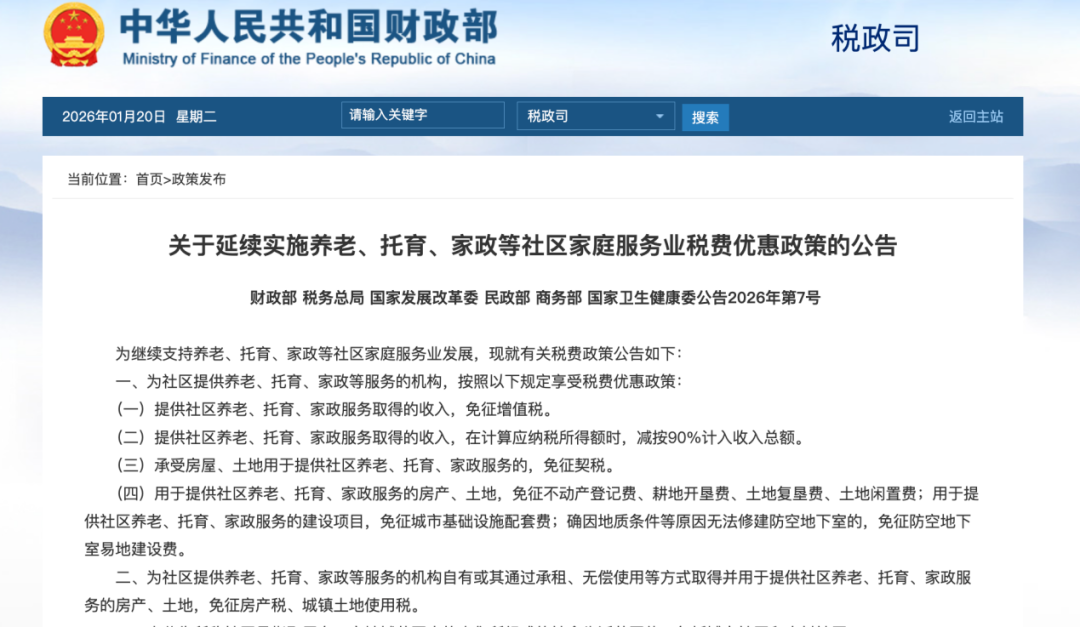
养老托育等免税政策再续两年,有两点小变化
Di Yi Cai Jing· 2026-01-20 12:00
Core Viewpoint - The announcement extends tax and fee incentives for community service industries such as elderly care, childcare, and domestic services until December 31, 2027, to support the growing demand due to an aging population and to encourage childbirth [1]. Group 1: Policy Extension - The Ministry of Finance and six other departments have released an announcement to extend tax incentives for community service industries, originally set to expire at the end of last year, for an additional two years [1]. - The extension aims to improve people's livelihoods, support the elderly care sector, promote childbirth, increase employment, and expand service consumption to stimulate domestic demand [1]. Group 2: Tax Incentives Details - The announcement maintains previous tax incentives, including exemption from value-added tax for income generated from community services, and a 90% reduction in taxable income for these services [2]. - Properties and land used for providing community services will be exempt from deed tax, property tax, and urban land use tax [2]. Group 3: Enhanced Compliance Measures - The new announcement emphasizes strengthened tax administration to ensure the effective implementation of the tax incentives [3]. - Taxpayers must retain specific documentation, such as registration receipts and service agreements, to validate their eligibility for the tax benefits [3]. - Provincial departments will regularly share necessary information with tax authorities to ensure the proper execution of the incentive policies [3].
关于延续实施养老、托育、家政等社区家庭服务业税费优惠政策的公告公告2026年第7号
蓝色柳林财税室· 2026-01-20 11:45
Core Viewpoint - The announcement extends tax and fee preferential policies for community family services such as elderly care, childcare, and housekeeping from January 1, 2026, to December 31, 2027, to support the development of these services [4]. Group 1: Tax and Fee Policies - Institutions providing community elderly care, childcare, and housekeeping services will enjoy the following tax benefits: - Exemption from value-added tax (VAT) on income from these services [1]. - A 90% reduction in the income included in the taxable income calculation [1]. - Exemption from deed tax for properties and land used for these services [1]. - Exemptions from various fees related to property registration and construction for these services [1]. - Properties and land used for community services will be exempt from property tax and urban land use tax [1]. Group 2: Definition and Scope - The term "community" refers to a social living community composed of people in a specific geographic area, including urban and rural communities [2]. - Institutions providing elderly care services are defined as those offering services such as daily care, rehabilitation, meal assistance, emergency rescue, and emotional support to the elderly [2]. - Institutions providing childcare services are defined as those offering care, supervision, meals, and nurturing for children under three years old [2]. - Institutions providing housekeeping services are defined as those offering services such as cleaning and cooking within family residences [2]. Group 3: Compliance and Documentation - Taxpayers benefiting from these policies must retain documentation such as registration receipts for elderly and childcare institutions, service agreements with community organizations, and evidence of service provision for verification [3]. - Failure to provide the required documentation or if the documentation is found to be false may result in the recovery of enjoyed tax benefits [3]. Group 4: Coordination and Oversight - Relevant departments, including civil affairs, health, commerce, and finance, are required to enhance coordination and establish a mechanism for information sharing to ensure the effective implementation of these policies [3].

财政部等六部门:延续实施养老、托育、家政等社区家庭服务业税费优惠政策
Sou Hu Cai Jing· 2026-01-20 11:04
Core Viewpoint - The announcement by the Ministry of Finance and other departments aims to support the development of community family services, including elderly care, childcare, and domestic services, by providing various tax exemptions and reductions from January 1, 2026, to December 31, 2027 [1][7]. Tax Exemption Policies - Income from community elderly care, childcare, and domestic services will be exempt from value-added tax (VAT) [1][5]. - When calculating taxable income, 90% of the income from these services will be included in the total income [2][5]. - Properties and land used for providing these community services will be exempt from deed tax [3][5]. - Various fees related to real estate and land, such as property registration fees and urban infrastructure fees, will be waived for properties used in these services [3][5]. Eligibility and Requirements - Institutions providing community services must retain documentation such as service agreements and registration receipts to prove compliance with the tax exemption criteria [4][5]. - Specific conditions must be met for domestic service companies to qualify for VAT exemption, including signing tripartite agreements and managing service personnel [6][5]. Coordination and Oversight - Relevant departments, including civil affairs and health, are required to enhance coordination and establish information-sharing mechanisms to ensure the effective implementation of these tax policies [7].