算力金融化

Search documents
北理工报告:建议全国统一算力定价,绿电算力享折扣、向小微企业发算力券
Xin Lang Cai Jing· 2026-01-21 14:26
Core Insights - The unprecedented demand for computing power driven by AI large models has become a critical topic in energy research, highlighting the interconnection between computing power and energy supply [1] - The report from Beijing Institute of Technology emphasizes the need for a low-carbon computing power service system to support China's transition from a "big computing power country" to a "strong computing power country" [1] Group 1: Current Challenges in Computing Power Services - The report identifies five major challenges in China's computing power services, including structural imbalances in demand and supply, insufficient autonomy in key hardware, and technical bottlenecks in transmission [2] - The demand side shows a coexistence of high-end computing shortages and low-end computing idleness, while the supply side faces dual constraints of hardware autonomy and uneven distribution [2] Group 2: Regional Disparities in Computing Power - Eastern core urban areas have a high concentration of computing power demand, with some hotspots experiencing load rates exceeding 85%, while western regions have low utilization rates due to insufficient demand [3] - The report notes that the cost of cross-regional transmission can reach 2-5 times that of local resources, undermining the economic attractiveness of western computing power [3] Group 3: Recommendations for Optimizing Computing Power Services - The report suggests strengthening the "East Data West Computing" initiative by implementing differentiated access requirements and establishing a compensation mechanism for green electricity [4] - It recommends creating a unified national pricing mechanism for computing power and providing subsidies for green electricity usage [4] Group 4: Future Projections - The report forecasts that by 2030, the average power load of data centers nationwide will reach 105 million kW, with total electricity consumption averaging 525.76 billion kWh [4] - By 2040, data centers are expected to account for 10.84% of national electricity demand, driven by medium-speed growth in intelligent computing power [4] Group 5: Integration of Computing Power and Energy Systems - Experts emphasize the need for coordinated planning between computing centers and the overall power grid to optimize both computing and energy transmission networks [5] - There is a call for improved price transmission channels between the electricity market and the computing power market to enhance synergy [6]
超级未来科技有限公司 搭建多国算力网络,为AI时代建立可交易的基础设施资产体系
Jiang Nan Shi Bao· 2025-11-19 11:52
Core Insights - The integration of AI and blockchain technology is reshaping the global tech landscape, with a focus on redefining "computing power" as a core production asset with financial attributes [1] - The company is pioneering a mechanism to NFT-ize computing power, providing a more predictable and efficient resource allocation path for AI developers and institutions [1][2] Group 1: Resource Allocation and Efficiency - The company's computing asset network has transitioned to a global scheduling framework, allowing developers to access remote computing power without concern for physical resource locations [2] - This new mechanism enhances resource utilization efficiency and reshapes incentive structures, enabling resource holders to inject idle resources into a blockchain-based computing pool [2] - The platform automatically allocates resources based on real-time demand and efficiency, allowing for revenue sharing with asset holders post-task completion [2] Group 2: Token Economy and Assetization - The company has developed a dual-token incentive model, where one token is used for resource transactions and the other is tied to platform governance and profit-sharing [3] - Developers are encouraged to encapsulate completed models as NFTs, allowing them to maintain control and earn revenue from each model invocation, thus transforming models into dynamic digital assets [3] Group 3: Security and Compliance - A four-layer security mechanism has been implemented to ensure resource safety, task stability, and data compliance, including identity authentication and hardware encryption [4] - The platform records energy consumption data on-chain and prioritizes high-efficiency nodes, linking token incentives to energy-saving performance, promoting a transition to sustainable energy architectures [4] Group 4: Market Position and Future Directions - The company's system is increasingly viewed as the backbone of next-generation AI infrastructure, attracting a diverse range of developers and institutions [5] - A new derivative product called "computing power on-chain bonds" is being developed, allowing NFT assets to be packaged into income-generating bonds, enhancing liquidity for resource holders [6] - The company aims to build a comprehensive on-chain computing ecosystem by integrating more edge nodes and distributed storage networks, while actively participating in the development of international token standards and scheduling protocols [6]
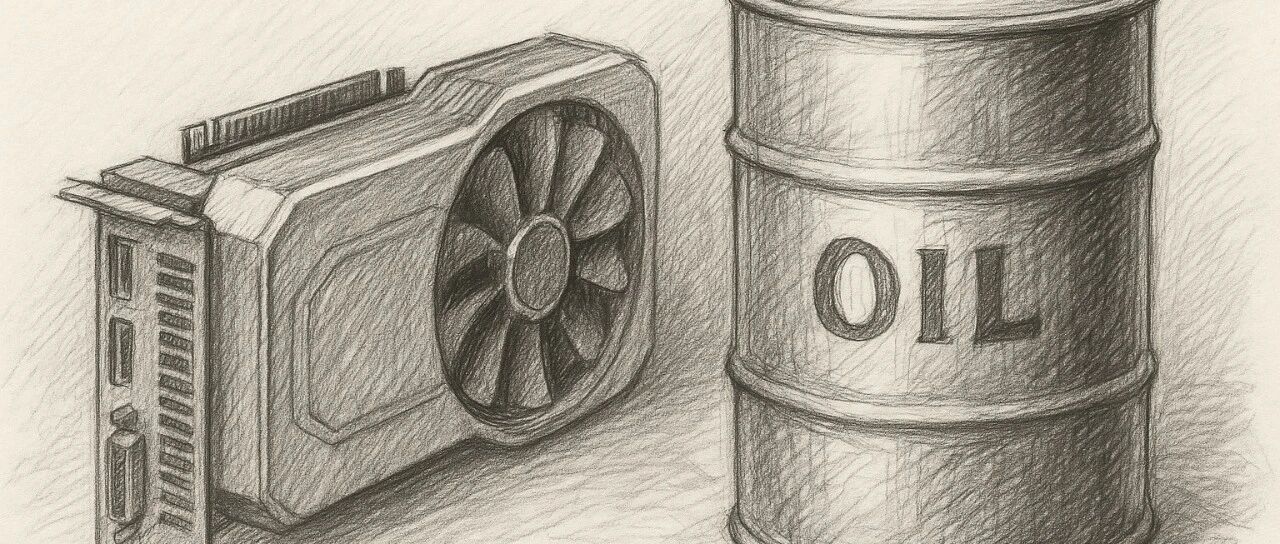
GPU会成为新的石油吗?
伍治坚证据主义· 2025-10-01 06:22
Group 1 - The founder and CEO of DRW, Don Wilson, suggests that global spending on GPUs may surpass that on oil in the next decade, highlighting the increasing importance of GPUs as a core resource for AI training [2][3] - The demand for GPUs is expected to explode, with the International Energy Agency projecting that electricity demand for AI data centers in the U.S. will reach 123 million kilowatts by 2035, which is 30 times the level in 2024 [3][2] - The supply of GPUs is uncertain due to factors such as TSMC's production capacity, U.S. export controls, and NVIDIA's product release schedule, leading to potential volatility in the market [3][4] Group 2 - The financialization of GPUs could lead to the creation of futures contracts and indices similar to those for oil, copper, and gold, allowing companies to hedge against price fluctuations [3][4] - Historical trends show that financialized commodities often experience bubbles and crashes, raising concerns about the potential for similar outcomes in the GPU market [4][5] - Unlike oil, which can be stored long-term, GPUs have a short lifecycle due to rapid technological advancements, making them more akin to perishable goods [4][5] Group 3 - Long-term investment success in commodities typically comes from companies that hold advantageous positions in the supply chain, such as manufacturers like TSMC and designers like NVIDIA, rather than from speculative trading in GPU futures [5][6] - The concept of "computing power capitalism" suggests a shift in resource perception from tangible materials like coal and oil to intangible assets like data, algorithms, and computing power [5][6] - The market will likely find ways to financialize new demands, but investors should focus on identifying companies and industries that will benefit from the emerging "computing power capitalism" rather than speculating on GPU futures [6]