系统性危机

Search documents
中美现在最大的一个共识,可能就是不要爆发系统性的危机,以现在的全球化程度而言,如果再发生类似于1929年那样的世纪大萧条
Sou Hu Cai Jing· 2025-10-22 17:02
Economic Overview - The global economic growth rate for this year is approximately 3.1%, which is one percentage point lower than the pre-pandemic average [3] - The total U.S. federal debt has surpassed $34 trillion, with the Federal Reserve maintaining interest rates above 5% [3] - Germany's GDP declined by 0.4% year-on-year in the third quarter, while inflation in France remains high [3] Debt and Financial Stability - Global debt has reached 330% of GDP, significantly higher than the 150% ratio during the 1929 crisis, indicating a precarious financial situation [3] - The 2008 financial crisis was mitigated by aggressive monetary policy, but this has led to a larger global debt bubble that now affects all countries [5] Income Inequality - There is a growing disparity between developed and developing countries, with the wealthiest 10% holding over 76% of global wealth, while the bottom half of the population receives less than 2% [5] - In the U.S., the top 1% has seen their income nearly quadruple over the past 30 years, while the bottom 50% has experienced stagnant real wages [5] Trust and Systemic Risks - The erosion of trust in economic systems is evident in political conflicts in the U.S. and social unrest in Europe, signaling a struggle for resource distribution [7] - The current U.S.-China relationship is characterized by a race against time, with both nations trying to maintain stability to avoid global repercussions [7] Long-term Economic Outlook - The current stability in the global economy is described as "false stability," with past reliance on globalization, low interest rates, and technology bubbles no longer sustainable [9] - The IMF's statement about entering a "new era of long-term low growth" highlights structural issues rather than cyclical ones [10]

市场在说什么?当纳指狂飙的时候,美债收益率却逼近高点,美元更是下跌
Hua Er Jie Jian Wen· 2025-05-14 03:10
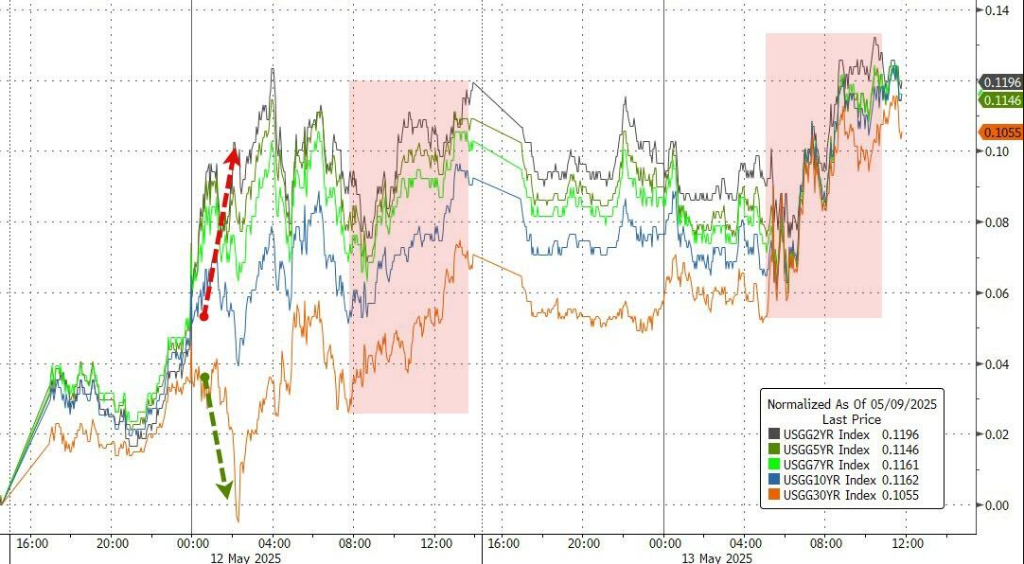
Core Viewpoint - The U.S. stock market experienced a rebound, particularly in technology stocks, while U.S. Treasury yields rose unexpectedly despite a slowdown in inflation, indicating potential structural fiscal issues in the U.S. economy [1][4][10] Group 1: Inflation and Market Reactions - The U.S. Consumer Price Index (CPI) for April increased by 2.3% year-on-year, lower than the expected 2.4%, marking the lowest level since February 2021 [1] - Despite the lower inflation rate, the 10-year U.S. Treasury yield rose by 2.4 basis points to 4.481%, contrary to expectations that lower inflation would lead to a decrease in yields [1][4] - The core inflation rate, excluding food and energy, remained at 2.8%, which aligns with expectations and may weaken market anticipation for interest rate cuts by the Federal Reserve this year [6] Group 2: Structural Fiscal Concerns - Analysts suggest that the recent rise in Treasury yields and the divergence from the dollar's performance indicate deeper structural fiscal problems in the U.S. [3][8] - The U.S. government is expected to issue over $2 trillion in debt, raising concerns about a lack of buyers, which could force the Federal Reserve to restart balance sheet expansion [3][7] - The Treasury plans to borrow $514 billion in the April to June quarter and $554 billion in the July to September quarter, with total borrowing exceeding $2 trillion annually, highlighting significant fiscal challenges [7] Group 3: Dollar and Yield Relationship - There is a notable disconnection between the dollar and Treasury yields, which traditionally move in tandem; this disconnect raises concerns about a potential deeper collapse of the dollar [3][10] - Analysts from Bravos Research indicate that further increases in interest rates may be necessary to stabilize the dollar, suggesting a real risk of a deeper collapse [10] - The market's perception of rising U.S. yields has shifted from a sign of strength to a signal of crisis, fundamentally altering the dollar's response to yield changes [10]