经济增长支持

Search documents
Sensex closes 296 points lower at 82,269, Nifty skids 98 points to 25,320; stock markets dragged lower by metal, IT stocks
BusinessLine· 2026-01-30 11:05
Market Performance - Benchmark equity indices Sensex and Nifty ended lower, with Sensex declining by 296.59 points or 0.36% to settle at 82,269.78, and Nifty dropping by 98.25 points or 0.39% to end at 25,320.65, snapping a three-day rally [1][2] - Tata Steel experienced the largest decline among Sensex firms, falling by 4.57%, while other laggards included ICICI Bank, Power Grid, HCL Tech, Tech Mahindra, Infosys, and Kotak Mahindra Bank [2] Foreign Investment Trends - Foreign institutional investors sold equities worth ₹393.97 crore, while domestic institutional investors bought stocks worth ₹2,638.76 crore, indicating a mixed sentiment in the market [3] - Persistent selling by foreign institutional investors and a depreciating rupee contributed to cautious market sentiment [4] Economic Outlook - India's economy is projected to grow by 6.8-7.2% in the upcoming fiscal year, reaffirming its status as the fastest-growing major economy despite global volatility and trade risks [5] - The Union Budget is highly anticipated for insights on growth support and fiscal discipline amid rising geopolitical risks and global tariff pressures [4] Global Market Influence - Indian equity markets showed volatility influenced by weakness in IT and metal stocks, with global growth concerns and higher US bond yields impacting the IT sector [3] - Mixed cues from overseas markets, along with ongoing rupee weakness, limited recovery attempts in the Indian markets [6]

金晟富:1.29黄金疯狂拉升加速赶顶!日内黄金分析参考
Sou Hu Cai Jing· 2026-01-29 02:59
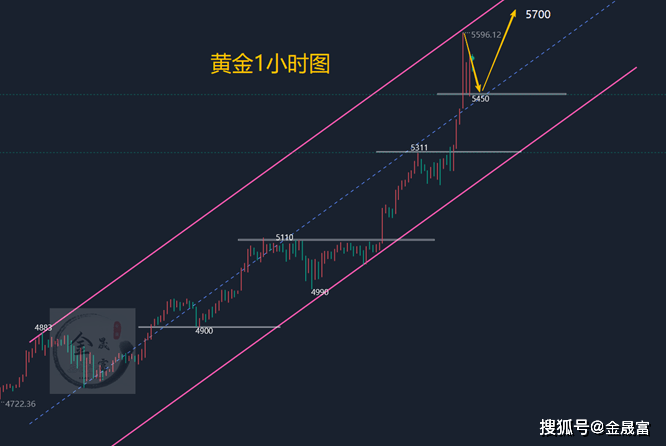
Group 1 - The core viewpoint of the articles highlights the significant rise in gold prices, driven by geopolitical tensions and monetary policy decisions, particularly the U.S.-Iran conflict and the Federal Reserve's decision to maintain interest rates [1][2][3]. - Gold prices reached a historical high of $5600 per ounce, reflecting a surge in safe-haven buying amid escalating geopolitical risks [1][2]. - The Federal Reserve's cautious stance on interest rates indicates a balanced approach to managing inflation and supporting economic growth, which has implications for market stability and investor sentiment [2][3]. Group 2 - Technical analysis indicates that gold prices are currently experiencing a strong upward trend, with resistance levels at $5550 and $5596, and potential targets above $5700 [5][6]. - The market is characterized by volatility, with significant price fluctuations observed, including a recent intraday increase of nearly $200 before a pullback [3][5]. - Suggested trading strategies include buying on dips around $5450 and selling on rebounds near $5595-$5600, emphasizing the importance of risk management and position sizing [6][7].
凯德北京投资基金管理有限公司:卡什卡利表示不要忽视了关税对美国经济的长期影响
Sou Hu Cai Jing· 2025-05-29 09:55
Core Viewpoint - The Federal Reserve's decision to maintain stable interest rates is crucial in the current economic climate, particularly as the impact of tariffs on inflation has yet to fully materialize [1][3]. Group 1: Economic Environment - The U.S. inflation rate has exceeded the Federal Reserve's 2% target for four consecutive years, raising concerns about long-term inflation expectations [3]. - The impact of tariffs, especially on intermediate goods, will not be immediate, leading to delayed effects on consumer prices [3]. - Ongoing global trade negotiations may last for months or even years, complicating the situation further [3]. Group 2: Federal Reserve's Stance - Some policymakers advocate for interest rate cuts to support economic growth, viewing tariff impacts as short-term inflation shocks [1][3]. - However, the Federal Reserve, particularly through the views of Kashkari, emphasizes the need to remain vigilant regarding the long-term effects of trade policies and tariffs on inflation and economic stability [1][3][5]. - Since December of the previous year, the Federal Reserve has maintained the policy interest rate between 4.25% and 4.5%, primarily due to uncertainties surrounding the new tariff policies [5].