
经济对策

Search documents
经济民生双承压下 日本再遭高市妄为之“祸”
Yang Shi Xin Wen Ke Hu Duan· 2025-11-22 05:54
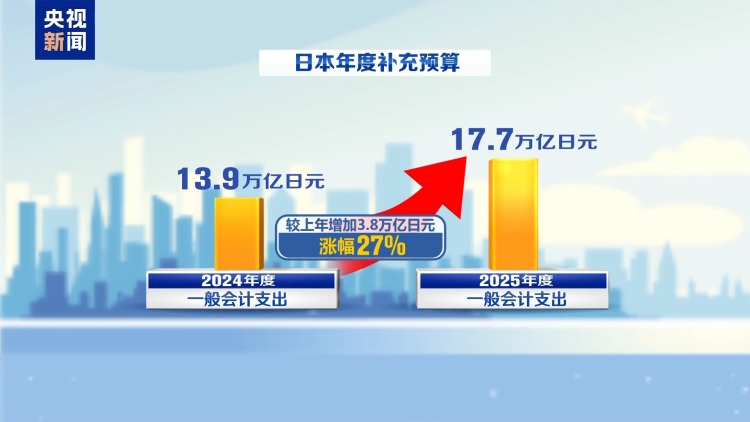
Group 1 - Japan's inflation problem is worsening, with the core consumer price index (CPI) rising by 3.0% year-on-year in October, marking a continuous increase for 50 months [16][18][24] - The Japanese government has approved a record economic stimulus package amounting to approximately 21.3 trillion yen (about 965.6 billion RMB), with the 2025 supplementary budget expected to reach 17.7 trillion yen, a 27% increase from the previous year [2][6] - Concerns about Japan's fiscal deterioration are growing, as the government relies on issuing additional national bonds to cover spending gaps, leading to market skepticism regarding the government's fiscal credibility [4][10][12] Group 2 - The Japanese economy has contracted for the first time in six quarters, with a 0.4% decrease in real GDP in Q3 2025, translating to an annualized decline of 1.8% [14] - The depreciation of the yen is exacerbating inflationary pressures, as it increases import prices, which in turn affects domestic prices [25][28] - The economic measures proposed by the government are seen as short-term solutions that do not address the underlying structural issues of the economy, such as high national debt and declining labor productivity [29][31]

受美国关税打击,三季度日本经济萎缩1.8%,为六个季度来首次负增长
Ge Long Hui· 2025-11-17 08:04
Core Viewpoint - Japan's economy experienced a year-on-year decline of 1.8% in Q3, marking the first negative growth in six quarters, with a quarter-on-quarter decrease of 0.4%, which, although better than the market expectation of a 2.5% drop, indicates increasing pressure on monetary and fiscal policies [2] Economic Performance - External demand turned negative, contributing -0.2 percentage points to GDP, a shift from the previous quarter's positive contribution of 0.2 percentage points [2] - Exports to the U.S. saw a significant decline, with a 24.2% year-on-year drop in September for automotive exports, which is the largest segment of Japan's exports to the U.S. [2] - Overall exports decreased by 1.2% quarter-on-quarter amid weak global demand [2] Domestic Demand - Personal consumption, which accounts for over half of GDP, only increased by 0.1%, a slowdown from 0.4% in the previous quarter, primarily due to high food prices suppressing household spending [2] - Business equipment investment grew by 1.0%, exceeding market expectations and serving as one of the few bright spots in the economy [2] - Residential investment declined significantly due to stricter environmental standards for new housing [2] Inflation and Government Response - The GDP deflator index rose by 2.8% year-on-year, indicating persistent underlying inflation [2] - The Japanese government plans to implement an economic stimulus package exceeding 17 trillion yen this week [2] - The Bank of Japan maintained interest rates at 0.5% last month, indicating a potential for further tightening if economic conditions align with expectations [2]

日本自民党与维新会正式就联合执政达成一致
Xin Hua She· 2025-10-20 12:10
Core Points - The ruling Liberal Democratic Party (LDP) of Japan and the Japan Innovation Party (JIP) have reached an agreement for a coalition government, with JIP confirming support for LDP candidate Sanae Takaichi in the upcoming prime ministerial election [1] - The agreement includes commitments to swiftly implement economic measures and structural reforms, as well as a proposal to reduce the number of seats in the House of Representatives by approximately 10% [1] - A mechanism for discussions on abolishing political donations from corporations and organizations will be established, aiming for consensus during Takaichi's tenure as LDP president [1] Political Dynamics - JIP will participate in the coalition as an "outside cooperation," meaning its members will not join the cabinet, despite LDP's desire for JIP to send cabinet members [1] - JIP's decision to support Takaichi indicates a high likelihood of her winning the prime ministerial election, potentially making her Japan's first female prime minister [1] - The prime ministerial election will take place in the National Diet, where a candidate must secure a majority in the first round of voting to win [1]