
绿色智能化

Search documents
研判2026!中国电工钢行业发展现状、细分市场、进出口情况、竞争格局及未来发展趋势研判:供需向好进出口优化,高端升级前景可期[图]
Chan Ye Xin Xi Wang· 2026-02-22 03:09
Core Insights - The electrical steel industry is experiencing simultaneous scaling and high-end development driven by domestic industrial structure optimization, with production and consumption expected to reach historical highs by 2025 [1][6] - The industry is characterized by dual concentration in both product categories and regions, with new capacities focusing on high-end products, particularly in East, Central, and North China [1][6] - The market is witnessing a significant increase in demand from downstream sectors such as electric vehicles and renewable energy, with a notable growth in both oriented and non-oriented electrical steel [1][6][11] Industry Overview - Electrical steel, also known as silicon steel, is a critical soft magnetic alloy material used in power, electronics, and military industries, known for its high magnetic permeability and low iron loss [2][5] - The main types of electrical steel are oriented and non-oriented, with the former used in high-frequency transformers and the latter in motors and household appliances [3][4] Current Development Status - From 2020 to 2024, the production of electrical steel is projected to grow from 11.18 million tons to 16.1 million tons, with consumption increasing from 11.08 million tons to 14.8 million tons [6] - By 2025, production is expected to reach 23.85 million tons, marking a significant increase of 775,000 tons from 2024, with consumption also rising to 22.495 million tons [6] Capacity Expansion - As of mid-2025, there are 27 ongoing and planned projects for electrical steel, with 15 projects for oriented steel and 12 for non-oriented steel, indicating a total new capacity of 668,000 tons [6][7] - The majority of new projects are concentrated in East China, with 13 projects, while Central and North China have 8 and 5 projects respectively [6][7] Import and Export Analysis - The import and export market for electrical steel has established a pattern of "export leading, import supplementing," with exports increasing from 53,000 tons in 2020 to 145,000 tons in 2024 [8][9] - By 2025, imports are expected to slightly increase to 15.9 million tons, while exports are projected to reach 151.4 million tons, reflecting a robust international competitiveness [8][9] Price Trends - The import price of electrical steel is expected to decline to $1,073.3 per ton by 2025, while the export price remains higher at $1,328.2 per ton, indicating a strong value proposition for domestic products [9] Industry Chain - The upstream of the electrical steel industry consists of raw material suppliers, while the midstream includes production companies that process these materials into electrical steel products [11][12] - The downstream applications are diverse, primarily in transformers and motors, with emerging sectors like electric vehicles and smart appliances driving growth [11][12] Competitive Landscape - The industry is characterized by a concentrated competitive landscape, with Baosteel and Shougang Zhixin as the leading players, dominating both capacity and market share [12][13] - The market is segmented, with Baosteel and Shougang leading the high-end oriented steel market, while other companies focus on mid to low-end segments [12][13] Future Development Trends - The electrical steel industry is expected to move towards high-end product development, increased concentration, and green intelligent upgrades, aligning with the dual carbon strategy [13][14][15] - The focus will be on high magnetic permeability, low iron loss, and thin specifications, with a significant emphasis on technological advancements to meet high-end equipment demands [13][14][15]


齐鲁制药:以“有温度的科技”锻造新质生产力
Feng Huang Wang Cai Jing· 2026-01-21 00:06
Core Viewpoint - Shandong Province has achieved a significant milestone by entering the 10 trillion yuan economy club, attracting national attention for its high-quality economic and social development [1] Group 1: Industry Development - The 20th National Congress of the Communist Party emphasized the implementation of a health-first development strategy, which provides fundamental guidance for the pharmaceutical industry [3] - Domestic pharmaceutical companies are seizing opportunities during a transformative period, focusing on innovation, internationalization, and green intelligence to create new development scenarios [3] - Qilu Pharmaceutical has made significant strides, with 143 new products developed and launched during the 14th Five-Year Plan, including 109 products winning national procurement bids and 38 being the first or only domestic listings [3][5] Group 2: Innovation and Product Development - Qilu Pharmaceutical's innovative drug, Ilruak (启欣可), has been approved for treating advanced non-small cell lung cancer, providing hope for patients [5][8] - The company has also developed a PD-1/CTLA-4 dual-function antibody, expected to offer a more effective and safer treatment for recurrent or metastatic cervical cancer [8] - Qilu's strategy balances innovation and generic drug development, addressing urgent clinical needs and enhancing drug accessibility [9] Group 3: International Expansion - Qilu Pharmaceutical has transitioned from a cost-driven model to a value-creating approach in international markets, becoming a notable player in the global pharmaceutical landscape [12] - The company responded to a clinical drug shortage in the U.S. by quickly facilitating the export of cisplatin injection, showcasing its capability and reliability in international supply [12] - Qilu's generic drug, gefitinib (伊瑞可), significantly reduced the price of a previously monopolized drug, enhancing accessibility for over 100,000 patients [13] Group 4: Manufacturing and Sustainability - Qilu Pharmaceutical has integrated smart manufacturing into its production processes, achieving high-quality and efficient drug production [16][17] - The company has invested nearly 2.1 billion yuan in environmental protection facilities and 2.7 billion yuan in safety and environmental expenditures during the 14th Five-Year Plan [20] - Qilu has received recognition for its green factories, with seven subsidiaries awarded national-level green factory status, reflecting its commitment to sustainable development [20] Group 5: Future Outlook - Qilu Pharmaceutical aims to become a world-class pharmaceutical enterprise, contributing to the "Healthy China" initiative and global health efforts [21]
科技赋能 打造零碳矿山新范式
Xin Lang Cai Jing· 2025-12-20 13:56
Core Insights - The company has integrated green, intelligent, and fusion technologies into the construction process of the Qunzhong Yihua No.1 open-pit coal mine, establishing a new paradigm for zero-carbon mine construction [1] Group 1: Environmental Initiatives - The project has developed a low-carbon transportation system centered around 173 new energy mining trucks, which is expected to reduce carbon emissions by approximately 33,000 tons annually, equivalent to the carbon offset of planting 1.83 million trees [1] - By the end of this year, the total number of new energy mining trucks in the mining area will increase to over 200, enhancing the effectiveness of clean transportation in emission reduction [1] - A wastewater recycling system has been established, capable of processing hundreds of thousands of cubic meters of wastewater annually, saving over 500,000 cubic meters of water resources each year for greening and dust suppression [1] Group 2: Technological Integration - The project employs a digital twin control platform that integrates IoT, big data, AI, and 5G technologies, connecting six core operational processes with six management elements for comprehensive monitoring and control [2] - This platform serves as the core engine for achieving full-process green and intelligent mining construction, enabling automatic identification of operational risks and ensuring precise control and low-carbon operations throughout the construction chain [2]

宁波远洋:从 “小舢板” 到 “百舸争流” 运力规模十年三倍增长 剑指蓝色经济圈
Zheng Quan Shi Bao Wang· 2025-08-25 05:17
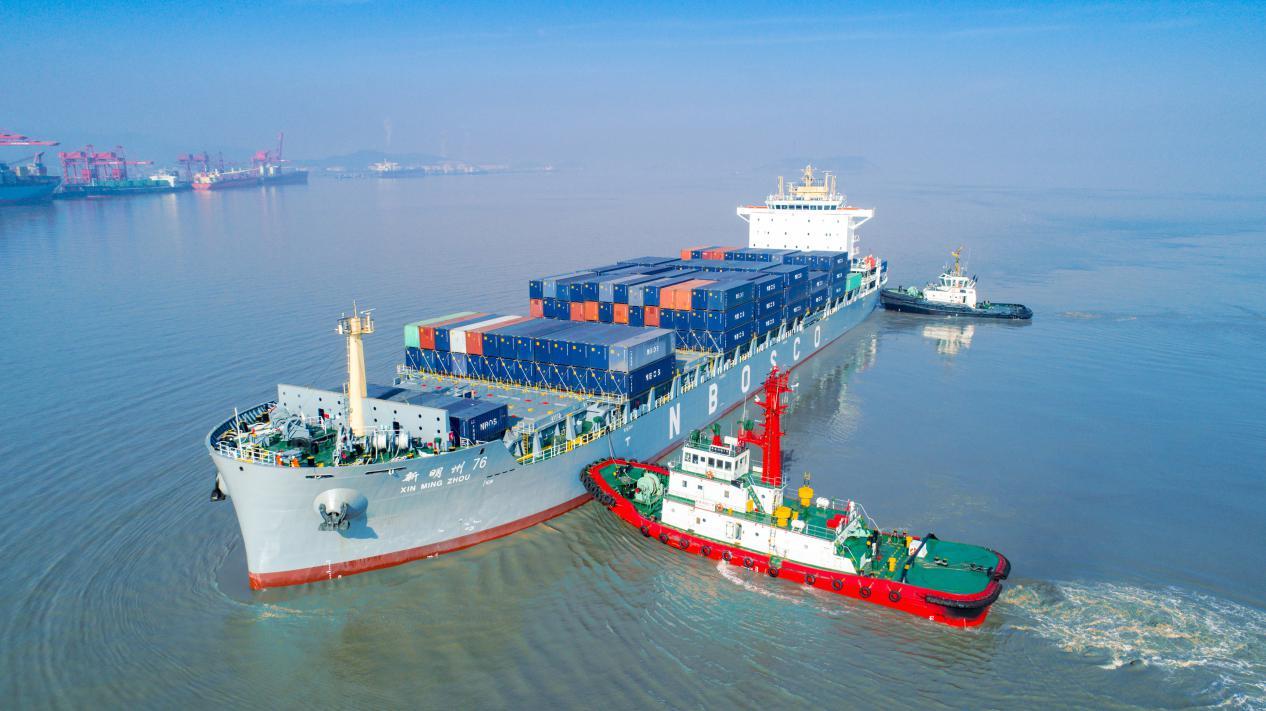
Core Viewpoint - Ningbo Ocean has achieved significant growth in its fleet size and carrying capacity over the past decade, marking a transition from a small fleet to a modern shipping force, with a threefold increase in key metrics [1]. Group 1: Fleet Expansion - Ningbo Ocean's fleet has grown to over 109 vessels with a total deadweight tonnage exceeding 1.7 million tons, representing over a threefold increase in both metrics over ten years [1]. - The company began its fleet expansion in 2015, capitalizing on the integrated port strategy in Zhejiang, which led to a surge in water transport demand [2]. - Between 2015 and 2017, Ningbo Ocean added 11 new container ships with capacities ranging from 13,000 to 40,000 tons, increasing its fleet to 54 vessels and total deadweight tonnage to over 640,000 tons by the end of 2017 [2]. Group 2: Capitalization and Technological Advancement - In 2020, Ningbo Ocean initiated a capitalization process to integrate shipping resources and support the group's "double first-class" construction, leading to its listing on the Shanghai Stock Exchange in December 2022 [3]. - Since 2021, the company has added 21 new vessels, increasing its deadweight tonnage by nearly 600,000 tons and container capacity by over 30,000 TEUs [5]. - The fleet is transitioning towards "green" and "intelligent" technologies, with applications such as smart collision avoidance systems and energy management systems, achieving energy savings of up to 69.6% [5]. Group 3: Global Shipping Network Development - The fleet upgrade has supported the expansion of shipping routes, with new direct routes to Southeast Asia and the opening of trans-Pacific routes starting in 2022 [6]. - By 2024, the company plans to launch container transport routes to the Middle East, further enhancing its international presence [6]. - Currently, Ningbo Ocean operates over 40 shipping routes and more than 100 cargo vessels, connecting domestic coastal areas and major international ports, significantly improving logistics efficiency and industry influence [6].

东方盛虹(000301):一季度业绩改善,炼化景气度企稳
Changjiang Securities· 2025-05-05 08:12
Investment Rating - The investment rating for the company is "Buy" and it is maintained [6]. Core Views - The company is expected to achieve operating revenue of 137.68 billion yuan in 2024, a year-on-year decrease of 1.97%. The net profit attributable to the parent company is projected to be -2.30 billion yuan, a year-on-year decline of 420.33%. The non-recurring net profit attributable to the parent company is expected to be -2.65 billion yuan, a year-on-year decrease of 1322.44% [4][10]. - In Q4 2024, the operating revenue is anticipated to be 29.37 billion yuan, a year-on-year decrease of 20.10% and a quarter-on-quarter decrease of 17.18%. The net profit attributable to the parent company is expected to be -878 million yuan, showing a reduction in losses year-on-year [4][10]. - For Q1 2025, the operating revenue is projected to be 30.31 billion yuan, a year-on-year decrease of 17.50% and a quarter-on-quarter decrease of 3.19%. The net profit attributable to the parent company is expected to be 341 million yuan, a year-on-year increase of 38.19% [4][10]. Financial Performance - The company has a significant share of its refining products, with 70% of its output coming from refined oil and aromatics, benefiting from the improvement in the market conditions for these products [10]. - The company has temporarily suspended the implementation of its biodegradable materials project, which is expected to reduce capital expenditures [10]. - The polyester chain is under pressure, but the company maintains a leading position in differentiated fiber production and has a strong capacity for recycled polyester fibers [10]. Future Outlook - The company is expected to see improvements in profitability, with projected net profits attributable to the parent company of 1.42 billion yuan, 2.55 billion yuan, and 3.38 billion yuan for 2025, 2026, and 2027 respectively [10]. - The price-to-earnings ratio (PE) for 2025, 2026, and 2027 is expected to be 41.0X, 22.8X, and 17.2X respectively, indicating a potential for growth [10].
