
绿色电力市场

Search documents
国办发文,我国2030年基本建成全国统一电力市场体系
Huan Qiu Wang· 2026-02-12 02:08
Core Viewpoint - The State Council of China has officially released the "Implementation Opinions on Improving the National Unified Electricity Market System," outlining a clear timeline and roadmap for electricity market reform over the next decade, aiming for a 70% market transaction volume by 2030 and a fully established market by 2035 [1][3]. Group 1: Strategic Goals - The implementation opinions set a two-step strategic goal for the establishment of a unified electricity market, with key milestones in 2030 and 2035 [3]. - The document addresses current issues such as market barriers and insufficient participation, proposing systematic reforms to optimize electricity resource allocation nationwide [3]. Group 2: Market Functions and Pricing Logic - The implementation opinions define six major market functions: spot, medium- and long-term, ancillary services, green electricity, capacity, and retail markets, marking a significant breakthrough in pricing systems [4]. - The establishment of a multi-value market indicates that price signals will guide future investment directions and transformation paths, moving beyond traditional energy quantity pricing [4]. Group 3: Green Electricity and International Integration - The construction of a green electricity market is emphasized, with plans to strengthen the traceability of green electricity consumption and explore the integration of green certificates into carbon accounting [5]. - Analysts highlight the importance of aligning China's green electricity standards with international standards to enhance the marketability of renewable energy sources like wind and solar [5].

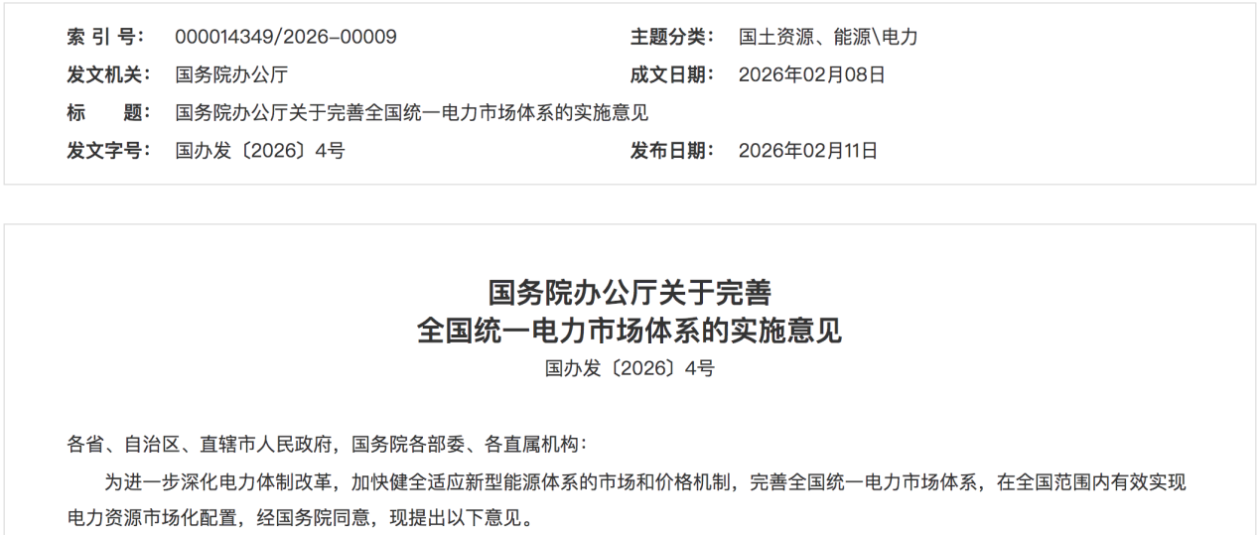
完善全国统一电力市场体系
Qi Huo Ri Bao Wang· 2026-02-12 00:59
Core Viewpoint - The State Council's "Implementation Opinions on Improving the National Unified Electricity Market System" aims to establish a comprehensive national electricity market by 2030, with market transactions accounting for approximately 70% of total electricity consumption, and to fully complete the system by 2035 [1] Group 1: Market Structure and Functionality - By 2030, all types of power sources and electricity users, except for guaranteed users, will directly participate in the electricity market, with a focus on market-based trading [1] - The implementation of a unified market regulatory system and a market pricing mechanism will be established to ensure fair competition [1] - The transition to a formal operation of the spot market is targeted for completion by 2027, enhancing real-time price discovery and supply-demand adjustment [2] Group 2: Long-term Market Stability - The long-term market will be improved to ensure stable electricity supply and enhance risk response capabilities through effective contract signing and performance measures [3] - The long-term market will be refined to allow continuous trading across various time frames, including annual and monthly contracts [3] - Effective integration between long-term and spot markets will be emphasized to meet national energy security requirements [3] Group 3: Green Electricity Market - A unified green certificate market will be established to recognize renewable energy production and consumption, promoting the expansion of green electricity consumption [4] - The introduction of a consumption certification mechanism for green electricity will be accelerated, incorporating technologies like blockchain for full-chain certification [4] - The development of various trading models for green electricity, including long-term purchase agreements, will be encouraged [4] Group 4: Participation of Generation Entities - The participation of generation entities in the electricity market will be further promoted, particularly for renewable energy sources [5] - A sustainable pricing settlement mechanism for renewable energy will be established to encourage long-term trading [5] - The optimization of coal-fired power generation operations will be pursued to ensure all generated electricity participates in the market [5]
国务院办公厅印发意见 完善全国统一电力市场体系
Qi Huo Ri Bao Wang· 2026-02-11 16:21
Core Viewpoint - The State Council's "Implementation Opinions on Improving the National Unified Electricity Market System" aims to establish a comprehensive national electricity market by 2030, with market transactions accounting for approximately 70% of total electricity consumption, and to fully complete the system by 2035 [1] Group 1: Market Structure and Functionality - By 2030, all types of power sources and electricity users, except for guaranteed users, will directly participate in the electricity market, with a focus on market-based trading [1] - The implementation of a unified market regulatory system and a sound market pricing mechanism is essential for the effective operation of the electricity market [1] - The transition to a formal operation of the spot market is targeted for completion by 2027, enhancing real-time price discovery and supply-demand adjustment [2] Group 2: Long-term Market Stability - The long-term market will be improved to ensure stable electricity supply and enhance risk response capabilities through long-term contracts [3] - The establishment of a standardized and flexible long-term contract adjustment and transfer system is crucial for maintaining market stability [3] - Effective integration between long-term and spot markets is necessary to meet national energy security requirements [3] Group 3: Green Electricity Market - A unified green certificate market will be established to recognize renewable energy production and consumption, promoting the expansion of green electricity consumption [4] - The introduction of a consumption certification mechanism for green electricity will be accelerated, incorporating technologies like blockchain for comprehensive certification [4] - The research on integrating green certificates into carbon emission accounting will be pursued to enhance the traceability of green electricity consumption [4] Group 4: Participation of Power Generation Entities - The participation of power generation entities in the electricity market will be further promoted, with a focus on sustainable pricing mechanisms for renewable energy [5] - Distributed energy sources will be encouraged to participate in the market through various trading models, ensuring fair cost distribution [5] - The optimization of coal-fired power generation operations will be emphasized, with all generated electricity participating in the market to cover operational costs [5] Group 5: Pricing Mechanism - The pricing mechanism will be refined to reflect the multidimensional value of electricity resources, primarily determined by supply and demand [5] - A unified national electricity billing policy and market price risk prevention system will be established to regulate local electricity pricing behaviors [5] - The exploration of a two-part tariff or single capacity pricing system will be considered when conditions are favorable [5]
刚刚,利好来了!国办最新印发
Zhong Guo Ji Jin Bao· 2026-02-11 14:32
Core Viewpoint - The State Council has issued the "Implementation Opinions on Improving the National Unified Electricity Market System," aiming to establish a unified electricity market by 2030 and fully realize it by 2035, promoting efficient resource allocation and supporting energy security and green transformation [1][11]. Group 1: Overall Requirements - The implementation opinions emphasize the need to break market segmentation and regional barriers, ensuring a unified, efficient, and competitive electricity market system that supports energy security and economic development [10][11]. Group 2: Optimization of Electricity Resource Allocation - The opinions call for optimizing the national electricity market system, enhancing cross-province and cross-region electricity trading mechanisms, and promoting seamless integration of trading activities [12][13]. Group 3: Market Functionality Enhancement - There is a focus on developing a robust spot market for real-time price discovery and supply-demand adjustment, with plans for the spot market to be operational by 2027 [14][15]. Group 4: Green Electricity Market Development - The establishment of a green electricity market is prioritized, including a dual system of mandatory and voluntary consumption of green certificates, to expand green electricity consumption [16]. Group 5: Capacity Market Establishment - The opinions propose the creation of a capacity market to ensure reliable power supply, with mechanisms for compensating reliable capacity and supporting the sustainable development of coal and other flexible resources [17]. Group 6: Participation of Various Market Entities - The document encourages equal participation of all market entities, including traditional and new energy sources, in the electricity market, promoting a diverse range of trading models [18][19]. Group 7: Unified Market System and Governance - A unified electricity market rule system and governance framework are to be established, ensuring effective regulation and coordination among various market participants [21][22]. Group 8: Policy Coordination and Emergency Response - The opinions highlight the importance of policy coordination and the establishment of an emergency response system to manage risks and ensure stability in the electricity market [23]. Group 9: Organizational Leadership - The implementation requires strong leadership and coordination among various governmental and regulatory bodies to ensure the effective rollout of the unified electricity market system [24].
国务院:加快建立强制消费与自愿消费相结合的绿证消费制度
Bei Jing Shang Bao· 2026-02-11 09:27
Core Viewpoint - The State Council of China has issued implementation opinions to improve the national unified electricity market system, focusing on enhancing the green electricity market to better realize environmental value [1] Group 1: Green Electricity Market Development - The plan aims to improve the national unified green certificate market, enhancing its role as a foundational certificate for renewable energy electricity production, consumption, and environmental attribute recognition [1] - The initiative includes expanding the scale of green electricity consumption and accelerating the establishment of a combined mandatory and voluntary green certificate consumption system [1] - There will be strengthened monitoring of green certificate prices to guide them to operate at reasonable levels [1] Group 2: Green Electricity Trading and Certification - The policy encourages both parties on the supply side to sign long-term purchase agreements for green certificates [1] - It promotes the implementation of inter-provincial renewable energy priority generation plans through green electricity trading, advocating for various trading models such as multi-year contracts and aggregated trading [1] - The establishment of a green electricity consumption certification mechanism will be accelerated, incorporating blockchain technology for full-chain certification of green electricity production and consumption [1] Group 3: Carbon Emission and International Standards - There will be ongoing efforts to strengthen the traceability of green electricity consumption and explore feasible paths for incorporating green certificates into carbon emission accounting [1] - The plan aims to improve the green electricity standard system, enhancing international communication and dialogue on green certificate application and accounting, with the goal of transforming China's green electricity consumption standards into international standards [1]
国务院办公厅:扩大绿色电力消费规模,加快建立强制消费与自愿消费相结合的绿证消费制度
Jin Rong Jie· 2026-02-11 09:22
Group 1 - The State Council has issued implementation opinions on improving the national unified electricity market system, emphasizing the enhancement of a green electricity market that better realizes environmental value [1] - The establishment of a unified green certificate market is proposed to further leverage green certificates as fundamental proof of renewable energy electricity production, consumption, and environmental attributes [1] - The plan aims to expand the scale of green electricity consumption and accelerate the establishment of a consumption system that combines mandatory and voluntary green certificate consumption [1] Group 2 - Strengthening green certificate price monitoring is highlighted to guide green certificate prices to operate at reasonable levels [1] - The initiative encourages both supply and demand sides to sign long-term purchase agreements for green certificates [1] - The promotion of various green electricity trading models, including inter-provincial priority generation plans for new energy, multi-year trading contracts, and aggregated trading, is also emphasized [1]
“十五五”能源规划应聚焦新能源基础设施建设
Zhong Guo Dian Li Bao· 2026-01-27 03:14
Core Viewpoint - The key to building a strong energy nation in China lies in overcoming the bottleneck of grid stability and constructing a new energy system, focusing on seven types of infrastructure development [1]. Group 1: Infrastructure Development - The seven types of infrastructure include: flexible and clean transformation of coal power; large-scale energy storage to reduce costs; development of charging facilities and "vehicle-grid interaction"; enhancement of grid intelligence through artificial intelligence; construction of transmission channels for renewable energy bases in the west; resource-oriented energy consumption; and deepening market reforms to establish a unified national carbon market and green electricity market [1][2]. Group 2: Coal Power Transformation - Clean and flexible coal power is a solid support and important infrastructure for the new energy system, with a significant decline in operating hours for coal power due to its role in supporting grid stability [2]. Increasing coal power utilization hours to 5,500 could match current wind and solar generation levels [2]. Group 3: Energy Storage - The cost reduction effect from advancements in energy storage technology is diminishing, necessitating economies of scale for future cost reductions, particularly for grid-side energy storage [3]. While coal power has lower short-term costs, its long-term costs are rising, whereas large-scale energy storage costs are expected to decrease over time [3]. Group 4: Electric Vehicle Infrastructure - The rapid increase in electric vehicle adoption necessitates widespread charging infrastructure, with projections indicating that by 2025, the penetration rate of new energy vehicles will exceed 50% [4]. This infrastructure will allow for flexible charging times, leveraging peak and off-peak electricity prices [4]. Group 5: Artificial Intelligence in Energy - Artificial intelligence enhances the intelligence of the grid, improving the efficiency of matching electricity supply and demand, and enabling real-time monitoring and dynamic optimization of the entire energy production, transmission, and consumption process [5]. Group 6: Renewable Energy Bases and Transmission - The construction of large-scale renewable energy bases in the west and transmission channels to the eastern load centers is crucial, with anticipated high costs for long-distance transmission [6]. Two main transmission routes are expected to connect the west and east, focusing on wind, solar, and hydrogen energy [6]. Group 7: Resource Optimization in Energy Consumption - Viewing energy consumption as a vital resource allows for economic benefits through optimized resource allocation, including virtual power plants and load aggregation platforms [7]. Enhancing existing system capacity and scheduling efficiency can help meet energy supply demands without relying solely on new energy sources [7]. Group 8: Market-Oriented Energy Reforms - The establishment of a unified national energy market, including carbon trading, green electricity, and green certificates, is essential for supporting new energy infrastructure [8]. These reforms aim to enhance market competitiveness and adapt to dynamic energy changes, with the potential for residential electricity price reforms as electric vehicle adoption increases [8].