美国劳务市场

Search documents
2026年2月美国非农就业数据点评:2月非农:数据偏弱,但噪音更强
Soochow Securities· 2026-03-07 13:11
Employment Data Summary - February non-farm payrolls decreased by 92,000, the largest drop since 2020, against an expectation of an increase of 55,000[1] - The unemployment rate rose to 4.4%, up from the previous value of 4.3%[1] - Average hourly earnings increased by 0.4% month-on-month, exceeding the expected 0.3%[1] Contributing Factors to Employment Data - Strikes contributed to a loss of at least 31,000 jobs, particularly in the healthcare sector due to a significant strike at Kaiser Permanente[1] - Statistical model adjustments accounted for an estimated job loss of between 90,000 to 211,000, affecting the accuracy of employment data[1] - Severe weather conditions delayed hiring activities, impacting approximately 74,000 jobs, particularly in construction and leisure sectors[1] Employment Market Trends - The labor market continues to show a moderate cooling trend, with the unemployment rate reflecting a stable structure despite the increase[1] - The employment diffusion index for one year stood at 49, indicating stability near the threshold of expansion[1] - Year-on-year non-farm payroll growth recorded a modest increase of 0.1%, with a three-month average change of 6,000 jobs, indicating a gradual decline[1] Risks and Market Reactions - Market expectations shifted from inflation concerns to recession fears following the weak employment data, with interest rate cut expectations rising from 1.34 to 1.86 times for the year[1] - The market's perception transitioned towards "stagflation" after comments from Trump regarding Iran, leading to a rebound in bond yields and the dollar[1] - Potential risks include unexpected policy actions from Trump, excessive rate cuts by the Federal Reserve leading to inflation rebound, and prolonged high-interest rates causing liquidity crises[1]
出国工作去美国,是镀金还是渡劫?一份清醒指南
Sou Hu Cai Jing· 2026-02-27 09:47
Group 1 - The article highlights the complexities and challenges faced by ordinary Chinese workers seeking employment in the United States, emphasizing that the path is not as simple as obtaining a ticket and finding a job [1][3] - The U.S. labor market has limited legal immigration or work channels for low-skilled foreign workers, with the visa system primarily designed for outstanding talents and highly skilled professionals [3][6] - Opportunities for ordinary Chinese workers are scarce and highly competitive, mainly available through specific visa categories such as H-1B for skilled professionals, L-1 for intra-company transferees, and O-1 for individuals with extraordinary abilities [3][6] Group 2 - The H-1B visa process is highly competitive, with a selection rate dropping below 20% in 2023, requiring applicants to have a bachelor's degree or higher and a job offer from a U.S. employer [6] - The L-1 visa does not have an annual cap but requires prior employment with a multinational company for at least one year, making it difficult for most ordinary workers to access [6] - Various scams targeting Chinese workers have emerged due to the narrow legal pathways, including fraudulent claims of high salaries and low entry barriers [8][10] Group 3 - To navigate the complex and high-risk journey to work in the U.S., individuals are encouraged to enhance their skills and seek reliable partners for guidance [10][11] - Professional service organizations can provide valuable support in career planning, resume optimization, and interview preparation, helping individuals identify legitimate opportunities [11] - The article stresses the importance of self-improvement and reliance on compliant, professional platforms to achieve employment goals in the U.S. [12]


2026年1月美国非农就业数据点评:“真的”失业率,“假的”新增非农
Soochow Securities· 2026-02-12 07:18
Employment Data - The January non-farm payrolls increased by 130,000, significantly exceeding the expected 65,000, representing a 2.46x standard deviation above expectations[1] - The unemployment rate fell to 4.28%, lower than the expected 4.4% and down from the previous value of 4.38%[1] - The average monthly non-farm payrolls for 2025 were revised down to 29,000 from 69,000, marking the highest downward adjustment since the 2009 financial crisis[1] Sector Analysis - The healthcare sector contributed 124,000 jobs, accounting for over 90% of the service sector's employment growth in January[1] - Other sectors such as construction and professional business services saw modest increases of 33,000 and 34,000 jobs respectively, while the federal government sector experienced a decline of 34,000 jobs[1] - Excluding healthcare, the private sector has shown a trend of zero job growth since 2023[1] Economic Outlook - The report anticipates that the U.S. economy will continue to perform better than expected in Q1 2026, driven by fiscal and monetary easing as well as seasonal factors[2] - The market is closely monitoring the upcoming release of the January core CPI for potential upward surprises, which could influence Federal Reserve interest rate expectations[2] - A combination of better-than-expected economic performance and rising expectations for Trump's visit to China in April could delay rate cuts until June[2] Labor Market Dynamics - The labor supply and demand gap has narrowed to -820,000, the lowest since the post-pandemic recovery began[2] - The labor force participation rate increased by 0.1 percentage points to 62.5%, with total employment rising by 528,000 in January[2] - Permanent unemployment rose by 38,000, indicating a slight upward trend in long-term unemployment[2]
张佳炜:9月FOMC前的主角团
Sou Hu Cai Jing· 2025-09-13 08:19
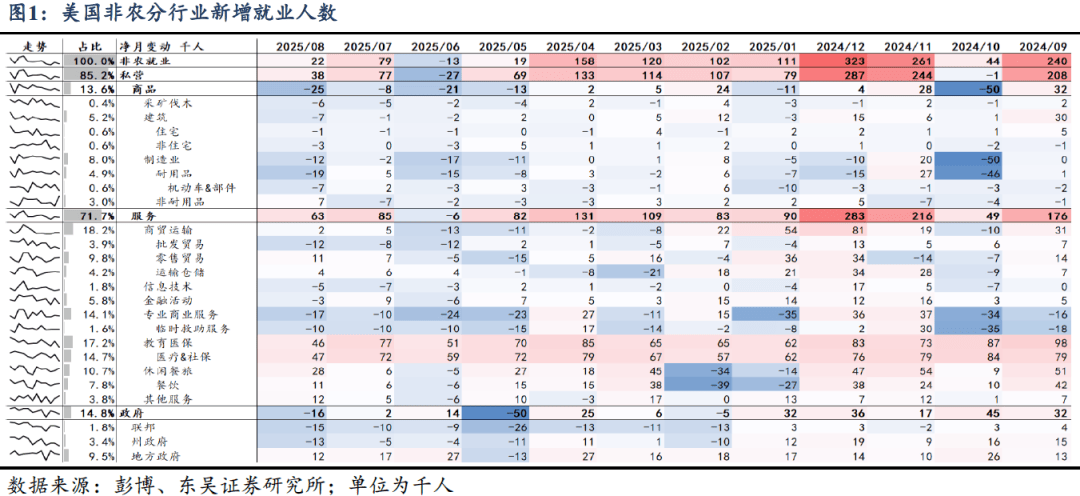
Core Insights - The U.S. added 22,000 non-farm jobs in August, significantly below the expected 75,000, marking a deviation of -2.68 standard deviations from the forecast [1][2] - The unemployment rate rose to 4.324%, slightly above the expected 4.3% and up from the previous value of 4.248% [1][2] - The labor market is exhibiting a "distorted balance" of weak supply and demand, leading to a more pronounced decline in non-farm employment compared to the rise in unemployment [1][3] Employment Data - The revised non-farm employment for June was adjusted from an initial value of 147,000 to -13,000, the first negative reading since 2021 [2][3] - The three-month average of non-farm employment recorded an increase of 29,000, which, while an improvement from the previous 28,000, is still the worst since July 2020 when excluding pandemic effects [3] - The employment diffusion index for one year is at 58.4, indicating that only 58.4% of companies are hiring compared to a year ago, the lowest for a non-recession period [3] Monetary Policy Outlook - The upcoming FOMC meeting in September will be influenced by three key data releases: the initial non-farm adjustment on September 9, PPI on September 10, and CPI on September 11 [4] - The current expectation is for a 25 basis point rate cut, with the possibility of 1-2 additional cuts throughout the year, aligning with market expectations [4] Market Reactions - Following the release of the non-farm data, market sentiment shifted from "bad news is good news" to "bad news is bad news," affecting asset prices [2] - The market is currently pricing in an expectation of 1.1 rate cuts in September and 2.9 cuts for the entire year [2] Trading Strategy - The market is expected to experience high data density and uncertainty, suggesting a strategy of going long on VIX and shorting rate cut expectations [5] - The recommendation includes buying U.S. stocks and 2-year Treasuries on dips while shorting 30-year Treasuries on highs, reflecting the anticipated market volatility [5]