美国政府债务风险

Search documents
杨德龙:美联储此次暂停降息不意味着本轮降息周期结束
Sou Hu Cai Jing· 2026-01-29 09:31
Group 1 - The Federal Reserve has decided to maintain the federal funds rate target range at 3.5% to 3.75%, pausing the rate cuts after three consecutive reductions since September last year, aligning with market expectations [1] - The pause in rate cuts is attributed to stable unemployment rates and the potential for inflation to rise again, despite improvements in economic growth data [1] - There is a possibility of rate cuts later this year, potentially after the departure of Chairman Powell, with expectations of two cuts of approximately 25 basis points each, which could lower the benchmark rate to 3% [1] Group 2 - The U.S. government debt has exceeded $38 trillion, with annual interest payments exceeding $1 trillion, accounting for over 20% of government revenue, leading to rising yields on 10-year Treasury bonds [2] - The 10-year Treasury yield reached 4.5%, reflecting market concerns about U.S. debt creditworthiness and potential default risks [2] - Concerns about increasing government debt and the potential devaluation of the dollar have been expressed by notable investors, indicating a need for caution in the current economic environment [2] Group 3 - The AI technology sector is supported by fundamentals, but there is a risk of a market correction, which could negatively impact tech stocks in both U.S. and Asian markets [3] - The rapid rise in tech stocks has led to elevated price-to-earnings ratios, with some exceeding 100 times, indicating speculative risks that need to be monitored [3] - A balanced investment strategy is recommended, focusing on quality stocks with strong fundamentals and lower valuations, particularly in the context of the current market divergence [3] Group 4 - Humanoid robots represent a significant opportunity in the "AI + consumption" sector, potentially becoming a major industry in China following electric vehicles [4] - The current focus is on upstream component companies for humanoid robots, which are transitioning from concept-driven to order-driven performance, with future earnings validation expected [4] - The technology sector remains a key feature of the current market, with innovation likely to produce leading stocks, although there is a risk of significant declines for purely speculative tech stocks [5]
高盛总裁:相比关税,债市对美国债务更担心
Hua Er Jie Jian Wen· 2025-05-30 02:52
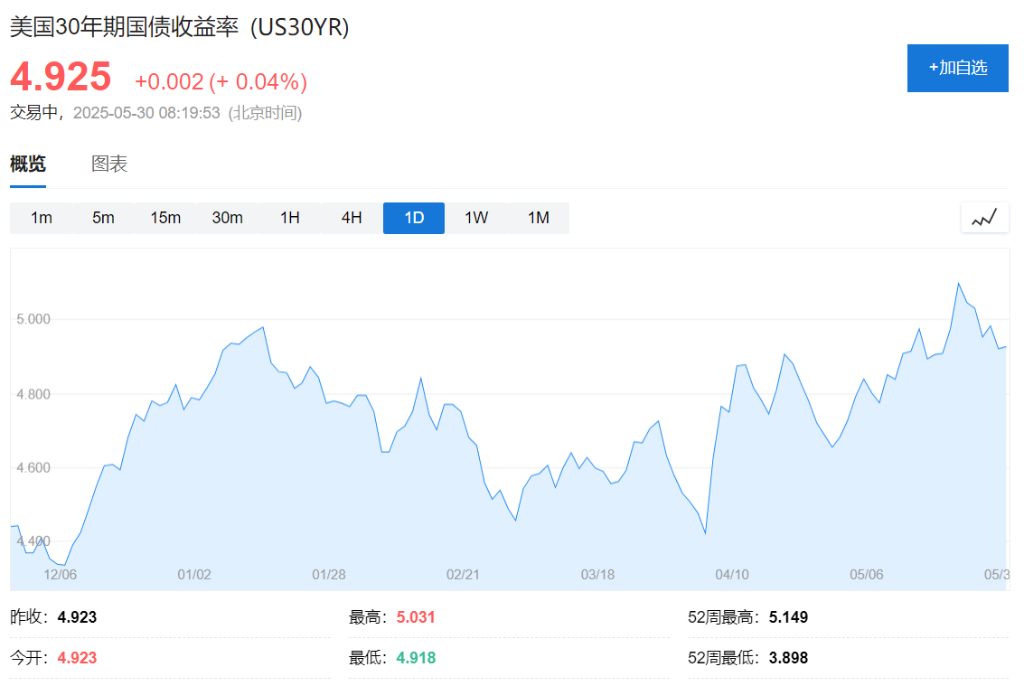
Group 1 - Goldman Sachs warns that the threat to the bond market from debt has surpassed that of tariffs, with rising concerns among bond traders regarding the U.S. government's debt levels [1] - John Waldron, President of Goldman Sachs, emphasizes that the macro-level risk is shifting from tariffs to the implications of tax cuts and fiscal conditions, which are increasingly alarming [1] - The increase in U.S. Treasury issuance is pushing up interest rates, particularly at the long end of the yield curve, making government debt more expensive and raising the risk of a growing deficit and higher borrowing costs for the economy [1] Group 2 - The recent rise in U.S. Treasury yields coincides with intense bipartisan negotiations in Congress over a significant tax cut bill proposed during Trump's second term, raising concerns about the worsening fiscal outlook for the U.S. [4] - The House passed a bill that extends tax cuts from Trump's first term and raises the debt ceiling, but it faces challenges in the Senate, where Republicans plan to make amendments [5] - Market participants are worried that the bill's measures could exacerbate the U.S. government's budget deficit, leading to greater pressure on the bond market [5] Group 3 - The total outstanding U.S. debt has surged from under $14 trillion at the end of 2016 to nearly $30 trillion, reflecting the impact of tax policies from Trump's first term and the debt explosion during the COVID-19 pandemic under both Trump and Biden [6] - According to the Congressional Budget Office, the U.S. public debt is approximately 100% of the economy, with interest payments projected to reach about $880 billion in 2024, exceeding the defense budget [5]