美联储独立性争议

Search documents
白银卖疯铜条禁售 谁在让它们接棒黄金"狂飙"?
Xin Lang Cai Jing· 2026-01-25 12:06
Group 1 - International silver prices have reached a historic milestone, with London spot silver prices surpassing $100 per ounce for the first time, marking a year-to-date increase of nearly 45% [1] - The surge in silver prices has led to a significant increase in demand for physical silver products, such as silver bars and coins, with some retail stores experiencing stock shortages [3][5] - The price of a 30-gram panda silver coin has risen from approximately 300 yuan to over 820 yuan, indicating a substantial increase in consumer interest and purchasing behavior [5] Group 2 - The current market dynamics show that silver prices have outperformed gold prices, with the international silver price increasing by nearly 148% from early last year to the end of December, and an additional 45% increase this year [14] - The "gold-silver ratio" has narrowed to about 50, suggesting that silver prices are entering a strong phase, as a ratio below 50 typically indicates undervaluation of silver [16] - Analysts attribute the recent surge in silver prices to geopolitical tensions and speculative investments, with liquidity and market sentiment playing a significant role in driving prices higher [18] Group 3 - Retail outlets are experiencing a boom in silver sales, with some stores reporting that they cannot keep up with the demand, leading to a notable increase in processing and production activities [7][11] - The price of silver jewelry has also increased significantly, with retail prices rising over threefold compared to last year, highlighting the growing interest in silver as an investment [11] - The potential imposition of tariffs on silver by the U.S. has created supply tightness in the international market, making the outcome of these tariff discussions a critical factor for future silver price movements [20]

ETO Markets 市场洞察:黄金“疯狂过山车”来袭,三大因素暗藏杀机,你的投资要“凉凉”?
Sou Hu Cai Jing· 2025-07-24 05:01
Core Viewpoint - The gold market experienced significant volatility due to multiple factors including progress in US-EU tariff agreements, a rebound in risk assets, and uncertainty surrounding Federal Reserve policies [1][3][4]. Group 1: Trade Agreements Impact - The decline in gold prices is attributed to market expectations of easing trade tensions, highlighted by a trade agreement between the US and Japan, which reduced auto tariffs from 27.5% to 15% and included a commitment from Japan to invest $550 billion in the US [3]. - The EU is also nearing a similar agreement with the US, potentially setting the baseline tariff for EU goods at 15%, alleviating fears of a 30% tariff increase on August 1 [3]. Group 2: Market Sentiment and Risk Assets - Optimism surrounding trade agreements has led to a rally in risk assets, with major US stock indices reaching new closing highs and significant gains in European automotive stocks [4]. - As a result, funds have shifted from safe-haven assets like gold to riskier investments, putting downward pressure on gold prices [4]. Group 3: Federal Reserve Policy Uncertainty - There is growing concern regarding the independence of the Federal Reserve, with President Trump publicly criticizing Chairman Powell for maintaining high interest rates, which could influence future monetary policy [4][5]. - Current market expectations for a rate cut in September stand at 58%, indicating a divided outlook on future Fed actions [5]. Group 4: Technical Analysis and Market Outlook - Technically, gold prices are struggling to maintain levels above $3400, with potential declines to the $3350-$3330 range if the price falls below the July 16 high of $3377.17 [6]. - Analysts suggest that the recent pullback in gold prices may be a healthy profit-taking phase, with long-term bullish factors still in play, including geopolitical risks and US debt issues [6]. - The future trajectory of gold prices will be influenced by three main factors: progress on trade agreements, signals from the Federal Reserve regarding interest rates, and upcoming economic data releases [8][9][10].

黄金破位形成头肩顶 另一潜在风险正在酝酿
Jin Tou Wang· 2025-07-24 04:15
Group 1 - The core viewpoint indicates that gold prices are under pressure, with a significant drop below $3,380, forming a head and shoulders pattern, suggesting a bearish outlook if prices do not break above $3,400 [1] - The market is currently focused on the upcoming Federal Reserve policy meeting on July 29-30, where no interest rate changes are expected, but political pressure on Fed Chairman Jerome Powell remains a critical variable [3] - The recent political interference regarding the Federal Reserve's independence could lead to long-term uncertainty, with potential implications for inflation and gold prices [2] Group 2 - The Relative Strength Index (RSI) suggests that buyers are losing momentum, indicating that gold prices may remain below $3,400 per ounce in the short term [4] - If gold surpasses $3,400, the next resistance level is at $3,452, while failure to maintain above this level could see prices drop to $3,350 and potentially lower [4] - Current market conditions show a downward trend in short-term moving averages, reinforcing a bearish outlook for gold prices [4]
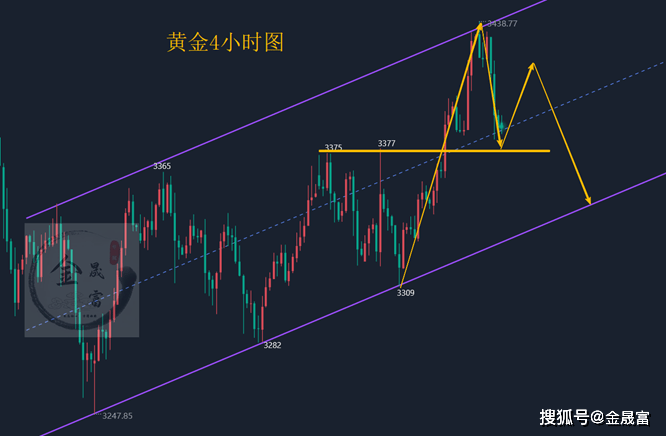
金晟富:7.24黄金高台跳水符合预期!日内黄金行情分析参考
Sou Hu Cai Jing· 2025-07-24 02:22
Group 1 - The recent fluctuations in gold prices are influenced by multiple factors, including progress in US-EU tariff agreements, a recovery in risk assets, and uncertainties surrounding Federal Reserve policies [2][3] - Gold prices experienced a significant drop, with a daily decline exceeding 1%, closing at $3386.99 per ounce after reaching a five-week high of $3438 [2][3] - The market is currently divided on the likelihood of a Federal Reserve rate cut in September, with expectations at only 58%, indicating ongoing volatility in gold trading [2][3] Group 2 - The easing of trade tensions, particularly the recent trade agreement between the US and Japan, has reduced market risk aversion, limiting upward pressure on gold prices [3] - The potential for similar agreements between the EU and the US could further alleviate concerns over a global trade war, which would diminish the demand for gold as a safe-haven asset [3] - Upcoming economic indicators, including US jobless claims and manufacturing PMIs, are expected to have mixed impacts on market sentiment, leaning towards bearish for gold [3][6] Group 3 - Technical analysis suggests that gold is currently in a downward adjustment phase, with potential support levels around $3350, indicating a bearish outlook for the near term [4][6] - The trading strategy for gold includes short positions around $3405-$3408 and long positions near $3365-$3370, emphasizing the importance of managing risk and stop-loss levels [7][8] - The market sentiment remains cautious, with traders advised to follow real-time strategies and adjust positions based on market movements [6][7]