美联储资产负债表缩表

Search documents
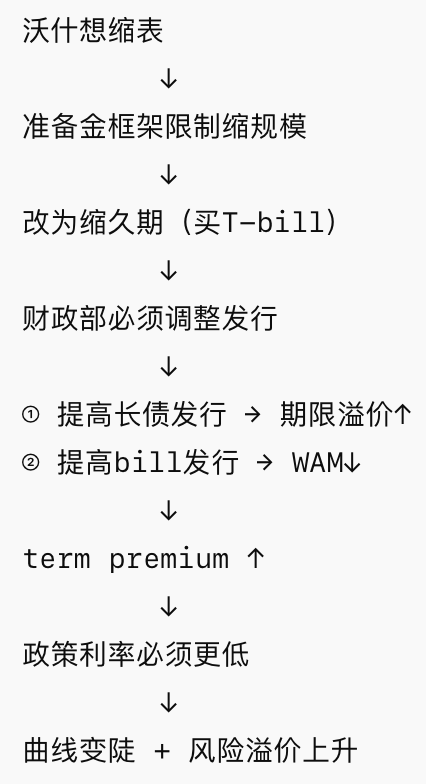
缩表-“美联储财政部协议”-降息,这就是沃什的“阳谋”?
Hua Er Jie Jian Wen· 2026-02-11 03:44
Core Viewpoint - The article discusses the need for the Federal Reserve to adjust its balance sheet strategy by shifting from long-term to short-term Treasury securities to reduce duration risk and potentially lower policy interest rates [1][19]. Group 1: Current State of the Fed's Balance Sheet - As of early 2026, the Federal Reserve's balance sheet is approximately $6.6 trillion, significantly higher than pre-pandemic levels of $4.4 trillion and $0.9 trillion before the Global Financial Crisis (GFC) [2]. - The balance sheet structure is deemed "distorted" by some analysts, with reserves nearing $3 trillion, accounting for 12% of bank assets [2][16]. - The weighted average maturity (WAM) of the Fed's Treasury holdings is about 9 years, compared to only 3 years before the GFC, indicating a longer duration risk [2][11]. Group 2: Proposed Strategy for Duration Management - The proposed strategy involves the Fed reinvesting maturing securities into short-term Treasury bills (T-bills) instead of similar long-term assets, which could increase T-bill holdings from $289 billion to approximately $3.8 trillion over five years [23]. - This shift would reduce the Fed's portfolio duration from 9 years to about 4 years, aligning more closely with pre-GFC norms [23][24]. Group 3: Coordination with the Treasury - Successful implementation of this strategy requires coordination with the Treasury to avoid market disruptions. If the Treasury increases long-term debt issuance without Fed support, it could lead to a significant supply-demand imbalance in the long-term bond market [25]. - The ideal scenario would involve the Treasury maintaining long-term issuance levels while increasing T-bill issuance to meet the Fed's needs, stabilizing the market [28]. Group 4: Implications for Interest Rates and Market Dynamics - A shorter duration portfolio may lead to an increase in term premiums, necessitating a reduction in policy interest rates to maintain economic stability [29]. - Research indicates that to offset the effects of a shorter duration portfolio, the federal funds rate may need to be lowered by 25 to 85 basis points [29][36].


一文读懂,沃什究竟会怎么做?
财联社· 2026-02-02 02:15
Core Viewpoint - The article discusses the implications of Kevin Walsh's potential appointment as the next Federal Reserve Chairman, focusing on his critical stance towards the Fed's balance sheet expansion and the potential for significant policy changes regarding interest rates and government borrowing [1][4][5]. Group 1: Walsh's Critique and Potential Actions - Walsh has been a vocal critic of the Federal Reserve's asset expansion, leading to speculation that he may quickly initiate a balance sheet reduction if appointed [4][5]. - His views align with Treasury Secretary Scott P. Mnuchin, advocating for a reversal of the Fed's overreach, which could impact long-term interest rates and the borrowing activities of major financial institutions [5][6]. - Walsh emphasizes the need for a new Treasury-Fed agreement to redefine their relationship, similar to the 1951 accord, to clarify the Fed's balance sheet goals [7]. Group 2: Market Reactions and Implications - Speculation about Walsh's potential policies has already led to increased long-term Treasury yields and a significant rebound in the dollar, while gold and silver prices have dropped [4]. - If Walsh opposes expanding the balance sheet to lower yields, the Treasury will bear more responsibility for managing borrowing costs, especially as the national debt exceeds $30 trillion [5][6]. Group 3: Challenges of Implementing Policy Changes - Reducing the Fed's footprint is expected to be challenging, given the significantly larger balance sheet compared to Walsh's previous tenure [9]. - The financial markets are sensitive to liquidity changes, as evidenced by past instances where the Fed had to intervene to stabilize short-term lending rates [9]. - Analysts suggest that Walsh may need to build consensus within the Federal Open Market Committee (FOMC) to implement substantial policy changes, as many members still support maintaining ample reserves [11][12].
美联储理事沃勒:可以考虑7月降息,支持继续缩表,增加短期资产比重
华尔街见闻· 2025-07-11 10:04
Core Viewpoint - The Federal Reserve should continue to reduce its balance sheet size, but not as aggressively as some observers suggest, according to Waller [1][2]. Group 1: Balance Sheet Management - Waller proposes reducing bank reserves from $3.26 trillion to approximately $2.7 trillion, which would bring the total balance sheet down to $5.8 trillion from the current $6.7 trillion [1]. - The minimum "adequate" level of reserves is crucial for estimating how much the Fed can shrink its balance sheet without disrupting the overnight funding market [1]. - Critics argue that the Fed's balance sheet has grown too quickly and should return to pre-financial crisis levels, which were around $800 billion [2]. Group 2: Duration Matching Strategy - Waller highlights that the Fed's balance sheet has a mismatch in the duration structure of assets, with too high a proportion of long-term assets [3]. - He advocates for a "duration matching strategy," suggesting that about half of the Treasury investments should be in short-term bills [3]. Group 3: Interest Rate Policy - Waller believes the current federal funds rate is overly restrictive and may support a rate cut at the upcoming Fed meeting, contingent on continued inflation decline [6]. - He has consistently advocated for lowering the policy rate since November 2023, arguing that tariffs will cause temporary price increases but not sustained inflation [6]. Group 4: Waller's Position and Recognition - Waller is considered a strong candidate for the next Fed chair, recognized for his data-driven approach to monetary policy [7]. - His balanced stance, neither hawkish nor dovish, has earned him broad recognition in both market and policy circles [7].