
股息贴现模型

Search documents
瑞银:降中国铁塔(00788)至“中性”评级 目标价下调至11.6港元
智通财经网· 2026-03-24 05:58
Core Viewpoint - UBS reports that China Tower's Q4 performance was mixed, with revenue and net profit meeting expectations, but EBITDA falling short due to increased maintenance costs from upgrading old towers [1] Group 1: Financial Performance - Revenue and net profit for China Tower in Q4 were in line with expectations, while EBITDA was below expectations due to rising maintenance expenses [1] - The company has fully depreciated tower assets acquired from telecom operators since 2015, leading to significant depreciation savings [1] - Management expects EBITDA to decline this year, stabilizing in 2027, primarily due to increased maintenance costs for upgrading old towers, estimated to rise by RMB 4 billion to 5 billion [1] Group 2: Valuation and Forecasts - UBS has changed its valuation method from target dividend yield to dividend discount model, adjusting the target price from HKD 13.5 to HKD 11.6, corresponding to a forecasted dividend yield of 6% for 2026 [1] - The company suggests a payout ratio of 77% of distributable net profit for this year, aligning with UBS's expectations [2] - UBS has revised its revenue and EBITDA forecasts for China Tower down by 1% to 6% for the next two years, reflecting weak capital expenditure from telecom operators and rising maintenance costs [2] Group 3: Future Projections - UBS forecasts net profit growth for China Tower of 31%, 5%, and 0% for 2026 to 2028, with per-share dividends expected to grow by 31%, 7%, and 9% respectively [2] - The dividend is projected to account for approximately 55% to 70% of free cash flow, sufficient to cover dividend distributions [2]

BEN share price at $11: here’s how I would value them
Rask Media· 2025-11-23 19:37
Core Viewpoint - The article discusses the valuation of Bendigo & Adelaide Bank Ltd (ASX: BEN) shares, highlighting the importance of understanding their true worth, especially for dividend-seeking investors. Group 1: Valuation Methods - The price-earnings (PE) ratio is a common tool for valuing shares, comparing a company's share price to its earnings per share. For BEN, the current PE ratio is 12.5x, compared to the banking sector average of 18x, suggesting a sector-adjusted valuation of $15.80 [4][6]. - A dividend discount model (DDM) is presented as a more effective valuation method for banks, relying on past or forecasted dividends and a risk rate. The DDM valuation for BEN shares, using a last year's dividend of $0.63, yields a valuation of $13.32, while an adjusted dividend of $0.65 results in $13.75 [7][11]. - Considering fully franked dividends, the valuation based on a gross dividend payment of $0.93 results in a share price valuation of $19.64 [12]. Group 2: Investor Preferences - Bank shares, including those of Bendigo & Adelaide Bank, are favored by Australian investors due to their potential for dividend income and franking credits [2][3]. - The financial sector, particularly the banking industry, is a popular investment choice alongside technology and industrial sectors, with the largest banks operating in an oligopoly [2]. Group 3: Economic Considerations - Investors are encouraged to consider the bank's growth strategy, focusing on lending versus non-interest income, and to analyze economic indicators such as unemployment, house prices, and consumer sentiment [14].


中国资产暴涨!背后的“推手”是什么?
天天基金网· 2025-10-05 02:47
Core Viewpoint - The article discusses the recent surge in Chinese assets and the underlying factors driving this trend, emphasizing the importance of understanding how professional investors evaluate assets compared to amateur investors [3][4]. Group 1: Investment Evaluation - Professional investors focus on future cash flows rather than just asset prices, which distinguishes them from amateur investors who rely on price appreciation [7]. - The article references the cash flow discount model by economist Irving Fisher, highlighting its significance in assessing stocks and bonds [6][9]. Group 2: Comparative Valuation - As of September 30, the Shanghai Composite Index had a dividend yield of 2.48% and a price-to-earnings (P/E) ratio of 16.6, while the Hang Seng Index had a dividend yield of 2.24% and a P/E ratio of 12.3 [9]. - In contrast, the Dow Jones Industrial Average had a dividend yield of 0.56% and a P/E ratio of 32, and the Nasdaq had a dividend yield of 0.3% with a P/E ratio of 44, indicating that Chinese assets may be undervalued compared to U.S. markets [9][10]. Group 3: Shareholder Returns - The article notes that leading A-share companies are improving their dividend payout ratios and share buyback activities, which are expected to enhance shareholder returns [9]. - For instance, Kweichow Moutai's dividend payout ratio is projected to increase from 52% in 2020 to 75% in 2024, while Mindray Medical's payout ratio is expected to rise from 45.7% to 65% in the same period [9]. Group 4: Internal Measurement - The article emphasizes the need for investors to establish a scientific measurement perspective when evaluating investments, particularly in light of foreign capital's attitude towards Chinese assets [13]. - It cites Warren Buffett's investment philosophy, which stresses the importance of understanding intrinsic value and future cash flows rather than relying solely on market trends [14][15].

中国资产暴涨,背后的“推手”是什么?
Zheng Quan Shi Bao· 2025-10-04 23:54
Core Insights - Chinese assets have seen a significant surge, with the Nasdaq Golden Dragon Index rising approximately 3.8% during the National Day and Mid-Autumn Festival holidays, indicating international capital's recognition of A-shares and Hong Kong stocks [1] - The recent strength of Chinese assets is attributed to the alignment of prices with their underlying value, as highlighted by the cash flow discount model [2] Investment Evaluation - The investment evaluation methods have been influenced by economist Irving Fisher, who emphasized the importance of future cash flows over mere asset prices, distinguishing professional investors from amateurs [3] - Professional investors focus on the income generated by assets, while amateur investors often rely on price appreciation, which can lead to significant losses if not grounded in cash flow realities [3] Comparative Valuation - As of September 30, the Shanghai Composite Index had a dividend yield of 2.48% and a price-to-earnings (P/E) ratio of 16.6, while the Hang Seng Index had a dividend yield of 2.24% and a P/E ratio of 12.3. In contrast, the Dow Jones Industrial Average had a dividend yield of 0.56% and a P/E ratio of 32, and the Nasdaq Index had a dividend yield of 0.3% and a P/E ratio of 44 [5] - The increasing dividend payout ratios and share buyback activities of leading A-share companies indicate a growing commitment to returning value to shareholders [5] Share Buyback Trends - A-share companies are beginning to adopt share buyback practices, although they lag behind international counterparts like Apple, which has repurchased 13.5% of its shares since August 2020 [6] - If A-share companies align with international practices and implement consistent buybacks, their current valuations may become more attractive [6] Internal Measurement Perspective - Establishing an internal measurement perspective is crucial for investors, as external capital flows provide only a partial view of asset value [7] - Warren Buffett's investment in a farm exemplifies the importance of understanding intrinsic value and expected returns, which can lead to successful investments without specialized knowledge [7] Behavioral Insights - Successful investing relies on a critical mindset and the ability to maintain confidence in one's investment strategy, as emphasized by Benjamin Graham [8] - The behavior of investors is more significant than their investment methods, highlighting the importance of discipline and courage in achieving stable returns [8]
BEN share price at $13: here’s how I would value them
Rask Media· 2025-09-14 20:38
Group 1: Company Overview - Bendigo & Adelaide Bank Ltd (ASX: BEN) shares are currently priced around $12.60, with a focus on determining their true value for investors seeking dividend income [1][11] - The bank operates in a competitive environment dominated by a few large players, with a preference among Australian investors for bank shares due to their dividend potential and franking credits [2][3] Group 2: Valuation Methods - The Price-Earnings (PE) ratio is a common valuation tool, with BEN's current PE ratio calculated at 14.5x, compared to the banking sector average of 19x, leading to a sector-adjusted valuation of $16.92 [6] - A Dividend Discount Model (DDM) is highlighted as a more effective valuation method for banks, with BEN's share price estimated at $13.32 using a blended growth and risk rate, and $13.75 using an adjusted dividend payment [11][12] - Considering fully franked dividends, the valuation based on a gross dividend payment of $0.93 results in a share price estimate of $19.64 [12] Group 3: Growth and Risk Considerations - The analysis includes various growth and risk rate scenarios, indicating that a 6% risk rate with a 2% growth rate yields a valuation of $16.25, while a 10% risk rate with a 4% growth rate results in a valuation of $10.83 [13] - Investors are encouraged to assess the bank's growth strategy, including its focus on lending versus non-interest income, and to consider economic indicators such as unemployment and consumer sentiment [14]



Are WBC shares good value? 2 ways to value them
Rask Media· 2025-09-12 01:37
Core Viewpoint - Westpac Banking Corp (ASX: WBC) is currently trading around $38, and various valuation models are utilized to assess its share price, including the Price-Earnings (PE) ratio and the Dividend Discount Model (DDM) [1][3][9]. Valuation Models - The PE ratio compares a company's share price to its earnings per share, with WBC's current PE ratio calculated at 20x, compared to the banking sector average of 19x, suggesting a sector-adjusted valuation of $37.30 [5][8]. - The DDM focuses on future dividend forecasts rather than profits, with WBC's last year's dividend at $1.66, leading to a valuation of $35.10 under standard assumptions, and $34.05 using an adjusted dividend payment [10][13]. - When considering fully franked dividends, the valuation based on a gross dividend payment of $2.30 results in a share price valuation of $48.64 [14]. Growth and Risk Assumptions - Different growth rates (2% to 4%) and risk rates (6% to 11%) yield a range of valuations, with the highest valuation at $80.50 under a 4% growth rate and 6% risk rate [15]. - The analysis emphasizes the importance of understanding the growth in total loans on the balance sheet, as rapid growth may indicate higher risk, while slow growth may suggest conservatism [17]. Financial Health Indicators - Key areas to analyze include provisions for bad loans, assessment rules for bad loans, and sources of capital, with a focus on the cost of capital acquisition [18].

农业银行为何成为A股市值新科冠军?得益于银行板块大涨 盈利确定性在“四大行”中最高
Mei Ri Jing Ji Xin Wen· 2025-08-07 15:20
Core Viewpoint - Agricultural Bank of China has reached the top position in A-share market capitalization, surpassing Industrial and Commercial Bank of China, driven by strong stock performance and favorable market conditions [2][3]. Group 1: Market Performance - On August 6, Agricultural Bank's stock price closed at 6.62 yuan, marking a 1.22% increase and achieving the highest level since its A-share listing [2]. - As of August 7, the bank's market capitalization was reported at 2.35 trillion yuan, reflecting a 1.36% increase from the previous day [3]. - Since the beginning of 2025, Agricultural Bank's stock price has increased by 29.54%, while Industrial Bank's stock price has risen by 16.85% [4]. Group 2: Factors Contributing to Market Position - The increase in Agricultural Bank's market capitalization is attributed to a significant rise in bank stocks, which are favored by investors seeking high dividend yields and stable returns [3]. - Agricultural Bank's A-share circulating stock is 3.192 billion shares, compared to 2.696 billion shares for Industrial Bank, contributing to its higher market value [4]. - The bank's strong profitability and dividend stability have enhanced its appeal, with experts noting its high earnings certainty among the top four banks [9]. Group 3: Capital Structure and TLAC Bonds - Agricultural Bank has issued a total of 800 billion yuan in TLAC bonds since 2025, with the latest issuance of 500 billion yuan completed on August 4 [4]. - The issuance of TLAC bonds helps optimize the bank's capital structure, even though these bonds are not considered regulatory capital [5]. - The bank's ability to maintain a high level of excess provisions contributes to its capital adequacy and risk management [10][11]. Group 4: Investment Trends - The banking sector has become a star performer in the A-share market, with a notable increase in public fund holdings in bank stocks, which rose to 4.88% of the total A-share market capitalization by the end of Q2 2025 [7]. - The shift in market dynamics has led to increased allocations to bank stocks by institutional investors, driven by the need for stable returns amid market volatility [8].

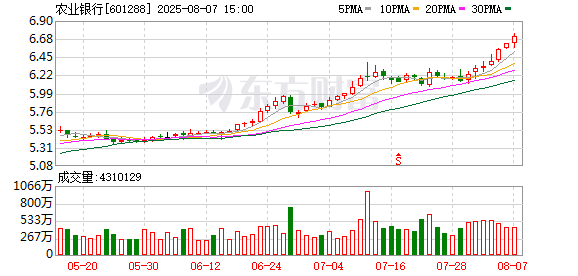
农业银行为何成为A股市值新科冠军? 得益于银行板块大涨,盈利确定性在“四大行”中最高
Mei Ri Jing Ji Xin Wen· 2025-08-07 15:19
Core Viewpoint - Agricultural Bank of China has reached the top position in A-share market capitalization, surpassing Industrial and Commercial Bank of China, driven by strong stock performance and investor interest in bank stocks [1][2][3] Company Performance - As of August 7, Agricultural Bank's stock price rose by 1.36%, with a total market capitalization of 2.35 trillion yuan [2] - The stock price has increased by 29.54% since 2025, while the stock price of Industrial and Commercial Bank has risen by 16.85% during the same period [4] - Over the longer term, Agricultural Bank's stock has surged by 145% since 2023 [5] Market Dynamics - The rise in Agricultural Bank's market capitalization is attributed to a significant increase in bank stocks, which are favored by investors seeking high dividend yields and stable returns [2][6] - The banking sector has become a star performer in the A-share market, with a notable shift in market dynamics favoring bank stocks [6][7] Capital Structure and Financial Health - Agricultural Bank has issued a total of 800 billion yuan in TLAC bonds since 2025, which helps optimize its capital structure [3] - The bank's high profitability certainty among the four major banks enhances its dividend appeal, supported by a strong capital adequacy ratio and low non-performing loan ratio [8][9] - Agricultural Bank's excess provisions for losses are higher than the regulatory limits, providing a buffer for future profitability [10]

平安银行(000001):信贷存款回暖,计息成本改善
Tianfeng Securities· 2025-04-21 14:15
Investment Rating - The investment rating for Ping An Bank is "Accumulate" with a target price of 12.75 CNY, representing a potential upside of 16% from the current price of 11.02 CNY [6][4]. Core Views - The report highlights a recovery in credit and deposits, with improvements in interest costs. The bank's revenue for Q1 2025 was approximately 33.7 billion CNY, down 13.05% year-on-year, while net profit attributable to shareholders was 14.1 billion CNY, down 5.60% year-on-year. The non-performing loan ratio stood at 1.06% with a provision coverage ratio of 237% [1][2][4]. Financial Performance Summary - **Revenue and Profitability**: In Q1 2025, net interest income was 22.8 billion CNY, accounting for 67.6% of total revenue, while non-interest income was 10.9 billion CNY, down 19.78% year-on-year. The pre-provision profit and net profit attributable to shareholders decreased by 12.92% and 5.60% year-on-year, respectively [2][10]. - **Asset Quality**: The non-performing loan balance was 36 billion CNY, with a non-performing loan ratio of 1.06%, unchanged from 2024. The ratio of non-performing and attention loans decreased by 15 basis points to 2.84% [3][22]. Asset and Liability Management - **Asset Growth**: The total interest-earning assets reached 5.59 trillion CNY, growing 1.1% year-on-year. The structure of interest-earning assets showed an increase in loans and interbank assets, while financial investments decreased [3][18]. - **Liability Management**: The interest-bearing liabilities amounted to 5.02 trillion CNY, with a year-on-year growth of 0.2%. Deposits grew by 6.2% compared to 2024, indicating significant improvement [3][21]. Profit Forecast and Valuation - The forecast for net profit attributable to shareholders for 2025-2027 is expected to grow by 0.81%, 2.92%, and 3.28%, respectively. The estimated book value per share (BPS) for these years is projected to be 23.24 CNY, 24.93 CNY, and 26.65 CNY [4][24].

平安银行:年报点评报告:非息亮眼,质量稳健-20250320
Tianfeng Securities· 2025-03-19 06:23
Investment Rating - The investment rating for Ping An Bank is adjusted to "Accumulate" with a target price of 13.12 CNY, representing a potential upside of 14% from the current price of 11.49 CNY [5]. Core Views - The bank's non-interest income continues to show strong performance, with total revenue for 2024 estimated at approximately 146.7 billion CNY, reflecting a year-over-year decline of 10.93% but an upward revision in growth rate by 1.65 percentage points compared to the previous quarter [2][9]. - The net interest income for the year is projected at 93.4 billion CNY, down 20.82% year-over-year, while non-interest income is expected to reach 53.3 billion CNY, up 14% year-over-year, indicating a significant recovery in growth [2][9]. - The bank's asset quality remains stable, with a non-performing loan ratio of 1.06%, consistent with the previous quarter [3][19]. Financial Performance Summary - For 2024, the bank's total revenue is approximately 1467 billion CNY, with a net profit attributable to shareholders of 44.5 billion CNY, showing a year-over-year decrease of 4.19% [1][9]. - The bank's net interest margin (NIM) is recorded at 1.87%, a decline of 6 basis points compared to the previous quarter [3][19]. - The bank's total interest-earning assets amount to 6.09 trillion CNY, reflecting a slight increase of 0.2% from the previous quarter [3][19]. Profitability and Valuation - The bank's profitability is expected to show resilience, with projected net profit growth rates for 2025, 2026, and 2027 at 1.40%, 3.94%, and 3.15% respectively [4][26]. - The price-to-book ratio (P/B) is estimated to be 0.41x for 2025, indicating a valuation that suggests potential for price appreciation [4][26]. Asset and Liability Structure - As of the end of 2024, the bank's interest-bearing liabilities total 5.07 trillion CNY, marking a 2.9% increase from the previous quarter [3][19]. - The composition of interest-earning assets includes loans (54.1%), financial investments (26.2%), interbank and reverse repos (15.3%), and deposits with the central bank (4.4%) [3][19].