自动驾驶配送

Search documents
DoorDash(DASH):订单与GOV维持高增,规模效应驱动盈利能力持续释放
Huaxin Securities· 2026-03-31 02:50
Investment Rating - The report maintains a "Recommended" investment rating for DoorDash [1] Core Insights - DoorDash's revenue for Q4 2025 reached $3.955 billion, a year-on-year increase of 38%, driven by a 39% growth in Marketplace GOV to $29.683 billion and a 32% increase in total orders to 903 million [5][6] - The company's GAAP net profit for the quarter was $213 million, up 51% year-on-year, with adjusted EBITDA of $780 million, also reflecting a 38% increase [7] - The strong performance indicates robust business momentum despite a complex macro environment, with a full-year revenue of $13.717 billion, marking a 28% year-on-year growth [6] Revenue and Profit Performance - Revenue growth is aligned with GOV expansion, showcasing a stable monetization rate during the platform's category expansion [6] - The company reported a full-year GAAP net profit of $935 million, indicating significant enhancement in profit certainty [7] - Operating cash flow for the full year reached $2.431 billion, demonstrating strong cash generation capabilities [7] Business Structure and Platform Capability - The core business saw a 27% year-on-year growth in Marketplace GOV, with a notable performance in U.S. food delivery [9] - Non-food business segments, particularly groceries and retail, are emerging as key growth drivers, with over 30% of U.S. MAU participating in non-food consumption by December 2025 [9] - The membership ecosystem, including DashPass and Deliveroo Plus, has reached 35 million, enhancing customer retention and reducing delivery costs [9] R&D and Technology Layout - The company is increasing investments in long-term technology infrastructure, with adjusted R&D expenses growing 65% year-on-year [10] - Focus areas include building a unified global technology platform and enhancing automated delivery systems [10] Regional Market Performance - International business is becoming a significant growth lever, with GOV growth accelerating in Q4 [11] - The integration of Deliveroo is ahead of expectations, contributing over $45 million to adjusted EBITDA in Q4 [11] Investment Recommendations - For Q1 2026, Marketplace GOV is expected to be between $31 billion and $31.8 billion, with a slight seasonal decline in adjusted EBITDA guidance [12] - Profitability is projected to show a "low in the front, high in the back" characteristic for 2026, with significant improvements expected in the second half [13]

优步(UBER.US)联手Starship在英国推出配送机器人,明年将扩张至欧洲多国
智通财经网· 2025-11-21 03:42
Core Viewpoint - Uber has partnered with Starship Technologies to address the "last mile" delivery challenge using autonomous sidewalk robots, with initial operations set to begin in the UK in December and expansion planned for multiple European countries in the following year [1] Group 1: Partnership Details - The collaboration aims to leverage Starship's AI-driven robots, which have completed over 9 million deliveries across 7 countries, to enhance Uber's delivery services for European users [1] - The robots are capable of Level 4 autonomous driving, allowing for deliveries within a 2-mile radius in 30 minutes without human intervention [1] Group 2: Future Plans - Starship's robot services are expected to launch in the U.S. market by 2027 [1] - Uber's global head of autonomous driving business emphasized that this partnership is a crucial part of Uber Eats' future vision, facilitating intercontinental deployment of delivery capabilities [1] Group 3: Existing Operations - Over the past 11 years, Starship has deployed 2,700 robots in more than 100 cities across 15 countries [1] - In the U.S., Uber has already initiated robot delivery services through partnerships with Serve Robotics and Avride in cities such as Austin, Chicago, Dallas-Fort Worth, Miami, Los Angeles, Atlanta, and Jersey City [1]


DoorDash(DASH.US)绩后股价大跳水:Q3利润逊色 巨额开支计划引发增长焦虑
Zhi Tong Cai Jing· 2025-11-06 00:48
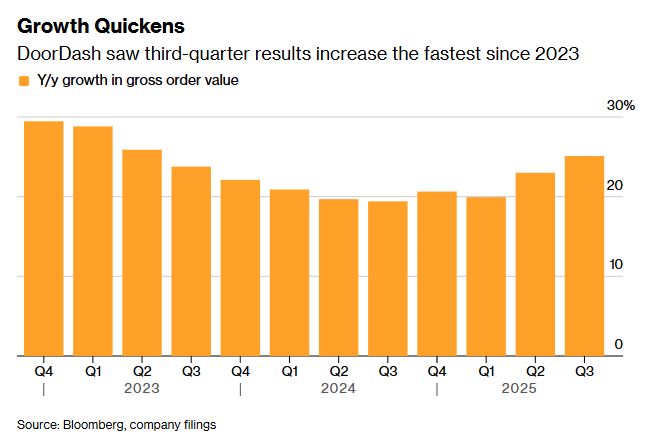
Core Insights - DoorDash reported third-quarter earnings that exceeded revenue and order value expectations, but rising operational costs led to profits falling short of forecasts, resulting in a significant drop in stock price post-announcement [1][4] Financial Performance - Total order value increased by 25% year-over-year to $25 billion, surpassing analyst expectations of $24.6 billion, marking the largest growth since mid-2023 [1] - Revenue grew by 27% year-over-year to $3.45 billion, exceeding the market expectation of $3.36 billion [1] - Total costs and expenses surged by 23% year-over-year from $2.6 billion to $3.19 billion [4] - Net profit rose significantly from $162 million ($0.38 per share) to $244 million ($0.55 per share), but fell short of the market expectation of $0.69 per share [4] Strategic Investments - The company plans to increase spending on new products by several hundred million dollars by 2026, alongside investments in internal platforms to enhance operational stability and product development speed [4][5] - DoorDash is focusing on improving developer efficiency through AI tools as part of its investment strategy [4] - The company has engaged in a series of acquisitions, including the recent purchase of Deliveroo, to expand its international presence and enhance restaurant services [6] Future Outlook - DoorDash anticipates continued growth momentum, projecting total order value for the fourth quarter to be between $28.9 billion and $29.5 billion, with adjusted EBITDA expected to range from $710 million to $810 million [6] - The contribution from Deliveroo is expected to add approximately $45 million to the fourth-quarter earnings, with a projected long-term profit increase of about $200 million by 2026 [6]

军疑似回应余承东:诋毁,本身就是一种仰望,随后删除;京东外卖将扩招至15万名全职骑手;5月各大车企销量公布丨邦早报
创业邦· 2025-06-02 00:48
Sales Performance Summary - NIO delivered 23,231 vehicles in May, a year-on-year increase of 13.1% [3] - XPeng delivered 33,525 vehicles in May, a significant year-on-year increase of 230%, marking the seventh consecutive month of deliveries exceeding 30,000 units [3] - Li Auto delivered 40,856 vehicles in May, up 16.7% year-on-year, with a cumulative delivery of 1,301,531 vehicles as of May 31, 2025 [3] - BYD's passenger car sales reached 376,930 units in May, with 204,369 units being pure electric and 172,561 units being plug-in hybrids [3] - Geely's May sales were 235,208 units, reflecting a year-on-year growth of 46% [4] New Energy Vehicle Trends - Great Wall Motors sold 102,200 new vehicles in May, with 32,638 being new energy models, a year-on-year increase of 32.41% [4] - China FAW's total vehicle sales exceeded 261,300 units in May, with a 69.8% increase in new energy vehicle sales [4] - Xiaomi's automotive division delivered over 28,000 vehicles in May and is preparing for mass production of the Xiaomi YU7 [5][11] Market Developments - JD.com plans to expand its delivery rider workforce to 150,000, having already surpassed 100,000 [7] - Wahaha's shares faced significant price drops in recent auctions, with some shares selling for half their previous value [7] - BYD announced plans to launch a low-cost micro electric vehicle in Japan next year, targeting the $18 billion microcar market [21] Technological Innovations - Musk's Neuralink raised $600 million, setting a record for the brain-computer interface industry, with a pre-money valuation of $9 billion [22] - Zhiyuan Robotics announced its humanoid robot has received certifications from China, the EU, and the US, making it the first to achieve such recognition [21] Automotive Industry Updates - Ford's new model, the Lingrui Heartbeat Edition, was launched at a price of 98,800 yuan, with a government subsidy bringing the effective price down to 83,800 yuan [24] - Audi's Q6L e-tron family has begun pre-sales, featuring Huawei's intelligent driving technology and a charging capability of 270 kW [26]




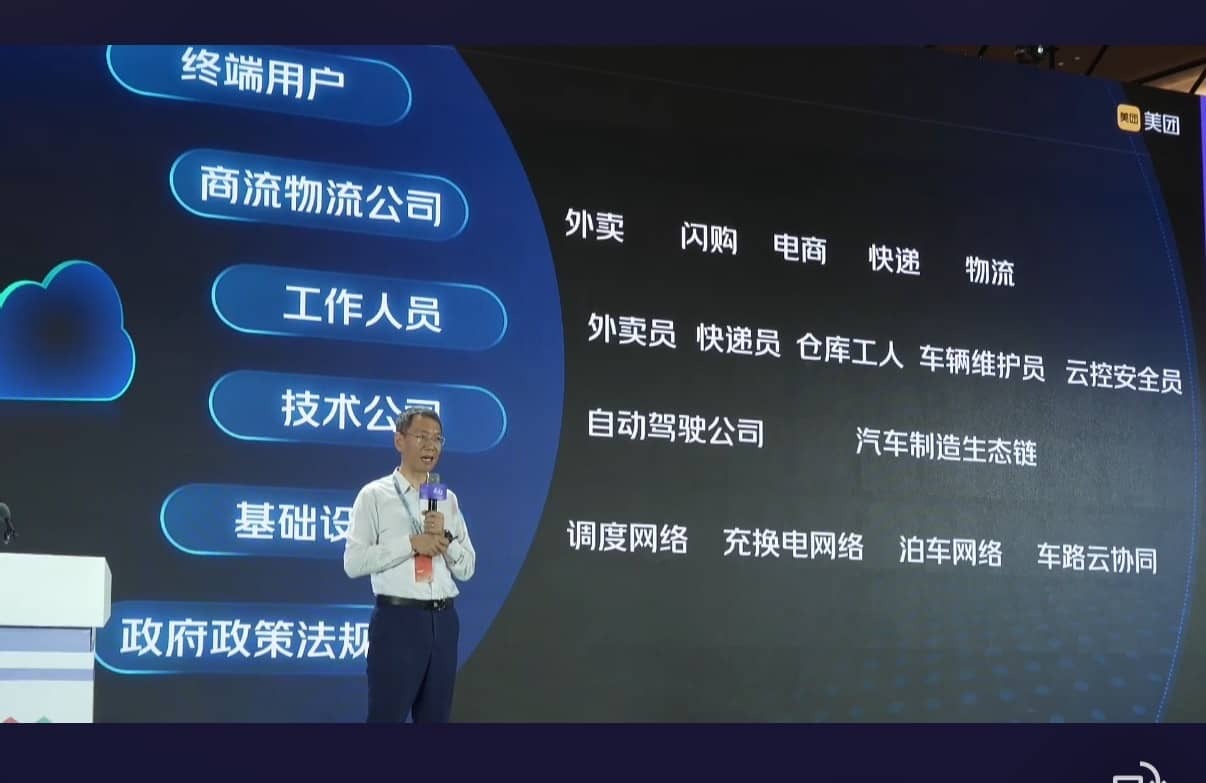
美团副总裁夏华夏:未来十年,中国自动配送网络必将重构城市生态系统
Mei Ri Jing Ji Xin Wen· 2025-06-01 06:08
Core Viewpoint - The autonomous delivery industry is transitioning from stage 1.0 to 2.0, with the expectation of reaching 3.0, which will reshape the logistics landscape [1][4]. Group 1: Development Stages - The past decade has seen autonomous delivery in the 1.0 technology exploration phase, focusing on refining algorithms and enhancing vehicle safety and speed [2]. - The current 2.0 phase emphasizes scenario reconstruction and commercial validation, with the goal of running minimum viable products (MVP) to verify business value in specific contexts [2][3]. - The future 3.0 phase aims to create an integrated ecosystem for autonomous delivery, involving collaboration among manufacturers, logistics companies, and government entities [3]. Group 2: Industry Advancements - Significant advancements have been made in the autonomous delivery supply chain, including a drastic reduction in lidar costs, lowering the overall vehicle cost from 300,000-400,000 yuan to below 100,000 yuan [3]. - Cities like Shenzhen have opened their entire road networks, facilitating large-scale commercial validation [3]. - Collaborations with companies like BYD and CATL are exploring automated battery swapping technology to enhance operational efficiency [3]. Group 3: Key Drivers and Future Outlook - The dual drivers of policy and technology are crucial for the transition to the 2.0 phase, while ecological collaboration is essential for industry success [4]. - Over the next decade, the autonomous delivery network in China is expected to reconstruct urban ecosystems, with a commitment from companies to promote standardized and ecological development in the autonomous driving sector [4].