自适应推理

Search documents
AI过度思考问题:智能推理资源配置的新挑战
Sou Hu Cai Jing· 2026-01-22 15:42
Core Insights - The article discusses the inefficiencies of advanced reasoning models in AI, particularly their tendency to apply deep reasoning to simple queries, leading to unnecessary delays and increased costs [2][3][5]. Group 1: Inefficiencies in AI Reasoning Models - Advanced reasoning models can take excessive time to answer simple questions, such as "1+1 equals how much," highlighting a fundamental inefficiency in their design [2]. - The application of deep reasoning to queries that do not require it results in significant computational costs, with unnecessary prompt length causing millions of dollars in additional expenses annually [3]. - These models generate 7 to 10 times more tokens for simple tasks compared to non-reasoning models, leading to slower user experiences and increased provider costs [5][9]. Group 2: Need for Adaptive Reasoning - There is a call for a fundamental shift in AI systems to assess query complexity and allocate reasoning resources accordingly, mirroring human cognitive processes [3][6]. - Hybrid reasoning models represent a partial solution but still place the decision-making burden on developers, which is not ideal [3]. - Amazon is pursuing a path towards truly adaptive reasoning, where models autonomously decide when deep thinking adds value, aiming for end-to-end trained models that can dynamically adjust their reasoning processes [4][9]. Group 3: Query Complexity Classification - Queries can be classified into three categories based on complexity: simple retrieval (e.g., "What is the capital of France?"), medium complexity (e.g., "List G7 countries with monarchies"), and high complexity (e.g., "Plan a week-long trip to Paris with a budget of $3000") [7][8]. - The classification framework emphasizes the need for models to recognize when deep reasoning is unnecessary, ensuring efficiency without compromising responsible AI principles [8].


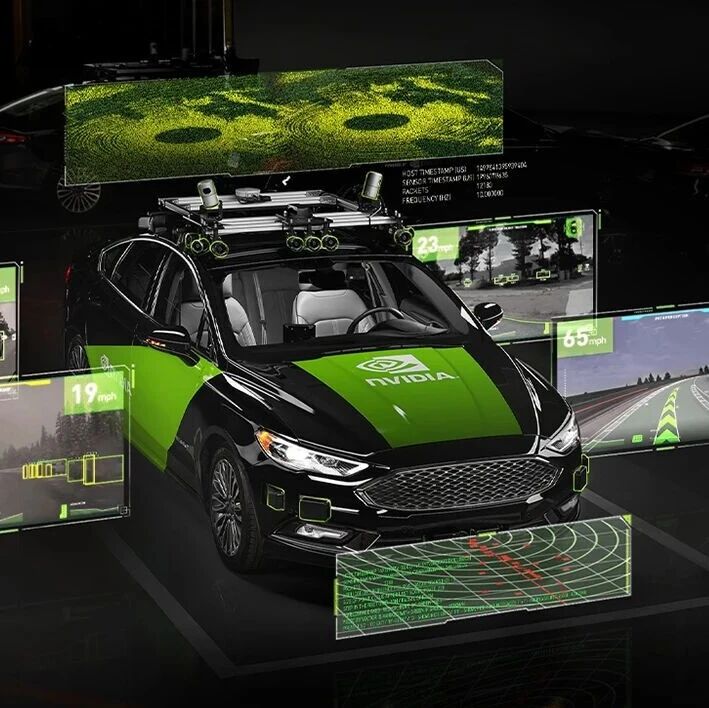
英伟达Alpamayo再进化!反事实推理VLA,安全性能提升很可观
自动驾驶之心· 2026-01-07 01:07
Core Insights - The article discusses the development of the Counterfactual Vision-Language-Action (CF-VLA) model, which incorporates self-reflective reasoning to enhance the safety and accuracy of autonomous driving systems [3][54]. - CF-VLA aims to address the limitations of existing Vision-Language-Action (VLA) models by enabling them to reflect on their planned actions and make necessary adjustments before execution [10][54]. Group 1: Model Development - CF-VLA introduces a self-reflective reasoning loop that allows the model to analyze and correct its planned actions based on potential outcomes [10][54]. - The model generates time-segmented meta-actions to summarize driving intentions and performs counterfactual reasoning to identify unsafe behaviors [3][10]. - A "rollout-filter-label" data processing pipeline is designed to extract high-value scenarios from the model's rollout results, enhancing the training process [11][15]. Group 2: Performance Improvements - Experiments show that CF-VLA improves trajectory accuracy by up to 17.6% and safety metrics by 20.5% compared to baseline models [14][54]. - The model demonstrates adaptive reasoning capabilities, activating counterfactual reasoning primarily in complex scenarios, thus optimizing computational resources [16][54]. - The integration of counterfactual reasoning transforms the model's reasoning from descriptive to causal self-correction, significantly enhancing its decision-making process [15][54]. Group 3: Data Utilization - The training dataset includes approximately 11.6 million 20-second video clips, providing a diverse range of driving behaviors [8][35]. - The meta-action training set consists of 433,000 20-second clips and 801,000 8.4-second samples, with a validation set of 39,000 video clips [8][35]. - The counterfactual reasoning dataset typically contains 200,000 samples, which are crucial for training the model's reflective capabilities [8][35]. Group 4: Experimental Results - The CF-VLA model was evaluated on a large proprietary dataset comprising 80,000 hours of human driving data from 25 countries, covering various driving conditions [35][36]. - Key performance metrics include minimum average displacement error (MinADE), minimum final displacement error (MinFDE), and collision rates, which indicate the model's effectiveness in real-world scenarios [37][41]. - The results indicate that CF-VLA consistently outperforms traditional models in both trajectory accuracy and safety, demonstrating the effectiveness of its self-reflective reasoning approach [42][45].

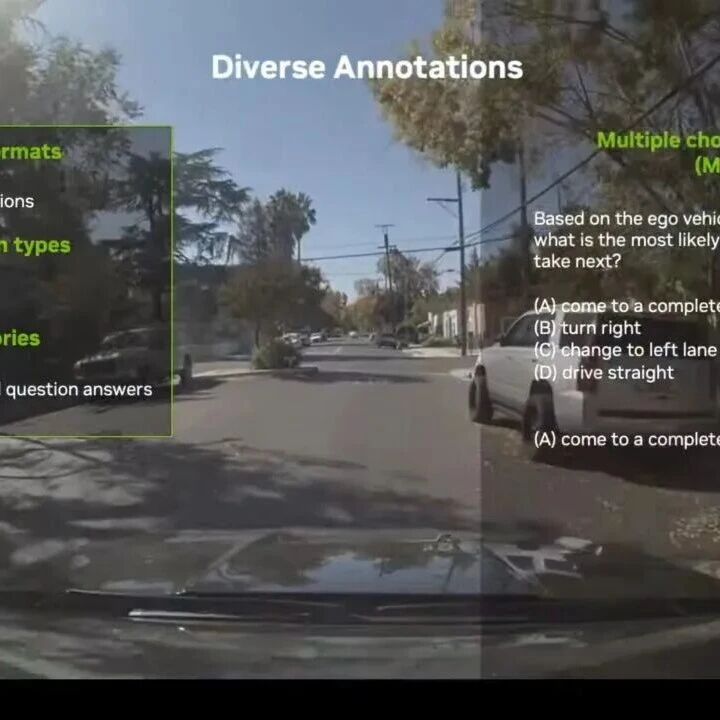
英伟达用千万Clip搞定了反事实推理VLA!安全指标提升了20%......
自动驾驶之心· 2026-01-05 03:33
Core Insights - The article discusses the development of the Counterfactual Vision-Language-Action (CF-VLA) model, which incorporates self-reflective reasoning to enhance the safety and accuracy of autonomous driving systems [3][56] - CF-VLA aims to address the limitations of existing Vision-Language-Action (VLA) models by enabling them to reflect on their planned actions before execution, thereby improving decision-making in complex driving scenarios [10][56] Group 1: Model Development - CF-VLA introduces adaptive reasoning and self-reflection capabilities, allowing the model to adjust its actions based on potential outcomes identified through counterfactual reasoning [3][10] - The model generates time-segmented meta-actions to summarize driving intentions and utilizes these to perform counterfactual reasoning, identifying unsafe behaviors and correcting them before final trajectory generation [3][10] - The "rollout-filter-label" data processing pipeline is designed to extract high-value scenarios from the model's rollout results, enhancing the training process for counterfactual reasoning [11][14] Group 2: Performance Metrics - Experiments on large-scale driving datasets show that CF-VLA improves trajectory accuracy by up to 17.6% and safety metrics by 20.5% compared to baseline models [14][56] - The model demonstrates adaptive reasoning capabilities, activating counterfactual reasoning primarily in complex scenarios, thus optimizing computational resources during testing [16][48] - The introduction of meta-actions significantly enhances the model's performance, reducing minimum average displacement error (MinADE) and minimum final displacement error (MinFDE) by approximately 9% compared to pure trajectory models [43][44] Group 3: Practical Applications - CF-VLA's self-reflective capabilities allow it to make context-specific corrections, improving safety and traffic efficiency in various driving scenarios, such as avoiding congestion and responding to pedestrians [57] - The model's ability to dynamically decide when to engage in reasoning helps maintain a balance between computational efficiency and decision-making quality [21][48] - The findings suggest that counterfactual self-reflection can effectively bridge reasoning and control in autonomous driving systems, providing a framework for future advancements in the field [56][57]
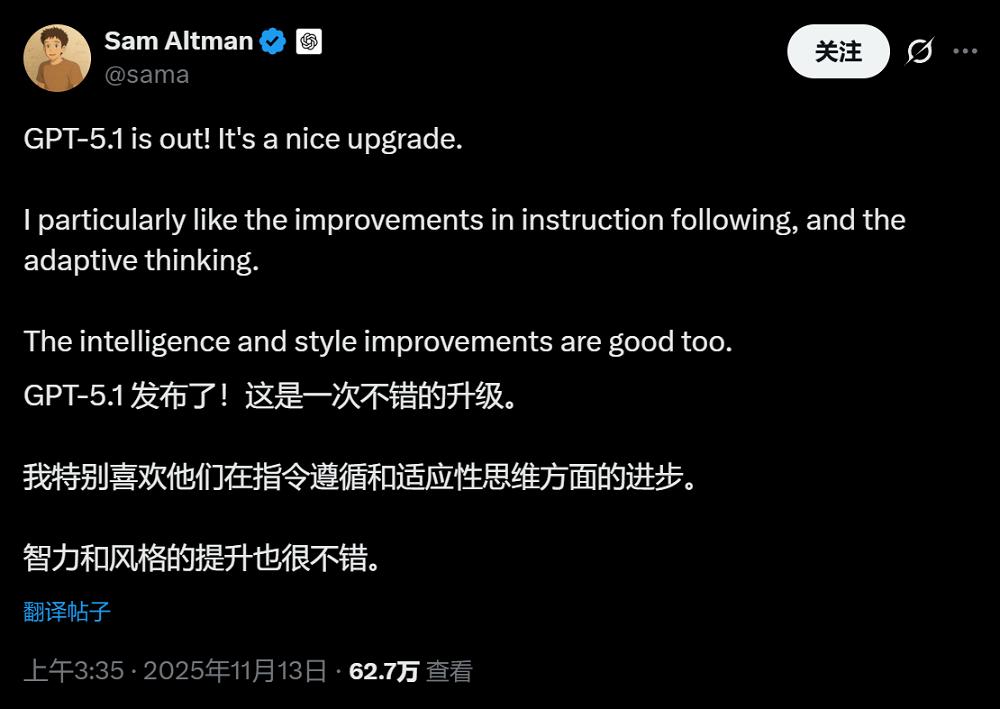
OpenAI发布GPT-5.1:自适应推理与个性化体验双升级
Haitong Securities International· 2025-11-17 12:35
Investment Rating - The report does not explicitly provide an investment rating for the industry or specific companies involved in the release of GPT-5.1 models Core Insights - The release of GPT-5.1 signifies a shift in focus from parameter scale and computational power to enhancing user experience and system integration [2][5] - The introduction of adaptive reasoning and intelligent routing mechanisms aims to improve accuracy and computational efficiency [3][14] - Personalization features and safety measures are designed to enhance platform stickiness and regulatory compliance, facilitating broader adoption in B2B markets [4][15] Summary by Sections Event Overview - On November 12, 2025, OpenAI launched the GPT-5.1 series, introducing two models: GPT-5.1 Instant and GPT-5.1 Thinking, which enhance user interaction and reasoning capabilities [1][12] User Experience Enhancements - The naming of "5.1" indicates an iterative upgrade focusing on user experience rather than merely increasing specifications [2][13] - Significant improvements in interaction naturalness and intent understanding are expected to increase user engagement [2][13] Technical Advancements - GPT-5.1 Instant utilizes a lightweight adaptive reasoning mechanism to enhance answer completeness for complex queries, while GPT-5.1 Thinking optimizes response times based on task complexity [3][14] - The system's intelligent routing capabilities allow for optimal model deployment based on task requirements, improving overall performance [3][14] Personalization and Safety - The introduction of eight preset tones and adjustable parameters enhances the model's adaptability for various applications, including education and content creation [4][15] - Enhanced safety measures address regulatory concerns, particularly in sensitive areas, promoting trust and compliance [4][15] Industry Implications - The launch marks a transition in industry competition towards a focus on holistic user experience and system capabilities rather than just computational power [5][16] - Other model vendors must enhance their productization and safety frameworks to remain competitive in this evolving landscape [5][16]
用户破8亿,GPT-5.1来了,表情包含量可自定义
3 6 Ke· 2025-11-13 03:09
Core Insights - OpenAI has launched the latest upgrade of the GPT-5 series, named GPT-5.1, which includes two main models: GPT-5.1 Instant and GPT-5.1 Thinking, enhancing both intelligence and communication capabilities [1] - The user base of OpenAI has surpassed 800 million, although it is unclear whether this figure refers to registered users or weekly active users [5] - The upgrade introduces more intuitive tone control options for ChatGPT, allowing users to adjust response characteristics such as conciseness and friendliness [3] Model Enhancements - GPT-5.1 Instant has improved instruction-following capabilities, accurately responding to user queries with specific constraints, such as limiting responses to a certain number of words [13] - The new models feature "adaptive reasoning," enabling them to determine when to take time to think before answering more challenging questions, resulting in more thorough and accurate responses [13] - In terms of token usage, GPT-5.1 models have shown a reduction of up to 57% in token consumption for easier questions, while increasing token usage by 71% for the most difficult questions [13] User Experience - Users have reported that GPT-5.1 Instant feels more calm and adept at answering questions, while the Thinking version operates in a focused mode, maintaining speed on simpler tasks [16] - The new customization features have received positive feedback, particularly from users applying the models in productivity scenarios [18] - Despite the upgrades, some users expressed confusion over the specific changes and improvements made in the new version [20] Future Outlook - OpenAI indicates that the transition from GPT-5 to GPT-5.1 represents a meaningful improvement, but the model remains within the GPT-5 generation, suggesting a gradual upgrade approach rather than significant leaps [22]