
芯片供应短缺

Search documents
高通盘后跌逾8%,本财季业绩展望平淡,有迹象显示手机芯片需求不稳
Ge Long Hui· 2026-02-04 23:53
Core Viewpoint - Qualcomm's stock dropped over 8% after reporting first-quarter adjusted revenue of $12.25 billion, slightly above analyst expectations of $12 billion, but provided a lackluster outlook for the current quarter due to concerns over storage chip shortages impacting mobile demand [1] Group 1: Financial Performance - Qualcomm's first-quarter adjusted revenue was $12.25 billion, exceeding analyst expectations of $12 billion [1] - The company forecasts second-quarter revenue between $10.2 billion and $11 billion, while analysts had an average estimate of $11.2 billion [1] - Excluding certain items, the expected earnings per share (EPS) is projected to be $2.55, compared to analyst expectations of $2.89 [1] Group 2: Market Conditions - The company noted that while there is still demand for high-end smartphones, the tight supply and rising prices of storage chips may lead to some customers producing fewer phones than anticipated [1] - CEO Cristiano Amon is pushing for a transformation to diversify the business by increasing chip sales for automotive, personal computers, and data centers, although these new business areas are not yet large enough to offset the slowdown in the mobile chip market [1] - Amon expressed optimism about the demand for high-end smartphones despite the short-term challenges posed by industry-wide storage chip supply constraints [1]

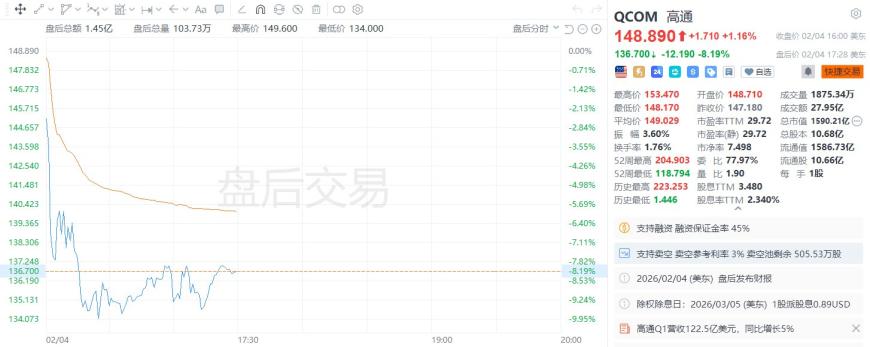
高通本财季业绩展望平淡 盘后大跌近9% 有迹象显示手机芯片需求不稳
Xin Lang Cai Jing· 2026-02-04 22:04
Core Viewpoint - Qualcomm has provided a subdued revenue outlook for the current fiscal quarter, raising concerns that shortages in memory chips and rising prices may suppress smartphone demand [1][2] Financial Performance - For the second fiscal quarter, Qualcomm expects revenue to reach between $10.2 billion and $11 billion, with an adjusted earnings per share (EPS) forecast of $2.55 [1][2] - Bloomberg data shows that analysts had an average estimate of $11.2 billion in revenue and an EPS of $2.89 [1][2] - In the first fiscal quarter ending December 28, Qualcomm reported an adjusted EPS of $2.78 and a revenue increase of 5% to approximately $12.3 billion, while analysts had estimated an EPS of $3.41 and revenue of $12.2 billion [1][2] Market Dynamics - Despite ongoing demand for high-end smartphones, Qualcomm indicated that tight supply and rising prices of memory chips are expected to lead to lower-than-expected production for some customers, particularly in China [1][2] - CEO Cristiano Amon is pushing for a transformation within the company to diversify its business by increasing chip sales for automotive, personal computers, and data centers, although these new business areas are not yet large enough to offset the slowdown in the smartphone chip market [1][2] - Amon expressed optimism about the demand for high-end smartphones despite the short-term challenges faced by the mobile chip business due to industry-wide memory chip supply constraints [1][2] Stock Performance - Qualcomm's stock closed at $148.89 on Wednesday, experiencing a post-market decline of approximately 9%, and has fallen 13% year-to-date [1][2]
英特尔亚洲供应商股价下挫
Xin Lang Cai Jing· 2026-01-23 01:11
Group 1 - Intel's Q1 earnings outlook is below market expectations, leading to a decline in the stock prices of its Asian suppliers [1][4] - Japanese supplier Lasertec saw its stock drop by 6.5%, marking the largest decline since November; Ibiden fell by 5.6%, and Tokyo Electron decreased by 2.3% [1][4] - South Korean supplier SK Hynix's stock also experienced a decline of 2.1% [3][6] Group 2 - SoftBank Group, which announced a $2 billion investment in Intel last year, saw its stock drop by 5% [2][5] - Andrew Jackson, head of Japanese stock strategy at Ortus Advisors, described Intel's earnings as "disappointing," suggesting it may lead to a "short-term weakness" in chip equipment suppliers' stock prices [3][6] - Jackson noted that some issues appear to stem from supply shortages, making it harder for companies to meet customer demand [4][7]

安世又刷屏!现在情况有哪些变化?
芯世相· 2025-11-20 07:42
Core Viewpoint - The recent suspension of intervention by the Dutch government regarding ASML Semiconductor is seen as a positive step, but it does not resolve the underlying issues affecting the company's control and operations [3][10][11]. Recent Developments - On November 19, Dutch Economic Minister Karremans announced the suspension of intervention against ASML Semiconductor, indicating a constructive approach following discussions with European and international partners [3][4]. - The Dutch government also released an official statement confirming this suspension, which is viewed as a potential step towards resolving ongoing tensions [4][6]. - However, the control of ASML by Wentai Technology remains limited due to an existing court ruling, which continues to affect the company's operations [8][10]. Market Reactions - The semiconductor market has shown signs of cooling since November, with a noticeable decrease in inquiries for ASML chips, although actual demand still exists [19]. - Factors contributing to this market shift include previous rumors about supply chain coordination, announcements from the Dutch government regarding chip supply restoration, and the completion of inventory restocking by overseas clients [19][20]. - Despite the suspension of the ministerial order, the judicial measures from the Dutch court remain in effect, indicating that the situation is still precarious for ASML and Wentai [10][11]. Industry Impact - The automotive sector is experiencing mixed outcomes, with some manufacturers beginning to resume production while others face potential shutdowns due to chip shortages linked to the ASML situation [22][23]. - Companies like Honda and Bosch are navigating production challenges, with Honda planning to restart operations in North America and Bosch facing supply interruptions in multiple locations [22][23]. - Overall, while there are signs of recovery in some areas, the core issues surrounding ASML's control and chip supply remain unresolved, necessitating close monitoring of future developments [23].


安世芯片短缺,日产再次减产
芯世相· 2025-11-19 06:00
Group 1 - Nissan is set to reduce production by 1,400 vehicles at its Kyushu plant due to ongoing chip supply disruptions related to Nexperia [3][4] - Previously, Nissan had anticipated a reduction of approximately 900 vehicles for its popular Rogue SUV model due to the same semiconductor shortage [3][4] - The production adjustments are a response to a 16.5% decline in retail sales in Japan during the first half of the fiscal year, attributed to consumer concerns over the company's financial health [4] Group 2 - Other automakers are also responding to the Nexperia chip shortage, with Volkswagen stating it has secured enough chips for production, while Honda aims to resume normal operations in North America by November 24 [6] - Aumovio, a subsidiary of Continental AG, has received its first batch of Nexperia chips from China [6] - The Dutch government is seeking solutions to the issues surrounding Nexperia, with a delegation expected to visit China for discussions [7][9] Group 3 - The Chinese Ministry of Commerce has expressed a willingness to cooperate with the Netherlands to stabilize the global semiconductor supply chain and hopes for constructive proposals to resolve the Nexperia issue [9]


全球汽车业正陷入芯片供应危机 本田汽车最先被波及
Xi Niu Cai Jing· 2025-11-03 07:54
Core Insights - The Dutch government's forced takeover of Nexperia, a Chinese-controlled semiconductor company, has triggered a significant crisis in the global automotive supply chain, leading to production warnings from major automakers like Nissan, Mercedes-Benz, and Honda [2][3] Group 1: Impact on Automakers - Nissan's Chief Performance Officer, Guillaume Cartier, stated that the chip shortage is no longer a "minor issue," with the company only able to maintain supply until early November and lacking control over secondary suppliers [2] - Mercedes-Benz's CEO, Ola Källenius, indicated that the company is actively searching for alternative sources globally, but the situation remains unpredictable [2] - Honda has already halted production at its Celaya plant in Mexico, which has an annual capacity of approximately 200,000 units, significantly impacting the production of the HR-V SUV, a key export model for the U.S. market [2] Group 2: Broader Industry Effects - The automotive semiconductor supply crisis is causing a "domino effect" globally, with Brazilian officials warning that some automakers may cease operations in Brazil within two to three weeks if the chip shortage persists [3] - European automakers are also at risk of production halts due to the shortage of Nexperia chips, with the company currently seeking regulatory exemptions, although the timeline for restoring supply remains uncertain [3]


遭停供晶圆后,安世中国最新发声:库存充足,积极启动多套预案
Huan Qiu Wang· 2025-11-02 22:47
Core Viewpoint - The Dutch government's forced takeover of Nexperia, a semiconductor company controlled by a Chinese enterprise, has led to escalating tensions, with accusations of payment defaults and supply chain disruptions impacting the semiconductor industry, particularly in automotive applications [1][2]. Group 1: Company Actions and Responses - Nexperia China has accused Nexperia Netherlands of unilaterally halting wafer supplies to its packaging and testing factory in Dongguan, China, and strongly opposes the negative portrayal of its management by the Dutch headquarters [1]. - Nexperia China claims that the Dutch company owes it approximately 1 billion RMB in unpaid invoices, countering the allegations of default [1]. - In response to the supply disruption, Nexperia China has established sufficient inventory of finished and in-process products to meet customer demands through the end of the year and beyond [2]. Group 2: Industry Impact - The ongoing stalemate has raised concerns among automotive manufacturers in Europe, the U.S., and Japan about potential production issues due to chip shortages, as Nexperia's chips are widely used in automotive electronic systems [2]. - Nexperia's products are manufactured in the Netherlands but are ultimately integrated in China, highlighting the interconnected nature of global semiconductor supply chains [2].
丰田汽车(TM.US)CEO:目前不会因安世半导体出口限制问题遭遇芯片短缺
智通财经网· 2025-10-30 03:01
Group 1 - Toyota's CEO Koji Sato stated that the company is closely monitoring production risks but does not currently face a direct risk of chip shortages due to recent export restrictions related to Nexperia [1] - Sato acknowledged potential impacts on production but emphasized that Toyota, as the world's largest automaker, will not suddenly face severe supply shortages [1] - The Dutch government invoked a law for national security reasons, restricting Nexperia from making any adjustments for one year, which has raised concerns about supply tightness among global automakers [1] Group 2 - Japanese automakers are working towards standardizing traditional chips to avoid severe shortages experienced during the pandemic, where custom semiconductors put them at a disadvantage [2] - Nissan reported sufficient chip inventory to last until the first week of November, indicating no imminent supply disruptions [2] - Despite criticism from some shareholders, Toyota plans to maintain its offer price for the privatization of Toyota Industries Corporation, which is part of a broader restructuring effort [2] - The offer price of 16,300 yen (approximately 108.10 USD) is higher than the historical average before the announcement but lower than the price the day before, leading to investor dissatisfaction [2] - Toyota aims to advance its plans transparently while considering the interests of minority shareholders as a fundamental principle [2]
