
虚拟化

Search documents
半导体制造,变了
半导体行业观察· 2026-03-17 02:27
Core Viewpoint - The semiconductor manufacturing industry is transitioning from a focus on hardware performance to a greater emphasis on software architecture and underlying platform capabilities, driven by increasing demands from AI for logic, storage, and advanced packaging [1][2][3] Group 1: Changes in Semiconductor Manufacturing - Semiconductor manufacturing is evolving into a complex system that heavily relies on control software, data systems, and edge intelligence rather than just mechanical systems [2] - Advanced processes and equipment are pushing the requirements for control precision, response time, and system collaboration to new heights, exemplified by the demands of 3nm processes [2][3] - The industry is facing challenges in managing complexity due to increasing device models, customer demand differentiation, and the need for software functionality, necessitating a shift from project-based development to platform engineering [8] Group 2: Requirements for Underlying Platforms - Real-time performance and determinism are becoming baseline capabilities for critical processes in semiconductor manufacturing, requiring low-latency and high-reliability operations [4][5] - Software is transitioning from single control logic to multi-domain integration, necessitating mixed-criticality systems that can run real-time operating systems alongside general-purpose operating systems [5][6] - The development and delivery chain is being restructured to accommodate larger software scales, stricter compliance, and the need for unified development processes and lifecycle management [6] Group 3: Wind River's Role - Wind River is evolving beyond its traditional RTOS label, focusing on platform engineering that supports real-time control, edge analysis, and system isolation [7][9] - The company is enhancing its capabilities in software development and delivery, which is crucial for managing the complexity of heterogeneous chips and increasing product variants [8][10] - Wind River's collaboration with AI semiconductor company DEEPX aims to integrate AI capabilities into real-time and edge systems, highlighting the deepening coupling between chip capabilities, operating systems, virtualization, and industry applications [8][10] Group 4: Future of Semiconductor Equipment - Future semiconductor equipment will increasingly depend on a software foundation that supports deterministic control, edge intelligence, and long-term maintenance [9][11] - As semiconductor manufacturing evolves into a complex software system, the demand for platform capabilities that cover control, integration, development, and operations is rising [10][11]

英特尔否认分拆
半导体行业观察· 2026-03-15 02:20
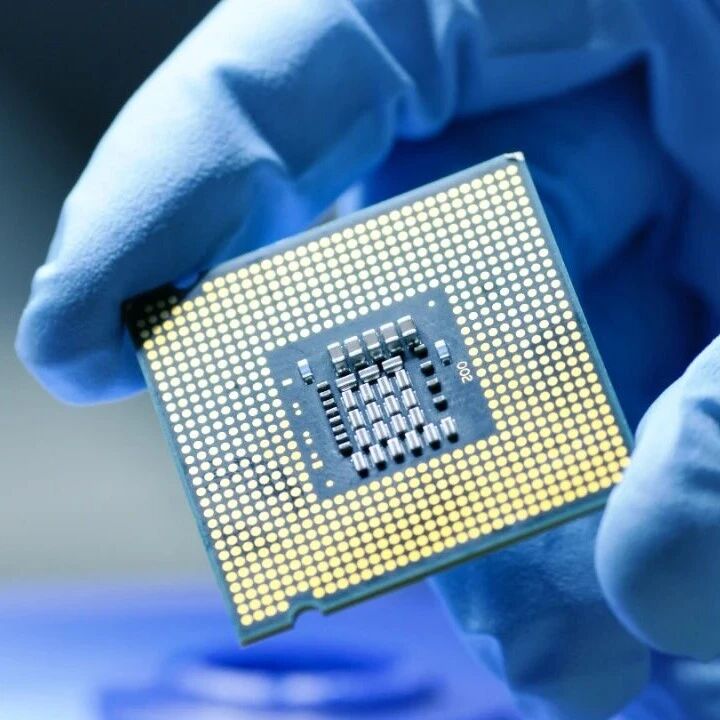
Core Viewpoint - Intel's latest processor for the RAN market, Granite Rapids, symbolizes the company's struggle to stabilize amidst significant revenue declines and restructuring efforts, yet it remains committed to the RAN sector and aims to leverage its new technology to regain market confidence [2][3]. Group 1: Financial Performance and Restructuring - Intel's revenue plummeted from $79 billion in 2021 to under $53 billion last year, with a prior loss of $19 billion [2]. - After securing $7 billion in funding from Nvidia and SoftBank, Intel abandoned plans to divest its Network and Edge Group (NEX) [2]. - Despite stagnant sales, Intel reported a net profit of $26 million last year, with stock prices recovering from around $20 to approximately $46 [2]. Group 2: Market Position and Client Relationships - Intel has reaffirmed its commitment to the RAN market, with NEX General Manager Christina Rodriguez stating that the company will not exit this sector [3]. - Intel remains the only commercial option in the virtual RAN market, which is crucial for major 5G network players like Samsung and Ericsson [3][4]. - Ericsson's dependence on Intel for chip supply is highlighted, with industry insiders noting that the company is "tied" to Intel [4]. Group 3: Product Development and Technology - The anticipated growth of the 5G chip market was overestimated, with actual sales figures falling short of Intel's projections [5]. - NEX's overall revenue decreased from $8.4 billion in 2022 to $5.8 billion in 2024, although its operating profit margin improved from 4% to 16% [5]. - Granite Rapids features a 72-core processor designed to reduce deployment costs and improve efficiency in RAN processes, integrating advanced technologies like AVX-512 and vRAN Boost [8][10]. Group 4: Competitive Landscape and Future Outlook - The rise of Nvidia's GPUs poses a challenge to Intel, as concerns grow over the performance and efficiency of general-purpose CPUs compared to specialized chips [8]. - Rodriguez asserts that Granite Rapids can meet RAN needs at a lower cost, countering the narrative that GPUs are necessary for RAN applications [10][11]. - Despite setbacks, Intel is optimistic about its future in the RAN market, with ongoing development of next-generation products [12].


Cowork很重要
小熊跑的快· 2026-01-22 08:33
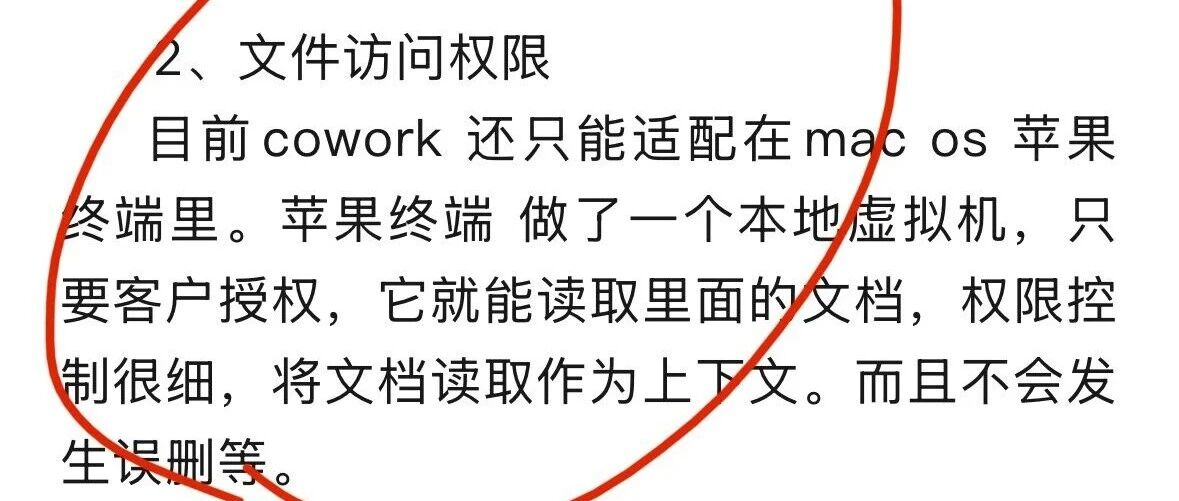
Core Insights - The article discusses the emergence of Cowork, a product by Anthropic, which integrates AI into the development process, making it accessible to non-programmers [3][4]. Group 1: Product Features - Cowork allows users to perform tasks without needing programming knowledge, as it automates the execution of commands through Claude Code [4]. - Users can grant Claude access to specific folders on their computers, enabling it to perform tasks such as organizing files, writing reports, and creating spreadsheets based on screenshots [4]. - The AI operates autonomously, planning and executing tasks while providing progress updates to the user [4]. Group 2: Market Potential - A recent meeting with a U.S. AI expert indicated that Cowork is expected to gain significant traction in the coming months due to its core virtualization technology [5]. - The article suggests that virtualization is a foundational technology for cloud services, implying that many data center operators already possess the necessary infrastructure [5].
100%兼容国产主流软硬件生态!联想问天WR5215 G5服务器发布
Xin Lang Cai Jing· 2026-01-04 10:22
Core Insights - Lenovo has launched its first 2U single-socket server, the Lenovo Wentiang WR5215 G5, based on the AMD EPYC processor, featuring a 50% increase in CPU core count compared to the previous generation [1][3] - The server is designed to provide robust computing power for high-load scenarios such as AI training, virtualization, and scientific computing, with up to 3TB of TruDDR5 memory and 14 PCIe expansion slots [1][3] Performance and Efficiency - The Lenovo Wentiang WR5215 G5 achieves a 25% significant improvement in AI workload performance through deep software-hardware integration optimization [1][3] - Its single-socket design can save up to 25% in overall power consumption compared to traditional dual-socket solutions, while the Lenovo Wentiang Haishen liquid cooling technology enhances cooling capacity by 100% [1][2][4] Compatibility and Cost Savings - The server is fully compatible with mainstream domestic software and hardware ecosystems, having completed deep adaptation and mutual certification with operating systems like Tongxin UOS and Kirin, as well as various domestic databases and virtualization platforms [2][4] - This compatibility helps users achieve smooth migration to domestic platforms and significantly reduces core CPU software licensing costs by up to 50% [2][4] Green Computing Initiatives - The Lenovo Wentiang WR5215 G5 can be equipped with Lenovo Wentiang Haishen liquid cooling technology, which covers CPU, memory, power supply, and GPU, effectively supporting the construction of data centers with a PUE value below 1.2, aligning with sustainable development goals [2][4]

四年稳居第一!华为DCS持续领跑中国软件定义计算软件市场
Sou Hu Cai Jing· 2025-10-30 10:05
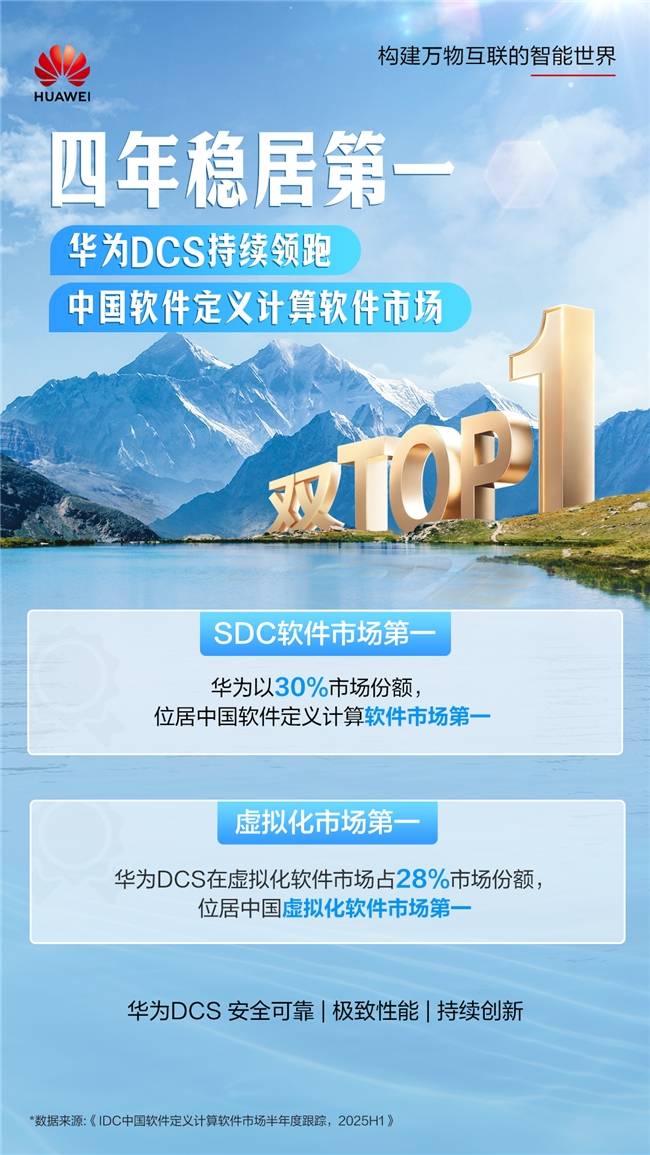
Core Insights - Huawei DCS leads the Chinese Software-Defined Compute (SDC) market with a 30% market share, ranking first in the sector [1] - In the virtualization software market, Huawei DCS holds a 28% market share, also ranking first [1] Group 1: Market Leadership - Huawei DCS has maintained its top position for four consecutive years, attributed to its core advantages of "security and reliability, extreme performance, and continuous innovation" [4] - The DCS eSphere serves as a core component for virtualization, enhancing resource utilization efficiency and gaining widespread trust in the global market [4] Group 2: Client Base and Industry Applications - Huawei DCS has served over 14,000 clients across more than 170 countries and regions, covering key industries such as government, finance, and healthcare [4] - In the government sector, Fujian Province has partnered with Huawei to implement a full-stack data center solution, ensuring stable operation of government applications [4] - The City of Ekurhuleni in South Africa has adopted Huawei's DCS solution to build a smart city, significantly reducing the time for new business deployment from days to hours [4] Group 3: Financial Sector Impact - Over 500 financial institutions have chosen Huawei DCS solutions for their digital transformation, including numerous domestic and international banks and insurance companies [5] - Anxin Securities has built a secure and stable financial data center based on Huawei DCS, achieving a 30% reduction in operational resource investment [5] Group 4: Healthcare Innovations - Shandong University Qilu Hospital has implemented Huawei DCS solutions to support various healthcare applications, enhancing patient access to medical services [5] - Shanghai Jiao Tong University School of Medicine's Ruijin Hospital has developed China's first clinical-grade pathology model using Huawei DCS AI solutions, significantly improving diagnostic efficiency [5]

适合您的操作系统
风河· 2025-05-18 06:15
Investment Rating - The report highlights Wind River's VxWorks as a leading real-time operating system for embedded systems, indicating a strong investment potential in the embedded operating system market. Core Insights - Wind River's VxWorks has a proven track record of successful deployments across various sectors, including aerospace, industrial, medical, and automotive applications, powering billions of smart devices and systems [3][8]. - The operating system supports both current and future embedded hardware through extensive collaboration with ecosystem partners, optimizing for advanced processors and system-on-chip (SoC) [4]. - Wind River provides a comprehensive development environment with tools that accelerate the development of safety-critical and mission-critical systems, including an integrated development and debugging environment [5]. - The operating system supports modern programming frameworks and languages, enhancing development efficiency and enabling the use of AI/ML frameworks [6]. - VxWorks offers full source code access for flexible configuration and expansion, allowing engineers to customize the OS according to specific project needs [7]. - The operating system is utilized in safety certification projects, meeting various safety standards such as DO-178C and ISO26262, which is crucial for industries requiring high reliability [8]. - VxWorks supports virtualization and OCI containers, enabling the integration of multiple embedded operating systems on a single device, maximizing existing intellectual property investments [9][10]. - Advanced security features are integrated into VxWorks, addressing current and emerging threats while providing a modular design for future-proofing [11]. - Wind River offers extensive technical support options, ensuring developers have access to real-time assistance and self-service resources [12].