
行业供需格局优化

Search documents
建筑材料行业周报:临近一季报窗口期,聚焦绩优股
东方财富· 2026-03-30 00:30
Investment Rating - The report maintains an "Outperform" rating for the construction materials sector [2] Core Views - The report emphasizes the importance of focusing on high-performing stocks as the first quarter earnings report window approaches, particularly in the fiberglass sector, which is expected to see continued performance growth due to rising prices of electronic fabrics [8][10] - The report highlights the impact of rising crude oil prices on raw material costs, suggesting that companies with strong pricing power and the ability to pass on costs will perform better [9][13] - The report identifies potential investment opportunities in companies that are less affected by raw material price fluctuations, such as Qingniao Fire Protection and Rabbit Baby, as well as those in the waterproof and coating sectors that are implementing price increases [9][13] Summary by Sections Cement - The cement market is gradually recovering, with a national shipment rate of 39% as of March 27, 2026, reflecting a 7.5 percentage point increase from the previous month [26][28] - The average price of cement is approximately 345 RMB/ton, with slight increases in various regions due to rising transportation and production costs [26][34] - Recommended companies include Huaxin Cement and Conch Cement, with attention to Tapai Group and Tian Shan Shares [34] Glass - Float glass inventory has decreased slightly to approximately 6,512 million weight boxes, with a price increase to 1,196 RMB/ton [35] - The report notes that the supply of float glass is expected to contract further, leading to potential price stabilization [35] - Companies to watch include Qibin Group and Xinyi Glass, as the market may be nearing a price bottom [13] Fiberglass - The demand for electronic fabrics remains strong, with prices for 7628 electronic fabrics around 5.4-6 RMB/meter, and expectations for further price increases [11][35] - The report recommends China Jushi as a key player in the fiberglass sector, with additional attention to International Composite Materials and Longhai Shares [10][11] Carbon Fiber - Carbon fiber prices have stabilized, with new demand expected from the rapid development of commercial aerospace [11] - Companies like Zhongfu Shenying and Guangwei Composites are highlighted for their potential in high-end applications [11]



全面走强!煤炭板块震荡走高掀上涨潮,山西焦化涨停领涨!
Jin Rong Jie· 2026-01-28 09:56
Group 1: Market Performance - The A-share coal sector is experiencing a strong upward trend, with sub-sectors like coking coal and thermal coal rising in tandem, indicating a sustained profit-making effect [1] - Shanxi Coking Coal has hit the daily limit up, becoming the leading stock in the sector, while Lu'an Environmental Energy has increased by over 8%, leading the coking coal sub-sector [1] - Other stocks such as Jinko Coal, Electric Power Energy, Shaanxi Black Cat, and Haohua Energy are also seeing synchronized gains, reflecting a significant increase in market activity [1] Group 2: Industry Outlook - The coal price is expected to rise by approximately 5-7% in 2026, with improved performance for listed companies anticipated to follow suit [2] - Coal inventory has significantly decreased, with a total of 22.59 million tons reported, marking a week-on-week decline of 2.9% and a year-on-year drop of 20.4%, indicating a tight supply-demand balance [2] - The implementation of stricter safety regulations and continued restrictions on imported coal are expected to accelerate the elimination of outdated production capacity, leading to an increase in industry concentration [2] Group 3: Related Industries - The coal chemical industry is expected to benefit from rising coal prices and stable supply, with a projected 6% growth in coal consumption driven by new coal chemical projects [3] - The power industry, particularly thermal power, is seeing a resilient coal demand, with a 3.3% year-on-year increase in coal consumption since the beginning of 2026 [3] - The steel industry is also benefiting from the improved coal sector, with a 1.5% year-on-year increase in pig iron production and a 0.9% week-on-week increase in coking coal sales, highlighting the synergy within the steel-coal supply chain [3]


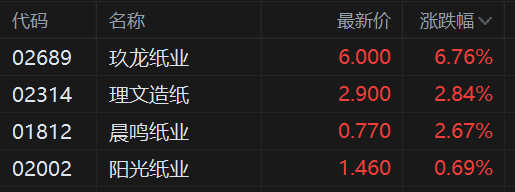
港股异动丨纸业股拉升 玖龙纸业盘初涨超7% 行业减产+涨价
Ge Long Hui· 2025-12-29 02:01
Group 1 - The core viewpoint of the article highlights a significant shift in the paper industry, where major companies are reducing production or slowing down expansion, leading to a decrease in supply pressure and an improvement in the supply-demand relationship [1] - Several paper types are beginning to see price increases, indicating a strategy focused on stabilizing prices rather than competing on volume [1] - The overall demand has not shown a significant recovery, but the reduction in supply and lower inventory pressure are contributing to a structural optimization in the industry [1] Group 2 - Specific companies such as Nine Dragons Paper have seen a stock price increase of over 7%, while Chenming Paper and Lee & Man Paper have also experienced gains of approximately 3% [2] - The demand for packaging paper is receiving temporary support from the overlap of e-commerce replenishment and pre-holiday procurement, although the overall consumption recovery remains moderate [1] - Cultural paper is entering its traditional peak season, with some orders being released before the New Year and Spring Festival, but the strength of the demand recovery still needs further validation [1]

长丝行业-桐昆股份&新凤鸣
2025-09-22 01:00
Summary of the Conference Call on the Polyester Filament Industry - Tongkun and Xinfengming Industry Overview - The polyester filament industry is primarily driven by downstream demand from the apparel and home textile sectors, accounting for 85% of total demand, which is closely related to the health of the apparel supply chain [1][3] - The industry has experienced several peaks in production capacity growth over the past few years, but demand growth has remained stable at around 5% to 7% due to a trend of consumption downgrade [1][5] Key Insights and Arguments - Significant slowdown in new production capacity is expected post-2024, with capacity growth from 2024 to 2026 projected to be significantly lower than demand growth, leading to a continuous rise in operating rates [1][6] - The industry is highly concentrated, with the top three companies (Tongkun, Xinfengming, and Hengli Petrochemical) holding a 61% market share, which enhances their market control and may lead to price increases [1][8] - The operating rate of the polyester filament industry is forecasted to rise, potentially reaching 92% by 2026, which is above the average operating rate of the chemical industry [1][7] Supply and Demand Dynamics - In 2025, the supply-demand balance is expected to improve, with leading companies implementing a 5% reduction in POY production, resulting in a profit of nearly 300 yuan per ton [4][11] - The supply side is characterized by a decline in growth rates and a concentrated supply structure, allowing companies to exert pricing power [11] - The industry has seen a history of production capacity peaks, with growth rates exceeding 10% in certain years, leading to supply excess [5] Long-term Industry Outlook - The long-term outlook for the polyester filament industry is positive, with potential advantages including continuous optimization of the supply-demand structure and the possibility of old capacity elimination [12] - Historical data indicates that the peak cash flow per ton for POY reached 1,200 yuan, suggesting significant upside potential from current profit levels [12] - The industry is currently undervalued, with companies like Tongkun and Hengyi Petrochemical showing relatively low price-to-book ratios [12] Company-Specific Insights - Tongkun has shown significant growth, with revenue increasing from 9.183 billion yuan in 2008 to 101.3 billion yuan in 2024, and net profit growing from 104 million yuan to 1.202 billion yuan over the same period [15] - Xinfengming's revenue grew from 4.5 billion yuan in 2009 to 67 billion yuan in 2024, with net profit increasing from 41 million yuan to 1.1 billion yuan [15] - Both companies have strong production capacities, with Tongkun at 13.5 million tons and Xinfengming at 8.45 million tons, and both are expanding upstream into PTA and MEG production [15] Market Performance and Valuation - The stock performance of Tongkun and Xinfengming has been closely aligned, with both companies' valuations primarily reflecting their polyester filament businesses [16] - Tongkun's additional asset in the petrochemical sector, which has not been fully reflected in its stock price, could potentially add 20 to 30 billion yuan in market value [16] Conclusion - The polyester filament industry is showing signs of recovery and is expected to maintain a positive trajectory, particularly as seasonal demand increases and operating rates rise [13][14] - The industry is recommended for attention due to its improving market conditions and potential for further valuation recovery [18]

桐昆股份(601233):2025Q2长丝开工较为饱和,行业供需格局持续优化
Huachuang Securities· 2025-09-11 09:13
Investment Rating - The report maintains a "Strong Buy" rating for Tongkun Co., Ltd. (601233) [1] Core Views - The company reported a revenue of 44.158 billion yuan for the first half of 2025, a year-on-year decrease of 8.41%, while the net profit attributable to shareholders was 1.097 billion yuan, an increase of 2.93% year-on-year [1] - In Q2 2025, the company achieved a revenue of 24.738 billion yuan, down 8.73% year-on-year but up 27.38% quarter-on-quarter, with a net profit of 486 million yuan, a slight increase of 0.04% year-on-year but a decrease of 20.54% quarter-on-quarter [1] - The long filament production capacity is fully utilized, with an operating rate of 96.3% in Q2 2025, and sales volume increased by 5% year-on-year and 38.2% quarter-on-quarter [7] - The report highlights that the supply-demand dynamics in the long filament industry are continuously improving, with expectations for profit margins to rise in the long term [7] Financial Summary - Total revenue for 2024 is projected at 101.307 billion yuan, with a year-on-year growth rate of 22.6%, while for 2025, it is expected to decrease to 97.086 billion yuan, reflecting a decline of 4.2% [3] - The net profit attributable to shareholders is forecasted to grow significantly from 1.202 billion yuan in 2024 to 2.167 billion yuan in 2025, representing a growth rate of 80.3% [3] - The earnings per share (EPS) is expected to increase from 0.50 yuan in 2024 to 0.90 yuan in 2025, with a corresponding price-to-earnings (P/E) ratio of 16 times [3] Market Position and Valuation - The company is positioned as a leader in the long filament industry, with a total production capacity of 13.5 million tons for polyester filament and 10.2 million tons for PTA [7] - The target price for the stock is set at 18.9 yuan, with the current price at 14.62 yuan, indicating a potential upside [3] - The report suggests that the stock price does not fully reflect the profitability potential of the petrochemical segment, which is significantly undervalued [7]