货币信任危机

Search documents
全球财富大洗牌!美元大放水,黄金或成普通人唯一的保命钱?
Sou Hu Cai Jing· 2026-02-19 04:22
Core Insights - The global financial system underwent a profound transformation in 2026, marked by a dramatic rise in gold prices, which increased by nearly 70%, and silver prices, which surged by approximately 150%, while the US dollar index fell by about 10% [1][3][5] Group 1: Market Dynamics - The significant increase in gold and silver prices reflects a rapid decline in cash purchasing power, with cash losing nearly 70% of its value relative to gold over the year [3] - The contrasting trends of rising gold and silver prices against the declining dollar index indicate a growing distrust in the existing monetary system [5][12] - The largest gold ETFs have been major players in the gold market, indicating that institutional investors are sensing a crisis and are moving towards gold as a safe haven [6] Group 2: Fiscal Challenges - The US federal deficit approached $1.85 trillion by January 2026, with nearly half of this amount allocated to debt interest payments, highlighting significant fiscal pressure on the US government [8][9] - The US national debt has surpassed 101% of GDP, raising concerns about the government's ability to manage such a heavy debt burden [11] - Despite the Federal Reserve's three interest rate cuts totaling 75 basis points in 2025, these measures have not resolved the underlying issues, exposing deeper crises in dollar credibility [11] Group 3: Global Monetary Trends - Central banks worldwide have significantly increased their gold purchases, with monthly acquisitions rising from 17 tons in 2019 to 70 tons in 2025, totaling 863 tons for the year [14] - The ongoing trend of converting dollars into gold by central banks signals a critical challenge to the dollar's status as the primary reserve currency [14] - The continuous expansion of monetary supply through large-scale fiscal stimulus in the US, Europe, and Japan has led to rising inflation concerns, further solidifying gold's role as a hedge against currency devaluation [15] Group 4: Future Outlook - The rise in gold prices is not merely a market reaction but a reflection of global investors' deep-seated doubts about the stability of fiat currencies [18] - In a context of excessive liquidity, gold is positioned as a "guardian" of financial markets, emphasizing its unique role in preserving wealth amid ongoing global financial restructuring [20]

银比油贵时隔45年再现,现货白银日涨超10%,钯金涨超14%,为何贵金属还在暴涨,历史信号怎么看?
Sou Hu Cai Jing· 2025-12-27 07:19
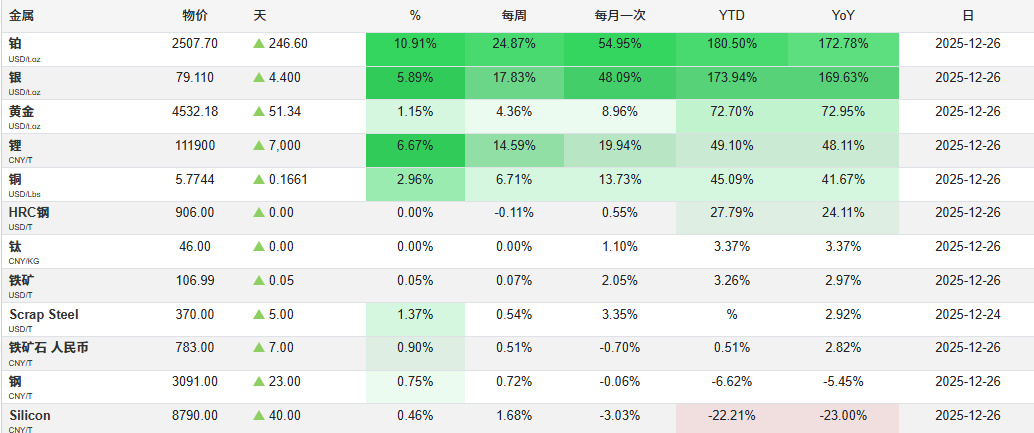
Group 1 - Precious metals are experiencing significant price surges, with silver reaching $79 per ounce, marking a year-to-date increase of over 173% [1][2] - The gold price is approaching its historical high of $4525 per ounce, while palladium has also seen a notable increase of 14.1% [1][2] - The phenomenon of "silver being more expensive than oil" has re-emerged after 45 years, indicating a significant shift in market dynamics [1][2] Group 2 - The current market behavior resembles a "bank run," driven by heightened investor anxiety and speculation, which is distorting normal supply and demand relationships [4][9] - Historical patterns suggest that financial crises tend to occur approximately every 30 years, often triggered by similar factors such as market manipulation and policy interventions [2][4] - The supply-demand mismatch in silver, with industrial demand growing while supply remains constrained, is creating a long-term support for silver prices [7][12] Group 3 - The expectation of a shift in monetary policy by the Federal Reserve, including potential interest rate cuts, is contributing to the attractiveness of precious metals as a hedge against currency devaluation [6][11] - The industrial demand for silver is expected to increase significantly, driven by advancements in AI and renewable energy sectors, while supply growth is projected to be minimal [7][12] - The current market dynamics are leading to a significant increase in physical silver purchases, as investors move away from paper contracts, resulting in a severe shortage of physical silver [9][11]
赵建:金融资产集体狂欢,世界发生了什么?
Sou Hu Cai Jing· 2025-11-04 07:18
Group 1 - The global asset market is experiencing a significant rally, with various stock markets, including A-shares and others, reaching historical highs, while gold has also seen substantial fluctuations [4][11][12] - The current market environment suggests a potential bubble, drawing comparisons to past financial crises, but the underlying dynamics indicate a shift in asset valuation rather than a straightforward bubble [4][11] - The volatility in gold prices highlights the importance of a long-term allocation strategy rather than short-term trading, as recent fluctuations have exceeded expectations [5][6][9] Group 2 - The A-share market's approach to the 4000-point mark is significant, reflecting a complex interplay of bullish and bearish sentiments, influenced by macroeconomic factors and easing tensions in US-China relations [10][21] - Global asset prices are diverging from macroeconomic fundamentals, raising concerns about a potential crisis of trust in currencies, which is a core issue driving current market dynamics [11][12] - The long-term bullish trend in US equities is linked to a reliance on asset appreciation and the implications of AI advancements, creating a unique economic environment characterized by "no employment prosperity" [14][15] Group 3 - The "Fifteen Five" plan emphasizes high-quality development, aiming to reduce reliance on real estate and finance while fostering new productive capacities in key sectors such as renewable energy and biotechnology [17][18] - The plan indicates a shift in focus towards service industries and innovation, with a clear intention to address structural economic challenges rather than resorting to aggressive stimulus measures [17][20] - The geopolitical landscape, particularly US-China relations and cross-strait dynamics, is expected to influence market sentiment and asset prices, particularly in the context of gold [21]