货币创造和派生

Search documents
央行重磅报告!专家解读
Sou Hu Cai Jing· 2025-11-11 15:46
Core Insights - The People's Bank of China (PBOC) has implemented a moderately accommodative monetary policy, maintaining ample liquidity to support economic recovery and stabilize financial markets, with GDP growth of 5.2% year-on-year in the first three quarters of 2025 [1][3][2] Group 1: Monetary Policy Execution - The report emphasizes the importance of a balanced approach in monetary policy, considering short-term and long-term goals, growth and risk prevention, and internal and external factors [3][2] - The PBOC aims to ensure reasonable growth in financial aggregates, effectively guide monetary credit policies, and enhance financial market infrastructure and openness [1][3] Group 2: Financial Indicators - The report highlights the need to focus on social financing scale and money supply rather than just loans, as direct financing through bond issuance is becoming more prevalent among enterprises [5][6] - The current RMB loan balance is 270 trillion yuan, and the social financing scale stands at 437 trillion yuan, indicating a natural decline in financial aggregate growth due to the increasing base [8][6] Group 3: Economic Structure and Credit Demand - The shift towards high-quality economic development is leading to a decrease in credit demand in traditional sectors like real estate and infrastructure, while technology-intensive industries are on the rise [6][8] - The report suggests that the focus should be on revitalizing existing financial resources rather than merely increasing credit volume, to avoid issues like "zombie enterprises" [6][8] Group 4: Interest Rate and Financial Market Dynamics - Maintaining reasonable interest rate relationships is crucial for effective monetary policy transmission, as different assets exhibit varying risk and liquidity profiles [12][11] - The report discusses the impact of asset allocation adjustments on financial asset structures, noting that the recent slowdown in deposit growth may reflect a reallocation of funds towards the stock market [14][12]
业内专家解读2025年第三季度中国货币政策执行报告
Zhong Guo Ji Jin Bao· 2025-11-11 15:40
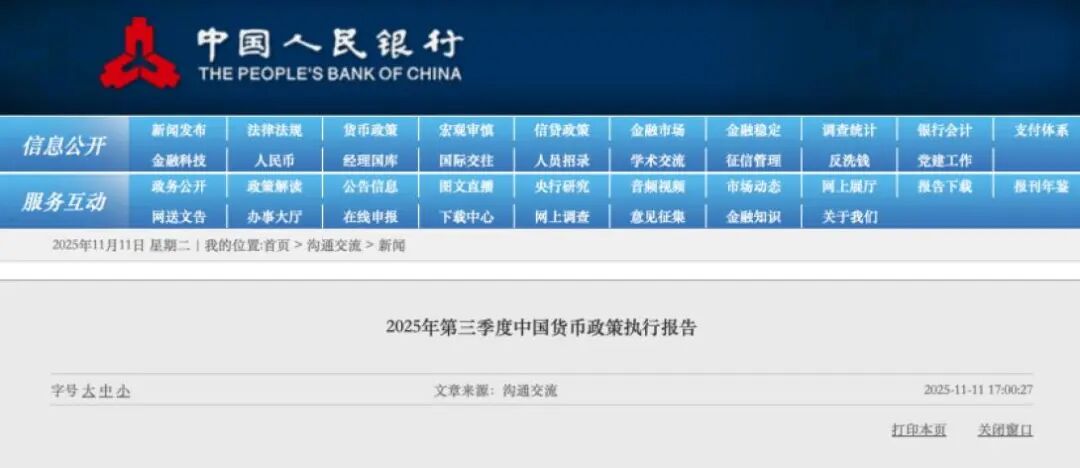
Core Viewpoint - The People's Bank of China (PBOC) has released the "Monetary Policy Implementation Report for the Third Quarter of 2025," summarizing the monetary policy execution in the first three quarters and outlining future policy directions [1][4]. Economic Performance - In the first three quarters of this year, China's GDP grew by 5.2% year-on-year, indicating resilience and vitality in economic operations [4][6]. - The PBOC has implemented a moderately accommodative monetary policy, maintaining ample liquidity and utilizing various monetary policy tools to support economic recovery and stabilize financial markets [4][5]. Monetary Policy Strategy - The report outlines the main strategies for the next phase of monetary policy, which include maintaining reasonable growth in financial aggregates, leveraging monetary and credit policies, balancing interest and exchange rates, accelerating financial market reforms, and proactively managing financial risks [4][6]. Financial Indicators - The report emphasizes the importance of observing financial aggregates through social financing scale and money supply, rather than solely focusing on loans [8][10]. - As of now, the balance of RMB loans has reached 270 trillion yuan, and the total social financing scale stands at 437 trillion yuan, indicating a natural decline in the growth rate of financial aggregates due to the increasing base [10][11]. Credit Structure and Economic Transition - The report highlights the ongoing optimization of credit structure, with a shift towards direct financing methods such as bond issuance, which has become more accessible for enterprises [8][9]. - The transition from high-speed growth to high-quality development necessitates a change in the growth of monetary credit, focusing on revitalizing existing financial resources rather than merely expanding credit volume [9][11]. Interest Rate and Financial Market Dynamics - The report discusses the need to maintain reasonable interest rate relationships to enhance the effectiveness of monetary policy and reduce arbitrage opportunities [13][14]. - It notes that the recent slowdown in deposit growth may reflect a reallocation of funds from deposits to the stock market, driven by changes in asset yield expectations [14].

央行重磅报告!专家解读
中国基金报· 2025-11-11 15:36
Core Viewpoint - The People's Bank of China (PBOC) has implemented a moderately accommodative monetary policy to support economic recovery and stabilize financial markets, with a GDP growth of 5.2% year-on-year in the first three quarters of 2025 [2][4]. Group 1: Monetary Policy Implementation - The PBOC has maintained ample liquidity and utilized various monetary policy tools to create a conducive environment for economic recovery and financial stability [2][4]. - The report emphasizes the importance of coordinating macroeconomic policies to achieve a synergistic effect in supporting growth and structural adjustments [4]. - The PBOC's future monetary policy will focus on maintaining reasonable growth in financial aggregates, enhancing the guiding role of monetary credit policies, and balancing internal and external factors [2][4]. Group 2: Financial Aggregates and Credit Structure - The report highlights the need to observe financial aggregates through social financing scale and money supply, rather than solely focusing on loans [5][6]. - With the development of direct financing, companies are increasingly opting for bond issuance over loans, indicating a shift in financing preferences [6]. - The growth rate of social financing remains above 8%, reflecting the effectiveness of "wide credit" policies [6]. Group 3: Quality of Financial Development - The transition to high-quality development necessitates a shift from extensive credit expansion to enhancing the quality and efficiency of credit assets [7][8]. - The current balance of RMB loans has reached 270 trillion yuan, with a social financing scale of 437 trillion yuan, indicating a natural decline in financial aggregate growth due to larger bases [10]. Group 4: Monetary Creation and Derivation - The process of monetary creation and derivation is complex and influenced by various factors, including the roles of central banks, commercial banks, and the real economy [12]. - The report notes that loan issuance is not the only means of monetary derivation, as banks can also create deposits through purchasing other financial assets [12]. Group 5: Interest Rate Relationships - Maintaining reasonable interest rate relationships is crucial for effective monetary policy transmission and reducing arbitrage opportunities [14]. - The report discusses the importance of policy coordination to strengthen interest rate policy execution and ensure a balanced interest rate environment [14]. Group 6: Asset Allocation and Market Dynamics - The report addresses the phenomenon of deposit growth slowing down as funds are reallocated to the stock market, although this is more about redistribution among different entities rather than a net decrease in deposits [16]. - Investors are likely to shift their savings into other assets when deposit rates decline, indicating a dynamic adjustment in asset allocation [16].