货币政策转折

Search documents
全年32次!G10央行“降息潮”已达巅峰 明年加息将被摆上桌面?
Sou Hu Cai Jing· 2025-12-24 01:32
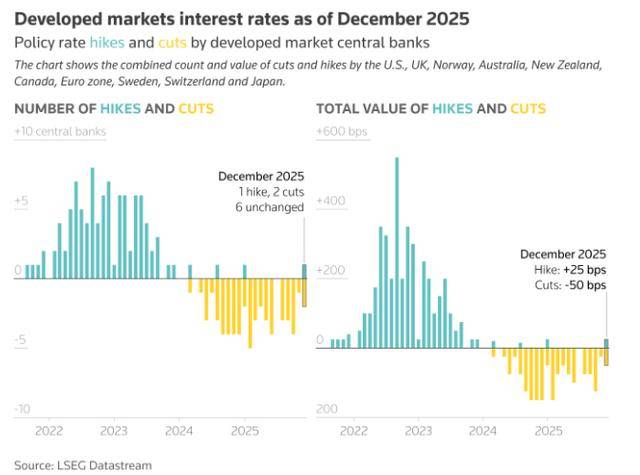
Core Viewpoint - In 2025, major developed economies' central banks are implementing interest rate cuts at the fastest pace and largest scale since the financial crisis, while emerging market policymakers are also accelerating their easing policies [1][2]. Group 1: Developed Economies - In 2025, nine out of ten G10 central banks lowered their benchmark interest rates, including the Federal Reserve, European Central Bank, and others [1]. - These central banks collectively executed 32 rate cuts this year, totaling a cumulative easing of 850 basis points, marking the highest number of cuts since 2008 and the largest easing since 2009 [2]. - The year 2022-2023 saw a stark contrast, with central banks raising rates in response to inflation driven by the Russia-Ukraine conflict, except for the Bank of Japan, which raised rates twice this year [4]. Group 2: Future Policy Outlook - Analysts predict a significant shift in monetary policy for major central banks in 2026, with indications from the Bank of Canada and the Reserve Bank of Australia suggesting potential rate hikes [5]. - The Federal Reserve is navigating a complex situation with intertwined labor market and inflation dynamics, with expectations that it may maintain or lower rates in 2025 but could face dual risks in 2026 [6]. Group 3: Emerging Markets - In December, 14 out of 18 surveyed emerging market central banks held meetings, with 8 implementing rate cuts totaling 350 basis points, including Turkey, Russia, and India [7]. - The cumulative rate cuts for emerging economies in 2025 reached 3,085 basis points (51 actions), significantly exceeding the 2,160 basis points in 2024, marking the largest easing since the pandemic began in 2021 [8]. - Emerging market central banks have raised rates by a total of 625 basis points this year, which is less than half of the 1,450 basis points tightening in 2024 [10]. Group 4: Future Easing in Emerging Markets - Analysts expect further easing in emerging markets next year, with countries like Brazil and Hungary likely to initiate rate cuts, while others may extend their easing cycles [11].

百利好丨美联储今夜重磅决议,全球市场严阵以待
Sou Hu Cai Jing· 2025-09-17 08:30
Core Viewpoint - The Federal Reserve's upcoming meeting on September 16-17 is highly anticipated, with expectations of a 25 basis point rate cut, indicating a potential shift towards a more accommodative monetary policy [1][3][6]. Group 1: Monetary Policy Expectations - The market widely anticipates a 25 basis point rate cut during the meeting, reflecting investor sentiment that the Fed is prioritizing labor market performance over inflation concerns [3][6]. - There is a nearly 70% probability of two additional rate cuts by the end of the year, suggesting an acceleration of the easing cycle and a potential rebound in risk sentiment [3][6]. Group 2: Key Focus Areas of the Meeting - The meeting will focus on whether the Fed's monetary policy is at a turning point, with a rate cut potentially signaling the start of a new easing cycle amid slowing job growth and persistent inflation above target [6]. - The independence of the Fed's policy is under scrutiny, particularly in light of ongoing political pressures and controversies surrounding board nominations, raising questions about Powell's ability to make independent decisions [6]. - The newly released economic projections (SEP) and the dot plot will be closely watched, especially regarding expectations for terminal interest rates before 2026, which could influence global asset allocation and market confidence [6]. - Powell's press conference will be crucial, as his comments on inflation, employment, and policy direction, along with responses to political pressures, may significantly impact market expectations [6].

供给、政治与数据三重施压下历史魔咒再现?全球长期债券或迎“最危险九月”
Zhi Tong Cai Jing· 2025-09-02 00:58
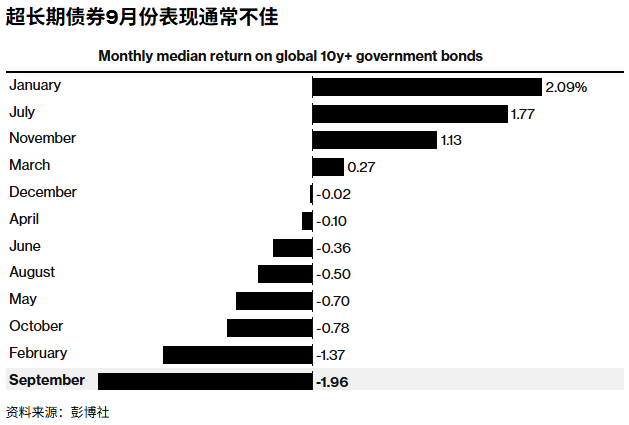
Group 1 - Historical data indicates that long-term bonds may face a dangerous September, with a median decline of 2% for global government bonds with maturities over 10 years in September over the past decade, marking it as the worst monthly performance of the year [1] - The expectation of government debt expansion is becoming a primary source of pressure, as increased fiscal spending by multiple countries leads to a rise in long-term bond supply, diminishing the yield advantage of shorter-term bonds [5] - Geopolitical disturbances are exacerbating market uncertainty, including persistent inflation in Japan, political turmoil in France due to Prime Minister Borne's confidence vote, and potential pressure from the Trump administration on the Federal Reserve to lower interest rates, which could further elevate domestic price pressures [5] Group 2 - Market sentiment is showing cautious signs, with institutional investors adopting a defensive posture, focusing on two major risk events: the upcoming U.S. non-farm payroll data that will validate the reasonableness of Federal Reserve rate cut expectations, and potential unexpected fluctuations in Eurozone inflation data that could disrupt the consensus on maintaining interest rates by the European Central Bank [5] - Seasonal supply patterns are also a key focus for strategists, as the weak performance of long-term bonds in September is closely related to issuance rhythms, with low issuance in July and August followed by a rebound in September, which explains the seasonal decline from a supply-demand perspective [5][6] - Multiple challenges must be overcome in the bond market this month, including the possibility that continued strong U.S. economic data may delay Federal Reserve rate cuts, and hawkish signals from the Bank of Japan could lead to a repricing of global interest rates, making September a notably risky month for bonds [6]