央行加息

Search documents
光大新鸿基晨会纪要-20260317
光大新鸿基· 2026-03-17 05:29
Core Insights - The report indicates that the Australian central bank is expected to continue raising interest rates by 0.25% [1] Group 1 - The market anticipates that the Australian central bank will implement a rate hike in response to ongoing economic conditions [1] - The potential increase in interest rates is projected to occur on March 17, 2026, reflecting the bank's strategy to manage inflation [1]
日元跳水!高市早苗对日本央行再次加息表示担忧
Hua Er Jie Jian Wen· 2026-02-24 08:08
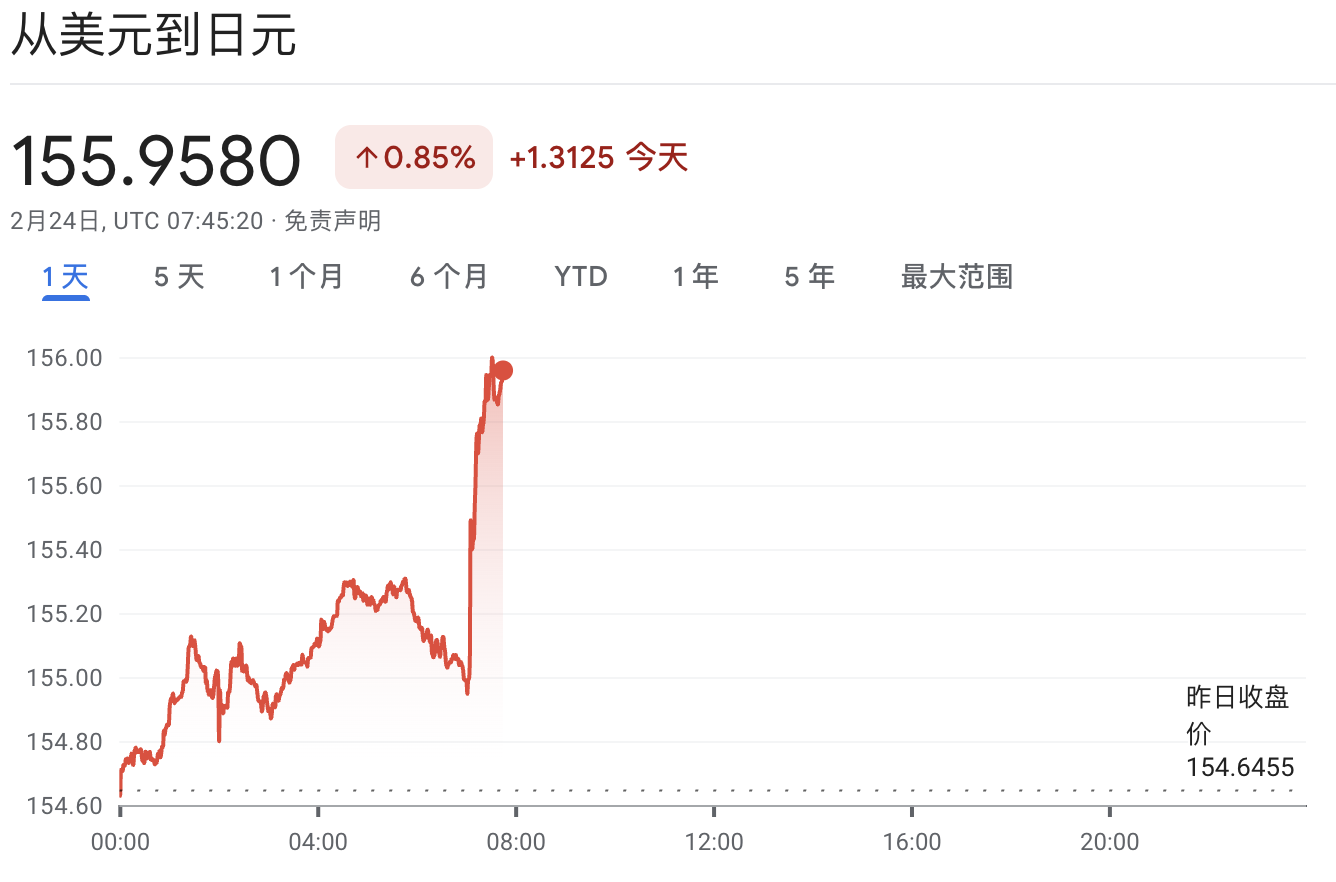
Group 1 - The core viewpoint of the article highlights that Japanese Prime Minister Fumio Kishida has intensified pressure on the Bank of Japan regarding monetary policy, leading to a rapid depreciation of the yen [1][3]. - Kishida expressed concerns about potential further interest rate hikes during a meeting with Bank of Japan Governor Kazuo Ueda, indicating a more assertive stance compared to their previous meeting in November [3][4]. - Following the news, the USD/JPY exchange rate surged by 0.85%, reflecting increased market pressure and a reassessment of expectations regarding the Bank of Japan's monetary policy [1][5]. Group 2 - The Bank of Japan, in response to concerns about political interference, emphasized that Kishida did not make any specific requests regarding interest rates during their meeting, thereby preserving the central bank's independence [4]. - The market reacted swiftly to the news, with the two-year Japanese government bond yield falling by 3.5 basis points to 1.215%, and the five-year yield dropping by 4 basis points to 1.565% [1][5]. - Kishida's statements have introduced uncertainty regarding the Bank of Japan's future actions, which could affect investor sentiment and market pricing of the central bank's policy trajectory [3][5].

日本执政联盟小党“维新会”领袖:日本应尽快在最早可行的日期启动为期两年的食品销售税暂停政策
Jin Rong Jie· 2026-02-16 02:29
Core Viewpoint - The leader of Japan's ruling coalition minor party, "Ishin," advocates for the immediate initiation of a two-year suspension of the food sales tax at the earliest feasible date [1] Group 1: Economic Policy - Japan should consider utilizing its substantial foreign exchange reserves to help cover the costs associated with the suspension of the food tax [1] - The Bank of Japan should independently decide when to raise interest rates, without government interference in monetary policy [1] Group 2: Currency and Interest Rates - Given the current weakness of the yen, there is a possibility that the Bank of Japan may further increase interest rates [1]
观点综述:欧洲央行加息的逆流押注
Xin Lang Cai Jing· 2026-02-13 22:05
Group 1 - Capital Group, an asset management firm with $3.3 trillion in assets under management, predicts that the European Central Bank will raise interest rates at least once this year, which is contrary to mainstream views [1][2] - The anticipated rate hike by the European Central Bank is expected to significantly boost the euro against the US dollar [1] Group 2 - Huw Pill, the Chief Economist of the Bank of England, advocates for maintaining the current interest rate at 3.75% for a longer duration to bring inflation back to target levels [2][3] - Pill noted that the current borrowing costs have not posed significant challenges for UK businesses [3]
巴克莱:马来西亚上半年GDP增长可能保持高位
Jin Rong Jie· 2026-02-13 06:54
Economic Growth Outlook - Malaysia's GDP growth is expected to remain high at 6%-7% for the first half of the year, followed by a slowdown to around 4%-5% as base effects diminish [1] - The growth forecast for Malaysia in 2026 has been raised from 5.0% to 5.5% after stronger-than-expected data for the fourth quarter of 2025 [1] Monetary Policy Implications - The stronger growth has led to questions regarding the necessity of the Bank Negara Malaysia's preventive rate cut in July of the previous year, prompting a 25 basis point hike to 3.0% in May [1] - The upcoming policy statement in March may signal a tightening bias, which will be closely monitored for indications that could pave the way for the May rate hike, although there is a risk of a delay until July [1]
澳大利亚3年期国债收益率涨10个基点 就业数据推升央行加息预期
Xin Lang Cai Jing· 2026-01-22 03:52
Core Viewpoint - The Australian 3-year government bond yield has increased significantly due to better-than-expected employment data, leading traders to raise their bets on an interest rate hike by the Reserve Bank of Australia (RBA) [1] Group 1: Bond Market - The 3-year Australian government bond yield rose by 10 basis points to 4.27%, marking the highest level since November 2023 [1] - Swap data indicates that traders currently expect a probability of over 60% for an RBA rate hike in February [1] Group 2: Currency Market - The Australian dollar strengthened, with the AUD/USD exchange rate rising by 0.6% to 0.6801, the highest level since October 2024 [1]
日本出口连续第四个月增长 料给央行渐进加息提供支撑
Xin Lang Cai Jing· 2026-01-22 00:13
Core Viewpoint - Japan's exports have increased for the fourth consecutive month, with December's overall exports rising by 5.1% year-on-year, although this is below the analyst forecast median of 6.1% [1] Group 1: Export Performance - Exports to the United States decreased by 11.1% [1] - Exports to China increased by 5.6% [1] - Exports to the European Union grew by 2.6% [1] Group 2: Trade Balance and Imports - The unadjusted trade surplus was 1,057 billion yen (approximately 6.67 million USD) [1] - Imports rose by 5.3% [1] Group 3: Monetary Policy Implications - These trade data are expected to support the central bank's continued gradual interest rate hikes [1] - The market widely anticipates that the Bank of Japan will maintain interest rates unchanged following a rate increase in December [1] - The central bank has indicated it will continue to raise rates as long as inflation and economic growth meet its expectations [1]
巴克莱:马来西亚央行或于5月加息
Jin Rong Jie· 2026-01-16 05:36
Core Viewpoint - Malaysian central bank is likely to raise interest rates by 25 basis points in May, potentially increasing the policy rate to 3.0%, with a risk of an earlier move in March due to stronger-than-expected economic growth [1] Group 1: Interest Rate Outlook - The central bank may reassess the necessity of last year's preventive rate cuts due to resilient economic growth [1] - An interest rate hold is expected in the January meeting, but the policy stance may shift to a more hawkish tone [1] Group 2: Economic Data and Predictions - The central bank is anticipated to wait for more data before signaling a May rate hike, with GDP forecasts for 2026 to be released in March [1] - Historical precedent suggests that the central bank has taken preventive actions in the past, indicating that an early rate hike cannot be ruled out [1]
去年日本企业破产数超1.2万
Di Yi Cai Jing Zi Xun· 2026-01-15 08:07
Group 1 - The number of corporate bankruptcies in Japan reached a record high of 12,610 cases last year, marking a 27.36% increase from 9,901 cases in 2024, and this is the fourth consecutive year of growth in bankruptcies [2] - The majority of bankruptcies involve small and medium-sized enterprises, with 6 out of 7 industries experiencing an increase in bankruptcies compared to 2024 [3][4] - The service industry saw the highest number of bankruptcies, with 2,648 cases, a 4.0% increase from 2,547 cases in 2024, while the retail sector also faced significant challenges with 2,193 bankruptcies, up 5.1% [3][4] Group 2 - The rise in bankruptcies is attributed to high prices, labor shortages, and interest rate hikes, creating a challenging business environment [2][4] - The "unfavorable economic conditions" category accounted for 8,502 bankruptcies, representing 82.8% of the total, with "poor sales" being the most common reason [4] - The average minimum wage in Japan increased from 902 yen to 1,121 yen over five years, a rise of 24.3%, further straining small businesses [5] Group 3 - The construction industry also faced significant bankruptcies due to rising material costs and labor shortages, with the number of bankruptcies in this sector exceeding 2,000 [3][5] - The trend of bankruptcies is expected to continue into 2026, with potential shifts from high prices to issues related to labor shortages and operator health [6] - Real estate prices have been rising, adding to the rental burdens for small businesses, with an average increase of 1.5% in land prices reported [5]
去年日本企业破产数超1.2万
第一财经· 2026-01-15 07:58
Core Insights - The number of corporate bankruptcies in Japan reached a new high, with 12,610 cases reported in the previous year, marking a 27.36% increase from 9,901 cases in 2024 [3] - This marks the fourth consecutive year of rising bankruptcies, surpassing the 10,000 mark for the first time since 2013 [3] - The majority of bankruptcies involve small and medium-sized enterprises (SMEs), with a significant impact on the service sector [3][5] Bankruptcy Trends - The number of bankruptcies among companies with liabilities under 50 million yen increased to 6,383, accounting for 62.2% of total bankruptcies, the second-highest proportion since 2000 [5] - The service industry saw the highest number of bankruptcies, with 2,648 cases, a 4.0% increase from 2,547 in 2024 [5] - Retail and construction industries also faced significant bankruptcies, with retail bankruptcies rising to approximately 2,193, a 5.1% increase [5] Regional Analysis - Eight out of nine regions in Japan reported an increase in bankruptcies, with the Shikoku region experiencing the fastest growth at 9.2% [6] - "Economic downturn bankruptcies" accounted for 8,502 cases, representing 82.8% of total bankruptcies, with sales downturn being the most common reason [6] Factors Contributing to Bankruptcies - Labor shortages and high prices are identified as primary factors driving the increase in bankruptcies, with 427 cases attributed to labor shortages and 949 to high prices, both reaching historical highs [6][9] - The average minimum wage in Japan rose from 902 yen to 1,121 yen between 2020 and 2025, an increase of 24.3%, further straining SMEs [8] Industry-Specific Challenges - In the restaurant sector, large chains benefit from economies of scale, while small businesses struggle with rising operational costs [8] - The price transfer rate in the restaurant industry is 32.3%, below the industry average of 39.4%, indicating challenges in passing on costs to consumers [9] - Rising real estate prices have also increased rental burdens for SMEs, with average land prices rising by 1.5% for four consecutive years [9] Future Outlook - The trend of SME bankruptcies is expected to continue into 2026, with concerns shifting from high prices to labor shortages and other human factors [9] - Close monitoring of the impact of tariffs on exports, particularly in the automotive and semiconductor sectors, is advised [9]