资产减记风险

Search documents
“我可能早了,但没错!”大空头Burry再次逆市而为,做空AI双雄英伟达和Palantir
Hua Er Jie Jian Wen· 2025-12-29 08:59
Core Viewpoint - Michael Burry, known for predicting the subprime mortgage crisis, believes that the AI sector, particularly companies like Nvidia and Palantir, is forming a bubble similar to the internet bubble, and he has taken short positions in these stocks through options trading [1]. Group 1: Market Position and Strategy - Burry has invested approximately $10 million in put options against Nvidia and Palantir, with potential returns exceeding $1 billion if a market crash occurs as he anticipates [1]. - He has publicly criticized Nvidia's internal memo, claiming it is filled with "straw man arguments" and suggests that the real risks are being obscured [1][5]. Group 2: Concerns about Nvidia - Burry's main concerns regarding Nvidia focus on the capital expenditures of its clients, which he believes are at risk of significant asset write-downs due to rapid technological advancements [1][5]. - He argues that Nvidia's clients, such as Microsoft and Meta, may extend the depreciation period of their GPUs to enhance short-term profits, which could lead to future financial issues as new technology renders existing hardware obsolete [5]. Group 3: Concerns about Palantir - Burry criticizes Palantir for its heavy reliance on government contracts and excessive executive compensation, as well as facing intense competition from companies like IBM [6]. Group 4: Historical Context and Market Reactions - Despite Burry's past successes, he has faced skepticism due to several failed predictions over the last 15 years, leading to a perception that he often enters positions too early [8]. - Burry's previous call to "sell" in early 2023 was followed by a significant market rally, which he later acknowledged as a mistake, but he defended his overall investment strategy [8].


“大空头 vs 英伟达”论战继续,“大空头”逐条反驳英伟达回应:不敢相信这来自全球市值最高公司
3 6 Ke· 2025-11-28 10:14
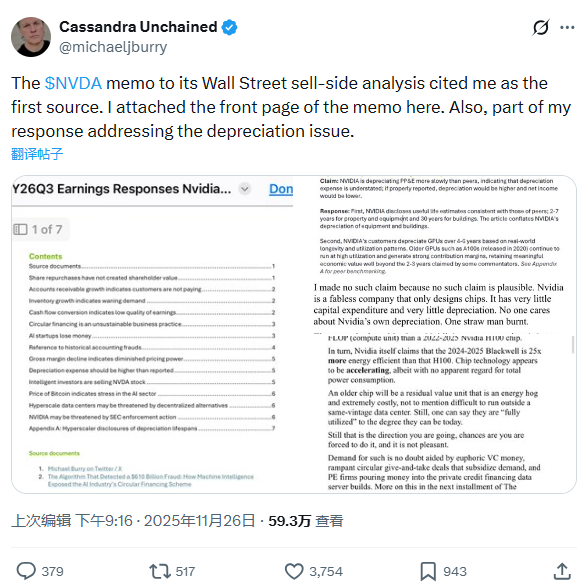
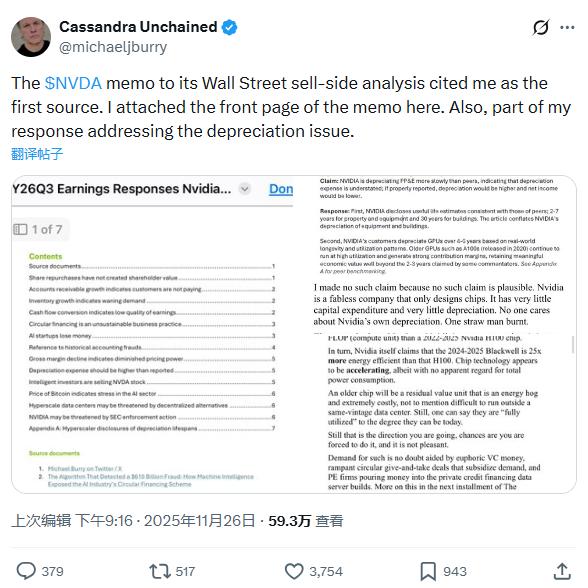
Core Viewpoint - The ongoing conflict between Michael Burry, known as the "Big Short," and Nvidia is intensifying, with Burry criticizing Nvidia's internal memo as disappointing and filled with "straw man arguments" [1][4]. Group 1: Burry's Critique - Burry expressed disbelief that a company of Nvidia's stature would respond to criticism with what he perceives as a misleading memo, which he described as reading "almost like a scam" [1]. - He continues to hold put options against Nvidia and Palantir, signaling his bearish outlook on these AI companies [3][9]. - Burry argues that Nvidia's memo misrepresents his criticisms, particularly regarding the depreciation policies of their fixed assets, which he claims are not the focus of his critique [4][6]. Group 2: Nvidia's Defense - Nvidia distributed a seven-page memo to Wall Street analysts to counter accusations of accounting fraud, circular financing, and an AI bubble, asserting that their financial reporting is robust and transparent [11]. - The company clarified that its customers typically depreciate GPUs over four to six years, countering claims that AI chips have a lifespan of only two to three years [11]. - Nvidia emphasized that its strategic investments in the third quarter were only $3.7 billion, a small fraction of its revenue, dismissing the notion of circular financing as unfounded [11]. Group 3: Market Reaction and Context - Following Burry's warnings and the release of earnings reports, Nvidia's stock has declined approximately 14% from its peak on November 3, indicating a shift in investor sentiment towards AI-related companies [2][10]. - Palantir's stock has also dropped 20% from recent highs, despite significant gains year-to-date, reflecting growing concerns about the sustainability of AI valuations [10].
“大空头 vs 英伟达”论战继续!“大空头”逐条反驳英伟达回应:不敢相信这来自全球市值最高公司
Hua Er Jie Jian Wen· 2025-11-27 01:08
Core Viewpoint - The ongoing conflict between Michael Burry, known as the "Big Short," and NVIDIA is intensifying, with Burry criticizing NVIDIA's internal memo as disappointing and filled with straw man arguments [1][3]. Group 1: Burry's Critique - Burry claims that NVIDIA's memo misrepresents his criticisms, addressing points he never made, particularly regarding the company's depreciation policies [5]. - He emphasizes that he has never questioned NVIDIA's fixed asset depreciation policy, stating that the company is primarily a chip designer with minimal capital expenditure [5]. - Burry warns that the rapid technological advancement in AI chips could lead to significant asset write-down risks for companies extending depreciation periods [8]. Group 2: Market Reaction and Positioning - Following Burry's criticisms, NVIDIA's stock has declined approximately 14% from its peak on November 3, indicating a shift in investor sentiment towards AI-related companies [2][11]. - Burry continues to hold put options against NVIDIA and Palantir, signaling his bearish outlook on these AI companies [3][10]. - The market has shown increased scrutiny of AI companies, with Palantir's stock also dropping 20% from recent highs, despite significant year-to-date gains [11]. Group 3: NVIDIA's Defense - In response to the criticisms, NVIDIA distributed a seven-page memo to Wall Street analysts, aiming to refute allegations of accounting fraud and circular financing [12]. - The company asserts that its depreciation practices align with industry standards, with customers typically depreciating GPUs over 4-6 years [14]. - NVIDIA emphasizes its leading position in the AI market, claiming to be the only company capable of running all AI models across various computing scenarios [12].