
趋势策略

Search documents
都叫CTA,怎么收益一个天上一个地下?
雪球· 2026-02-04 07:47
Group 1 - The overall performance of CTA strategies was strong last year, with an average return of 19% [3] - However, there was significant performance disparity among different CTA strategies, with some performing exceptionally well while others did not yield profits [4] - The classification of CTA strategies is essential to understand the reasons behind this performance variation [6] Group 2 - CTA strategies can be categorized based on the type of investor: either human or machine [9] - Subjective CTAs tend to have concentrated positions, which can lead to high returns but also higher volatility [11] - In contrast, quantitative CTAs diversify across multiple assets and timeframes, resulting in smoother performance [12] Group 3 - The duration of investment is another classification criterion, with short to medium-term strategies focusing on high-frequency data and being sensitive to market fluctuations [14] - Long-term strategies emphasize macro and fundamental analysis, using weekly or monthly indicators to capture major trends and filter out short-term noise [16] Group 4 - The two main investment approaches are trend-following and cross-sectional strategies [18] - Trend strategies involve going long on rising assets and short on falling ones, capitalizing on the continuation of trends [19] - Cross-sectional strategies involve buying relatively strong assets while selling weaker ones, profiting from the "strength-weakness spread" [24] Group 5 - The ideal environment for cross-sectional strategies is when there is significant differentiation among asset performances [26] - For example, in the first half of 2025, precious metals showed strong performance while energy assets lagged, benefiting cross-sectional strategies [28] - However, policy changes can disrupt these strategies, as seen in July when energy assets rebounded, impacting cross-sectional strategy performance [29] Group 6 - The combination of the three classification criteria allows for a rich variety of strategy types, such as subjective long-term trend strategies and quantitative short-term cross-sectional strategies [31] - The macroeconomic environment in 2025 was complex, favoring long-term trend strategies that could track trends while filtering out short-term disturbances [34] Group 7 - For investors with strong judgment on specific assets or trends, targeted selection of CTA strategies is advisable [36] - However, for most ordinary investors, it is recommended to choose multi-asset and multi-strategy CTAs to ensure more stable overall performance [39]


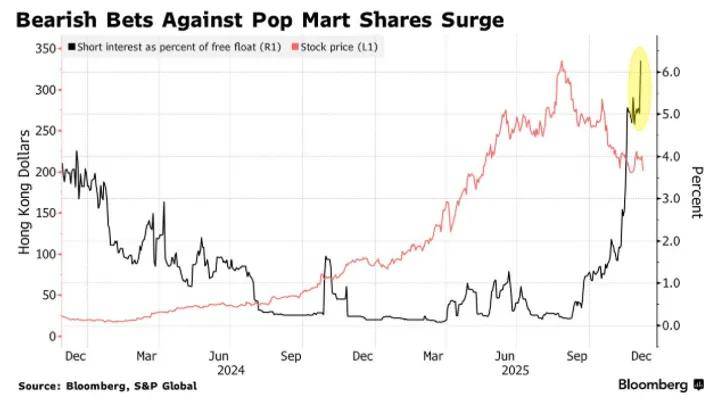
泡泡玛特大跌!做空新消费的人越来越多
Sou Hu Cai Jing· 2025-12-09 03:44
Core Viewpoint - The recent surge in short-selling funds against Pop Mart has led to a significant decline in its stock price, with the short-selling activity reaching a one-year high since September [1][4]. Group 1: Short-Selling Activity - The cumulative funds for short-selling Pop Mart have reached a new high over the past year, contributing to the continuous decline in its stock price [1]. - An increasing number of foreign institutions have published bearish views on Pop Mart, echoing concerns similar to those seen during the AI bubble, indicating a lack of immediate evidence to confirm or refute these views [4]. Group 2: Market Sentiment and Performance - The stock price of Pop Mart is expected to remain stagnant in the short term due to the absence of strong data supporting either bullish or bearish positions, leading to a stalemate [4]. - Concerns have been raised regarding the sustainability of high growth driven by the Labubu product, with fears of a high base effect impacting future performance [6][10]. Group 3: Future Outlook - The ideal time for bottom-fishing in Pop Mart would be when the premium expectations for Labubu diminish and market hopes for new hit products are low [5]. - Pop Mart is currently positioned between the expansion and peak phases of its product cycle, with market fears that it may soon transition into a downturn phase if new hit products are not developed [8][10].

低利率环境下债券市场投资研究的突围之路
Tianfeng Securities· 2025-08-14 05:44
Group 1: Report Industry Investment Rating - Not provided in the given content Group 2: Report's Core View - The bond market pricing logic has shifted from "asset - end" to "liability - end". A new framework based on "liquidity", "institutional behavior", and "relative value" is proposed to help institutions trade flexibly. The concept of fixed - income sell - side research also needs to change [8] Group 3: Summary by Relevant Catalogs 1. Current Bond Market's "Liability - End" Pricing Logic - **Key Variable for Interest Rate Fluctuation and Macroeconomic "Desensitization" - Money Velocity**: Interest rate and macro - economy relationship has become "desensitized". The link between interest rate changes and macro - economic trends assumes stable money velocity. Economic structural adjustment may have reduced money velocity, leading to a decline in nominal growth and a decrease in real - sector funding demand [9][10] - **Macro Observation of "Liability - End" Pricing of Interest Rate Trends - Relative Liquidity**: Interest rate pricing now depends more on the "liability - end" or the supply side of funds. With the weakening of real - sector financing demand, bond yields are more determined by the relative scale of funds chasing bonds, i.e., "relative liquidity" [15][16] - **Micro Observation of "Liability - End" Pricing of Interest Rate Trends - Institutional Allocation and Trading Power**: Institutional behavior is an intermediary variable affecting bond pricing. Institutions should be classified by "allocation behavior" and "trading behavior". Allocation behavior has seasonal characteristics, while trading behavior occurs in a short time and requires micro - confirmation [21][22] 2. Bond Investment Solutions in a Low - Interest - Rate Environment - Active Trading to Increase Returns - **Trading is a Process of Exchanging Liquidity for Returns**: Trading is not a zero - sum game but a process of exchanging liquidity for returns. Higher trading activity can bring liquidity premiums. Institutions can exchange liquidity for returns, and the central bank's policies aim to enhance market liquidity [29][30] - **Two Trading Strategies: Trend Strategy and Relative Value Strategy**: Trend strategy focuses on accurately judging the pricing factors of a target to follow the trend and gain returns, relying on grasping "common points". Relative value strategy focuses on finding the different pricing factors between related targets, reducing model complexity and analysis difficulty, and is a grasp of "differences" [32] - **Role of Two Trading Strategies' Logic in Allocation - Type Institutions**: For allocation - type institutions, timing corresponds to the logic of the trend strategy, and bond selection corresponds to the logic of the relative value strategy. When timing, they need to consider long - term and short - term factors; when selecting bonds, they need to judge the dynamic relative value [34] 3. New Framework for Bond Investment Research - Pyramid Pricing System Based on a Low - Interest - Rate Environment - **Triple Structure of the Pyramid Pricing System: Liquidity, Institutional Behavior, and Relative Value**: The bottom layer is the "liquidity" system, which includes macro, meso, and micro variables related to funds and bond liquidity. The middle layer is the "institutional behavior" system, which requires a complete and forward - looking research system. The upper layer is the "relative value" system, which shows the relative position of spreads but is not a decisive factor for relative value strategies [40][44][47] - **Building a Decision - Factor Tree for Relative Value Trading Strategies**: Select appropriate liquidity, institutional behavior, and relative value factors according to the target of a relative value trading strategy to build a decision - factor tree. Analyze each factor and assign weights to judge the strategy's win - rate and odds. Allocation - type institutions can transform their position adjustment problems into relative value trading strategies for analysis [51] 4. Understanding of the New - Era Fixed - Income Sell - Side Research Concept - In the high - interest - rate stage, fixed - income sell - side research provided macro - level information to support investment decisions. In the low - interest - rate stage, it should provide bottom - up market characteristics to support investment trading and position management, and its positioning should shift from "guiding direction" to "assisting execution" [54]