
网格交易

Search documents
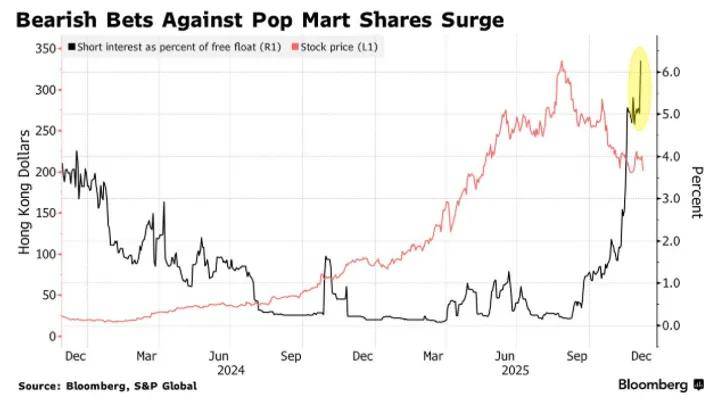
泡泡玛特大跌!做空新消费的人越来越多
Sou Hu Cai Jing· 2025-12-09 03:44
Core Viewpoint - The recent surge in short-selling funds against Pop Mart has led to a significant decline in its stock price, with the short-selling activity reaching a one-year high since September [1][4]. Group 1: Short-Selling Activity - The cumulative funds for short-selling Pop Mart have reached a new high over the past year, contributing to the continuous decline in its stock price [1]. - An increasing number of foreign institutions have published bearish views on Pop Mart, echoing concerns similar to those seen during the AI bubble, indicating a lack of immediate evidence to confirm or refute these views [4]. Group 2: Market Sentiment and Performance - The stock price of Pop Mart is expected to remain stagnant in the short term due to the absence of strong data supporting either bullish or bearish positions, leading to a stalemate [4]. - Concerns have been raised regarding the sustainability of high growth driven by the Labubu product, with fears of a high base effect impacting future performance [6][10]. Group 3: Future Outlook - The ideal time for bottom-fishing in Pop Mart would be when the premium expectations for Labubu diminish and market hopes for new hit products are low [5]. - Pop Mart is currently positioned between the expansion and peak phases of its product cycle, with market fears that it may soon transition into a downturn phase if new hit products are not developed [8][10].


一日售罄!这类ETF突然爆发,投资者为何痴迷?
证券时报· 2025-11-30 13:08
Core Viewpoint - The public fund industry is experiencing a surge in the issuance of industry-themed ETFs, driven by investors' preference for narrow-based ETFs over broad-based ETFs due to the structural characteristics of the A-share market [2][3][4]. Group 1: Market Trends - On November 28, the first batch of seven ETFs tracking the CSI Innovation and Entrepreneurship Artificial Intelligence Index was launched, with some products selling out on the first day [2][3]. - The total scale of narrow-based ETFs in the stock market has surpassed 1.6 trillion yuan, showing a growth rate of 100%, significantly higher than the less than 10% growth of broad-based ETFs [2][4]. - Investors are increasingly favoring narrow-based ETFs, with 18 ETFs attracting over 10 billion yuan in net inflows this year, all of which are narrow-based [4][5]. Group 2: Investor Behavior - The preference for narrow-based ETFs reflects a shift in investor strategy towards high-growth sectors like AI, semiconductors, and new energy, while traditional sectors like real estate are losing appeal [7][10]. - The trend of investing in narrow-based ETFs is expected to continue as investors seek to capture structural opportunities in high-growth industries [8][9]. - Investors are also utilizing strategies like grid trading and quantitative enhancements to achieve high-frequency trading in narrow-based ETFs, further driving their popularity [7]. Group 3: Performance and Risks - Narrow-based ETFs have shown significant volatility, with some experiencing substantial losses, highlighting the risks associated with concentrated investments [8][10]. - The average turnover rate of narrow-based ETFs is much higher than that of broad-based ETFs, indicating a tendency for investors to frequently adjust their positions [9]. - The concentration of funds in popular narrow-based ETFs can inflate valuations and increase the risk of market corrections, particularly if there is a sudden withdrawal of capital [9][10].
ETF及指数产品网格策略周报-20251125
HWABAO SECURITIES· 2025-11-25 09:06
Group 1: Overview of Grid Trading Strategy - The essence of "grid trading" is a high buy low sell strategy, which does not predict market trends but utilizes natural price fluctuations within a certain range to generate profits, making it suitable for frequently fluctuating markets [3][12] - Characteristics of suitable grid trading targets include: selecting on-market targets, stable long-term trends, low trading costs, good liquidity, and high volatility, with equity ETFs being relatively appropriate for grid trading [3][12] Group 2: Analysis of ETF Grid Strategy Targets - The Hang Seng Innovation Drug ETF (520500.SH) focuses on China's innovative drug pipeline, which ranks second globally, with significant policy support enhancing commercialization and internationalization opportunities [3][13] - The Military Industry ETF (512560.SH) is expected to benefit from a new round of military procurement cycles driven by the "14th Five-Year Plan" and increasing defense budgets, which are projected to reach 1.81 trillion yuan in 2025, a 7.2% increase year-on-year [4][14] - The Wine ETF (512690.SH) is characterized by price fluctuations within a certain range and is currently at a historical low valuation, making it suitable for grid strategies, with a daily average fluctuation of 1.77% as of November 21, 2025 [5][17] - The Sci-Tech Chip Design ETF (588780.SH) aims to capitalize on the AI and domestic substitution trends, focusing on the design segment of the chip industry, which is crucial for technological independence and security [6][18]
靠网格交易薅市场波动的羊毛?小心它悄悄偷走你的牛市收益
雪球· 2025-11-01 13:01
Group 1 - The article discusses the increasing popularity of "grid trading" as a strategy during market volatility, viewed as a "worry-free tool" for achieving low buy and high sell automatically, thereby enhancing returns [3][10] - Grid trading is defined as an automated trading strategy based on market price fluctuations, where funds are divided into several parts and a price range is predetermined, creating a "price grid" [4][6] - The strategy involves buying assets when prices drop to a certain level and selling when prices rise, aiming to profit from the price differences through repeated transactions [5][9] Group 2 - The article highlights the limitations of grid trading, particularly its ineffectiveness in trending markets, whether upward or downward [14][26] - An example using the CSI 300 ETF illustrates that a direct investment would yield a cumulative return of 84.47%, while grid trading resulted in only 41.89% after transaction costs [18][21] - The reasons for the performance gap include the risk of "selling out" during upward trends, low capital utilization due to the need to keep funds available for buying, and significant transaction costs associated with frequent trading [21][24][22] Group 3 - The article emphasizes that grid trading sacrifices long-term compounding benefits for short-term arbitrage opportunities, making it unsuitable for long-term wealth accumulation [39][47] - It argues that the fundamental logic of long-term investing is to hold quality assets to share in societal wealth growth, which contradicts the price fluctuation assumptions of grid trading [29][30] - Historical data shows that markets, including the A-share market, have a long-term upward trend, reinforcing the idea that holding assets is more beneficial than frequent trading [34][35] Group 4 - The article points out the challenges of timing the market, as distinguishing between a trending and a ranging market is often only clear in hindsight, making it difficult for most investors [41][44] - Successful grid trading requires a deep understanding of market parameters, such as grid spacing and price ranges, which can be complex for average investors [42][43] - The article concludes that while grid trading can be effective in short-term volatile markets, it is not a viable long-term wealth management strategy [46][47]

ETF及指数产品网格策略周报-20251021
HWABAO SECURITIES· 2025-10-21 08:28
Group 1: Overview of Grid Trading Strategy - The essence of "grid trading" is a high buy low sell strategy, which differs from trend trading that relies on long-term market predictions. Grid trading is based on price fluctuations and aims to profit from natural price movements within a certain range, making it suitable for frequently fluctuating markets. In a volatile market, investors can enhance returns by repeatedly capturing small price differences before adjusting positions and strategies when a new market direction becomes clear [4][12]. Group 2: Characteristics of Suitable Grid Trading Targets - Suitable characteristics for grid trading targets include: 1) selection of on-market targets; 2) stable long-term trends; 3) low transaction costs; 4) good liquidity; 5) high volatility. Based on these characteristics, equity ETFs are considered relatively suitable for grid trading [4][12]. Group 3: Analysis of ETF Grid Trading Targets - The report highlights three key ETFs for grid trading: 1. **Saudi ETF (159329.SZ)**: This ETF is one of the two domestic tools linked to the Saudi capital market, capturing the long-term economic transformation benefits under Saudi's "Vision 2030". The plan aims to reduce oil dependency and diversify the economy, with strategic goals including increasing the non-oil GDP share from 16% to at least 50% and elevating Saudi's global economic ranking from 19th to 15th. As of October 20, the financial sector accounted for over 40% of the ETF's holdings, with consumer and technology sectors exceeding 20%, while traditional fossil energy represented only about 10% [4][13]. 2. **Banking ETF (512800.SH)**: This ETF, tracking the CSI 800 Banking Index, has a dividend yield of 4.40% as of September 30, 2025, significantly higher than the market average and the ten-year government bond yield. It is expected to remain a key allocation direction for medium to long-term funds, particularly from insurance companies, as they seek to mitigate the impact of declining interest rates and address "asset scarcity" [5][15]. 3. **Military Industry ETF (512660.SH)**: The report notes that China's defense budget for 2025 is set at 1.81 trillion yuan, a 7.2% increase year-on-year, marking a historical high. However, this budget still represents less than 1.3% of GDP, significantly lower than the U.S. and Russia. The ETF tracks the CSI Defense Index, focusing on core areas such as aviation equipment, missiles, and new materials, and is expected to benefit from improvements in the defense sector's fundamentals [6][7][17]. Group 4: Recommendations for Grid Trading Strategy - Investors are advised to use grid trading strategies by selecting several suitable ETFs with low correlation to form a diversified portfolio. This can include combinations of different types of ETFs, such as "broad-based + sector" or "A-shares + Hong Kong stocks", which not only helps to spread risk but also enhances capital utilization through rotation effects [20][21].
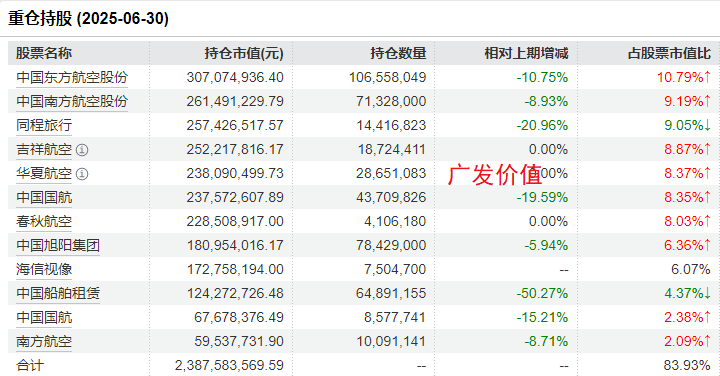
顺势高低切换!组合开始向低位方向调仓了
Sou Hu Cai Jing· 2025-10-17 22:00
Core Viewpoint - The investment strategy involves reallocating funds into the Guangfa Value Leading Mixed Fund, which focuses on sectors with potential for recovery, particularly in tourism and aviation, despite recent market downturns [1]. Fund Reallocation - The reallocation targets the Guangfa Value Leading Mixed Fund, which is characterized as a fund focused on the "airline + OTA platform" sector, effectively functioning like an index ETF while being actively managed [1]. - The rationale for this reallocation is to take profits from funds that have appreciated significantly and invest in those with lower growth, aiming to control portfolio drawdowns [1]. Sector Analysis - **Aviation Sector**: - The aviation industry faces challenges due to a decline in business travel and reduced consumer spending, impacting passenger numbers [5]. - Factors such as currency exchange rates, fuel costs, and aircraft supply are seen as favorable for the aviation sector, with a potential for recovery if consumer demand improves [6][12]. - Recent data indicates a strong willingness among consumers to travel, with domestic travel during the recent holiday period reaching 888 million trips, a 16% increase year-on-year [12]. - **Tourism Sector**: - The tourism sector is divided into four sub-sectors: duty-free (China Duty-Free Group and Shanghai Airport), attractions (Songcheng Performance and Overseas Chinese Town), airlines (Eastern Airlines, Southern Airlines, Air China, Spring Airlines), and hotels (Jinjiang and Shouqi) [4]. - The duty-free segment is struggling with declining consumer purchasing power, leading to reduced profit margins [4]. - The attractions sector is volatile, with visitor numbers fluctuating significantly, impacting financial stability for many companies [4]. - The hotel industry is facing intense competition, with new entrants emerging post-pandemic, leading to continued market saturation [4]. Investment Outlook - The aviation and duty-free sectors are viewed as having potential investment value, contingent on a recovery in consumer spending [5]. - The overall sentiment suggests that while the tourism and hotel sectors may present risks, the aviation sector could see significant upside if consumer demand is stimulated through effective policy measures [12].

ETF及指数产品网格策略周报-20251014
HWABAO SECURITIES· 2025-10-14 08:33
Group 1: Overview of Grid Trading Strategy - The essence of "grid trading" is a high buy low sell strategy, which differs from trend trading as it does not predict market trends but instead capitalizes on natural price fluctuations within a certain range to generate profits, making it suitable for frequently fluctuating markets [3][10] - Characteristics of suitable grid trading targets include: selecting on-market targets, stable long-term trends, low transaction costs, good liquidity, and high volatility, with equity ETFs being particularly appropriate for grid trading [3][10] Group 2: Analysis of ETF Grid Strategy Targets - The Saudi ETF (159329.SZ) is one of the only two instruments linked to the Saudi capital market, capturing the long-term economic transformation dividends under Saudi Arabia's "Vision 2030," which aims to reduce oil dependency and diversify the economy [3][11] - As of October 13, 2025, the Saudi ETF's underlying holdings show over 40% in the financial sector, over 20% in consumer and technology sectors, and only about 10% in traditional fossil energy, reflecting a diversified and emerging industry structure [3][11] - The Tourism ETF (159766.SZ) is a key driver in China's shift from investment-driven to consumption-driven growth, supported by government measures to stimulate domestic tourism consumption, with significant increases in domestic travel and spending during the 2025 National Day and Mid-Autumn Festival holidays [4][14]
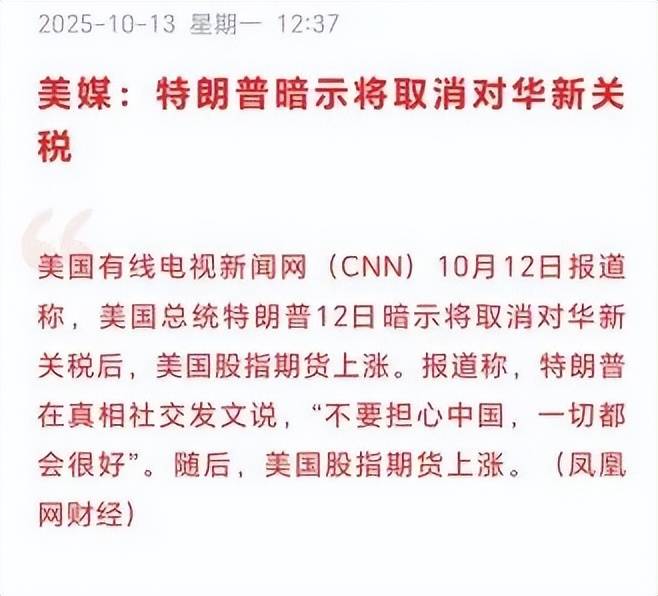
美国那边又搞事?复盘历次冲击后市场走势
Sou Hu Cai Jing· 2025-10-13 13:58
Market Overview - The US stock market experienced a significant decline last Friday, with Hong Kong stock futures dropping by 5%, causing distress among investors [1] - However, the market sentiment shifted quickly, with US stock futures rebounding before the opening, leading to a recovery in the Hong Kong market later in the day [1] Historical Context - Since 2018, market fluctuations have been heavily influenced by external events, particularly those initiated by "Old Trump," affecting both US and Hong Kong markets [2] - The market has gone through multiple bull and bear cycles, with notable downturns following significant events, such as a 5.58% drop after the May Day holiday in 2019 [2][4] - The overall market trend from 2018 to the present has shown that while external events can cause short-term declines, the medium-term trend is more influenced by domestic policies and liquidity conditions [6] Current Market Dynamics - The current market is characterized by strong performance in sectors such as rare earths, semiconductors, and military industries, while overseas-related sectors like automotive parts and consumer electronics are underperforming [6] - The upcoming third-quarter earnings reports are expected to validate the positive outlook for certain sectors, particularly in military and technology [6] Future Outlook - The timing of the upcoming summit at the end of October is seen as critical, with potential for market recovery if tensions ease [7] - The market is currently showing a favorable stock-bond yield spread of 5.28%, indicating a relatively high attractiveness of equities compared to bonds [10] Trading Strategies - A grid trading strategy has been activated for 20 trading varieties, with specific ETFs in sectors like consumption, real estate, and new energy showing activity [8] - Quantitative signals indicate trends in broad indices such as the ChiNext 50 and the Sci-Tech 50, suggesting potential investment opportunities [9]
盘中又有消息!但芯片一些风险要注意了
Sou Hu Cai Jing· 2025-09-24 20:45
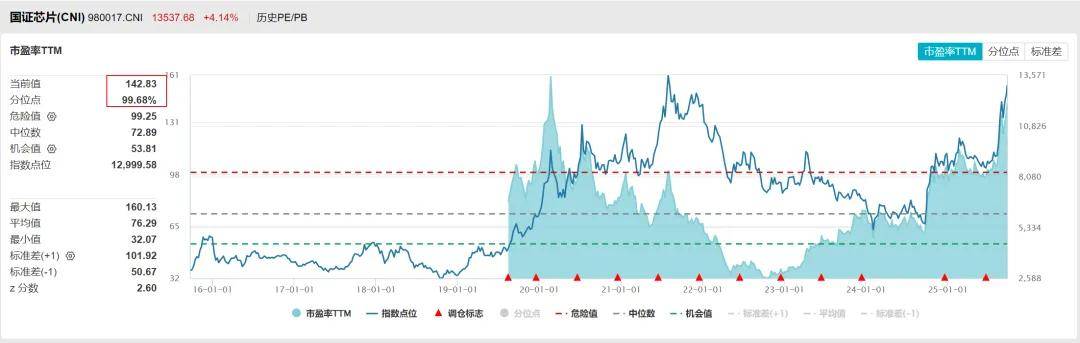
Group 1 - The semiconductor ETFs experienced significant gains, with the chip leader ETF rising by 5% and the semiconductor equipment ETF soaring by 8% due to rumors about a domestically developed EUV lithography machine expected to enter trial production in Q3 2025 and achieve mass production in 2026 [1] - The current PE valuation of the chip index has reached 143 times, placing it in the 99th percentile, the highest level since the index's inception, even surpassing the peak in 2021 [2][4] - The PB valuation of the chip index stands at 7.46 times, which is in the 83.71 percentile, indicating that while it is not as high as the PE valuation, it is still at a historically elevated level [4] Group 2 - Despite the high valuations, many investors remain cautious due to past experiences with high-valuation sectors like liquor, healthcare, and new energy, where significant losses were incurred despite stable profit growth [6][9] - Companies like Kweichow Moutai and CATL have seen their PE valuations drop significantly, with Moutai's PE decreasing from 70 times to 20 times, while CATL's dropped from 160 times to 29 times, highlighting the impact of valuation on stock performance [8][11] - The trend model strategy is proposed as a solution for navigating high-valuation environments, allowing investors to hold onto stocks as long as they maintain an upward trend, thus avoiding significant losses during market downturns [14][17] Group 3 - Alibaba announced a significant investment of 380 billion in AI infrastructure and a partnership with NVIDIA, leading to a 10% increase in its stock price, although it still needs to rise 40% to reach its previous high [19] - The ongoing investment in new energy by China contrasts with the U.S. approach, which may lead to China dominating the global new energy sector in the future [19]
ETF及指数产品网格策略周报-20250923
HWABAO SECURITIES· 2025-09-23 08:52
Group 1 - The core idea of the report emphasizes the grid trading strategy, which is a high buy-low sell approach that capitalizes on price fluctuations rather than predicting market trends, making it suitable for volatile markets [3][11] - The report identifies key characteristics for suitable grid trading targets, including selecting on-market assets, stable long-term trends, low transaction costs, good liquidity, and high volatility, with equity ETFs being particularly appropriate [3][11] Group 2 - The report highlights two main ETFs for grid trading: - The New Economy ETF (159822.SZ), which focuses on high-quality new economy leaders in China, aligning with government initiatives to promote technological and industrial innovation, and indirectly tracks the S&P China New Economy Index [3][12] - The Financial ETF (510230.SH), which provides a defensive high dividend yield through banks and captures performance recovery through securities and insurance sectors, with banks showing a dividend yield of 5.86% as of June 30, 2025, significantly above market averages [4][14] - The report suggests that investors can enhance returns by combining multiple ETFs with low correlation, such as mixing broad-based and sector-specific ETFs or combining A-shares and Hong Kong stocks [14][16]