
跨域协作

Search documents
走出大山、走向全国,甘肃叫响“甘味”劳务品牌
Xin Lang Cai Jing· 2026-02-26 19:41
Core Viewpoint - Gansu has positioned labor brand development as a key strategy for stabilizing employment, increasing income, and promoting revitalization, aiming to create 75 provincial labor brands by the end of 2025, which will support over 1.4 million stable jobs and entrepreneurial opportunities [1][2]. Group 1: Labor Brand Development - Gansu has transitioned from a spontaneous labor output model to a systematic cultivation approach, focusing on quality improvement rather than just quantity expansion [2]. - The "Lanzhou Noodle Master" and other labor brands have generated cross-regional effects, creating job opportunities for over 1 million people in Gansu, Qinghai, Ningxia, and Henan [2]. - The provincial government has launched a plan to enhance labor brand cultivation from 2026 to 2028, aiming to exceed 100 provincial brands by 2028 [2]. Group 2: Skills Training - Skills training has become essential for establishing a solid foundation for labor brands, shifting from a reliance on informal networks to structured training programs [3]. - Gansu has implemented a four-part service model combining job demand, skills training, skills evaluation, and employment guidance, resulting in over 300,000 training sessions conducted in the past three years [3][4]. - The introduction of standardized training courses, such as the "Lanzhou Beef Noodle Making" digital course, has been adopted in over 200 vocational schools and training institutions nationwide, aiming to train 50,000 qualified noodle chefs annually [4]. Group 3: Differentiated Brand Cultivation - Gansu has established a four-tier cultivation mechanism to avoid brand homogenization, focusing on local resources and unique cultural attributes [5][6]. - Local specialties, such as "Dunhuang Floral Artist" and "Yugur Embroidery Master," have been developed to leverage regional cultural resources [5]. - The province aims to conduct over 100,000 labor brand skill training sessions within three years, promoting the concept of "one county, one product" [6]. Group 4: Cross-Regional Collaboration - Gansu is breaking regional barriers to promote labor brands from local to national levels, signing agreements with Shandong and Ningxia for labor cooperation [7]. - In 2025, Gansu facilitated the transfer of 52,000 rural laborers through collaborative mechanisms with other provinces [7]. - Traditional state-owned enterprises are also participating in labor brand initiatives, such as training 500 petrochemical skilled workers for Turkmenistan [7]. Group 5: Integration with Industry - Labor brands are evolving from mere employment identifiers to integral parts of local industries, enhancing related sectors such as processing, packaging, and logistics [8]. - The "Lanzhou Noodle Master" brand is not only providing labor but also driving the development of associated industries [8]. - The ongoing actions are expected to inject continuous momentum into high-quality employment and comprehensive rural revitalization [8].
“娇龙”月季情牵两地 云南呈贡收到新疆昭苏《感谢信》
Xin Lang Cai Jing· 2026-02-13 09:01
Core Insights - The "Jiaolong" rose has been officially named and recognized, symbolizing a connection between Kunming, Yunnan, and Zhaosu, Xinjiang, reflecting a commitment to community service and collaboration [1][2] - The rose's naming and subsequent transfer to Zhaosu County is seen as a significant cultural and emotional gesture, promoting unity and cooperation between the two regions [1][2] Group 1 - The "Jiaolong" rose was named after a public naming event, with the name receiving overwhelming support, leading to an early conclusion of the naming process [1] - A letter of gratitude from Zhaosu County highlights the rose as a symbol of high moral character and resilience, bridging the cultural essence of both regions [1] - The initiative aims to strengthen future collaborations in areas such as industrial development, cultural tourism, and rural revitalization [1] Group 2 - The "Jiaolong" rose was officially handed over to Zhaosu County on February 2, 2026, and successfully arrived the following day [2] - The breeding team from the Yunnan Academy of Agricultural Sciences announced that all intellectual property fees and sales revenues from the "Jiaolong" rose will be donated to public welfare [2] - A partnership was established between Kunming Chenggong and Xinjiang Agricultural University to ensure that all proceeds from the rose will support rural revitalization and public welfare initiatives in Xinjiang [2]
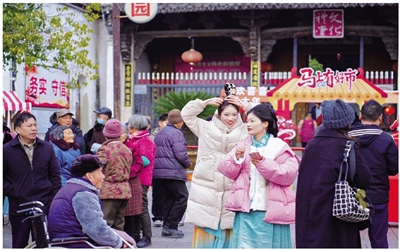
“荷风市集”三地联办 年货节成共富协作新窗口
Hang Zhou Ri Bao· 2026-02-03 03:35
Core Viewpoint - The "Lotus Wind Market" in Li Village, Dajiangyan Town, showcases a collaborative effort among three regions to promote local specialties and cultural integration, highlighting the success of cross-regional cooperation for common prosperity [2][3] Group 1: Event Overview - The "Lotus Wind Market" features over 40 stalls selling local agricultural products, traditional cultural creations, and authentic cuisine from Dajiangyan, Lanxi, and Longyou [2] - The event serves as a platform for cultural exchange, with activities such as writing Spring Festival couplets and watching folk performances, enhancing the festive atmosphere [2] Group 2: Collaborative Efforts - The collaboration among Dajiangyan, Zhuge, and Hengshan towns is driven by joint party building and the "Zhexi Lian" brand, achieving significant results in industry development, cultural integration, and shared governance [2][3] - The initiative aims to transform the regions from "boundary lowlands" to "common prosperity highlands" through various collaborative measures, including talent attraction and public service improvements [3] Group 3: Talent Development - A "Talent Service Zone" was established at the market to facilitate job opportunities and entrepreneurial policy consultations, promoting a two-way engagement between local talent and their hometown [3] - The "Qing Cheng Ji He Partners Program" was launched to invite professionals from outside to return and contribute to the regions' development, injecting expertise into the collaborative efforts [3]

成都环境资源法庭:用心守护“一江清水”
Ren Min Wang· 2025-04-28 00:40
Core Points - The Supreme People's Court's work report emphasizes the importance of ecological protection and strict punishment for environmental crimes, particularly in the Yangtze River and Yellow River basins [1] - The establishment of the Chengdu Environmental Resource Court aims to enhance judicial protection for the Yangtze River's upper reaches, focusing on comprehensive and systematic environmental protection [1][2] - The court has adopted a professional and innovative approach to environmental cases, ensuring that ecological damage assessments are integral to judicial decisions [2][3] Group 1: Judicial Actions and Cases - The Chengdu Environmental Resource Court has handled various environmental cases, including a significant case involving illegal sand mining that resulted in a compensation ruling of over 54 million yuan for ecological damages [2][3] - The court's approach includes detailed assessments of ecological damage, emphasizing the need for judges to understand both legal and technical aspects of environmental cases [3] - A notable case involved a villager causing a forest fire, where the court mandated compensation for firefighting costs, marking a precedent in supporting third-party rescue expenses in environmental lawsuits [4][5] Group 2: Ecological Restoration and Collaboration - The Chengdu Environmental Resource Court has introduced innovative restorative justice measures, such as the "wild release" of confiscated wildlife, which has been recognized as a successful ecological restoration method [6][7] - The court has established partnerships with various organizations to create restoration bases, enhancing the effectiveness of ecological restoration efforts [8] - Collaborative efforts extend to international platforms, where the court advocates for shared experiences in environmental governance [10][11] Group 3: Public Awareness and Education - The court has engaged in public education initiatives, including art exhibitions that promote ecological justice concepts, aiming to foster a culture of environmental protection within society [12][13] - Over 21 public awareness activities have been organized, reaching more than 30,000 participants, highlighting the court's commitment to community involvement in environmental issues [13]