跨境铁路建设

Search documents
煤炭开采行业专题研究:蒙古:跨越戈壁的煤炭动脉供需梳理
GOLDEN SUN SECURITIES· 2026-02-13 02:24
Investment Rating - The report provides a positive investment rating for the coal mining industry in Mongolia, highlighting its rich resources and potential for growth in exports, particularly to China [19][25]. Core Insights - Mongolia has abundant coal resources, with proven reserves of 252 million tons as of the end of 2020, including 135 million tons of lignite and brown coal, and 117 million tons of anthracite and bituminous coal [7][11]. - The coal mining sector is crucial for Mongolia's economy, with coal accounting for over 90% of the country's primary energy consumption, primarily used for power generation and exports [24][25]. - The report emphasizes the strategic importance of coal exports to China, which accounted for 94.9% of Mongolia's coal exports in 2024, showcasing the reliance on this market for growth [22][25]. Summary by Sections Coal Resource Overview - Mongolia's coal resources are mainly distributed across five regions, with the northern and southern areas being the most productive, contributing to 99% of the total output [7][11]. - The country has approximately 300 coal mines, with a significant portion of high-quality coking coal suitable for metallurgical processes [11][19]. Production and Export Trends - Coal production in Mongolia has seen fluctuations, with a peak of 32 million tons in 2011, primarily driven by export demand [21]. - The report forecasts a cumulative coal production of 97.72 million tons by 2024, reflecting a compound annual growth rate (CAGR) of 10.3% from 2013 to 2024 [21]. - In 2025, coal production is expected to slow down due to a decline in demand from the Chinese coking coal market [21]. Infrastructure and Trade Ports - Key coal export ports include Gashuunsukhait, Tsagaan Khad, and Mandula, with ongoing improvements in cross-border railway and logistics infrastructure to enhance export capacity [28][32]. - The report outlines various railway projects aimed at increasing coal export volumes by approximately 4 million tons annually [32]. Company Insights: Mongolian Coal - Mongolian Coal is identified as the largest high-quality coking coal producer and exporter in Mongolia, with a diversified resource portfolio including gold and copper [40][41]. - The company has strategically shifted towards resource diversification, reducing reliance on coal by expanding into gold and copper mining [46][90]. - As of mid-2025, the company reported total coal reserves of 612 million tons, with a focus on enhancing production capabilities and market presence [56][61]. Financial Performance - The company's revenue has shown significant growth, particularly from 2015 to 2019, driven by increased demand from infrastructure projects in China [55]. - The report notes a typical cyclical fluctuation in revenue, with a notable increase in 2022 and 2023, followed by a decrease in the first half of 2025 [55][61]. Cost Structure and Pricing - The report details the cost structure of coal production, with average costs remaining stable around $77 per ton from 2018 to the first half of 2025 [71]. - Pricing strategies are influenced by market dynamics, with a focus on maintaining competitive pricing in the context of international coal markets [68][70].
时隔70年!中蒙第二条跨境铁路开工,对能源贸易意味着什么
Di Yi Cai Jing· 2025-05-18 10:51
Core Points - The construction of a new cross-border railway between China and Mongolia has commenced, connecting the Ganqimaodu port in Inner Mongolia to the Gashuunsukhait port in Mongolia, which will enhance energy cooperation between the two countries [1][5] - This railway is significant as it is the second cross-border railway built between China and Mongolia in nearly 70 years, following the completion of the Erlianhot-Zamyn-Uud railway in 1956 [1][5] - The Ganqimaodu port is the largest road port in Inner Mongolia in terms of trade volume and is crucial for coal imports from Mongolia, with significant contributions to Mongolia's fiscal revenue [1][3] Industry Summary - The new railway is expected to double the customs clearance capacity at the port, potentially increasing Mongolia's coal export volume to 165 million tons, generating an additional annual revenue of $1.5 billion [6] - The railway will facilitate the transportation of coal from the Tavan Tolgoi mine, which has an estimated reserve of 6.5 billion tons, making it one of the largest undeveloped open-pit coal mines in the world [3] - Currently, coal imports from Mongolia primarily rely on road transport, but the new railway will significantly reduce transportation costs and enhance the stability of coal imports, minimizing weather-related disruptions [3][5] Trade Relations - China has been Mongolia's largest trading partner and a significant source of investment for several years, with bilateral trade expected to reach $18.263 billion in 2024, reflecting a 10% year-on-year growth [4] - The cross-border railway project is a joint effort between the two countries, with investments from both sides aimed at improving infrastructure and connectivity [5] - The completion of this railway will strengthen Mongolia's position as a long-term and reliable coal supplier to China, enhancing bilateral energy cooperation [6]

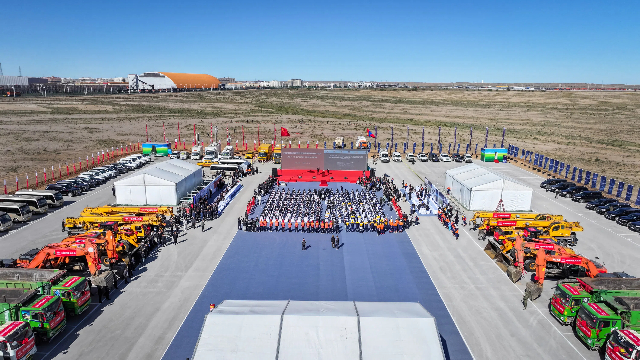
第二条中蒙跨境铁路开工建设
Ke Ji Ri Bao· 2025-05-15 00:56
Group 1 - The construction of the second cross-border railway between China and Mongolia, connecting Ganqimaodu to Gashuunsukhait, has officially commenced, marking a significant development in energy cooperation between the two countries [1] - This project is a collaboration between China and Mongolia, with the railway starting from Ganqimaodu port in Inner Mongolia and connecting to Gashuunsukhait station in Mongolia's South Gobi Province [1] - The project consists of two main components: the cross-border railway bridge and the domestic railway station construction at Ganqimaodu, with the Chinese segment being invested and constructed by the National Energy Group, aiming for completion by 2027 [1] Group 2 - The preliminary supporting project, the Ganquan Railway, is already operational, and the new railway will enhance connectivity with Mongolia's southern railways [2] - The completion of this project is expected to expand trade in energy resources between the two countries, promote infrastructure connectivity, and boost cross-border logistics and trade services [2] - This initiative is anticipated to foster a new chapter of integrated development and mutually beneficial trade between China and Mongolia [2]
中蒙两国第二条跨境铁路今天开工
news flash· 2025-05-14 04:29
Group 1 - The core point of the article is the commencement of the construction of the second cross-border railway between China and Mongolia, specifically the railway from Ganqimaodu, China to Gashuun Sukhait, Mongolia [1] - This new railway project marks the second cross-border railway between the two countries since the completion of the first railway from Erenhot to Zamiin-Uud in 1956, indicating a significant development in cross-border infrastructure [1]