杭州湾跨海铁路大桥

Search documents
中国最长的跨海大桥,要来了
虎嗅APP· 2026-03-12 10:24
Core Viewpoint - The article discusses the significance of the newly planned cross-sea transportation projects in the Hangzhou Bay area, particularly the Shanghai-Ningbo cross-sea passage, which is expected to enhance connectivity and economic integration in the Yangtze River Delta region. Group 1: Infrastructure Development - The Shanghai-Ningbo cross-sea passage is included in the national 14th Five-Year Plan, indicating a major investment exceeding 100 billion yuan for this super project [6][4]. - The new passage will span 70 kilometers, surpassing the Hong Kong-Zhuhai-Macao Bridge, and will be the longest cross-sea bridge in China upon completion [20]. - The project aims to create a dual-use transportation system for both road and rail, significantly reducing travel time between Shanghai and Ningbo to just over one hour [22]. Group 2: Economic Integration - The Shanghai metropolitan area is evolving into a "province-like" entity, with the cross-sea passage being a strategic move to enhance the integration of the Yangtze River Delta [27]. - The metropolitan area plan encompasses 14 cities in the Yangtze River Delta, establishing it as the largest urban agglomeration in China [28]. - Ningbo is projected to have a GDP of 1.87 trillion yuan by 2025, positioning it as a significant economic player within the metropolitan area [33]. Group 3: Future Projects - In addition to the Shanghai-Ningbo passage, another major project, the Shanghai-Zhoushan-Ningbo cross-sea passage, is also in the pipeline, with a length of 160 kilometers and a higher complexity [25]. - The article highlights the ongoing discussions regarding other major cross-sea projects, such as those in the Taiwan Strait, Bohai Strait, and Qiongzhou Strait, which are still under consideration and face various strategic, technical, and economic challenges [40][48].

杭州湾跨海铁路大桥攻克五项“世界第一”挑战 2027年底具备开通条件
Xin Lang Cai Jing· 2026-02-06 05:16
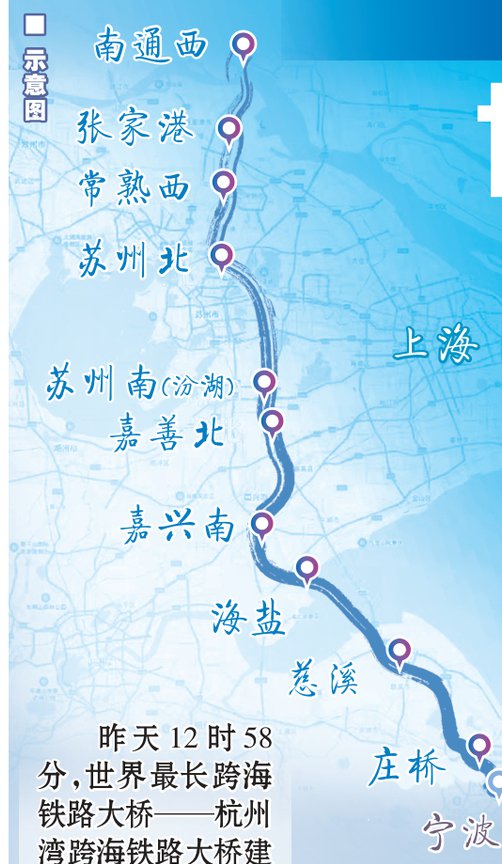
Core Viewpoint - The Hangzhou Bay Cross-Sea Railway Bridge, the longest cross-sea high-speed railway bridge in the world, has reached a significant construction milestone with the successful topping of the main tower of Pier 8, achieving 70% overall construction progress and expected to be operational by the end of 2027 [1][6]. Group 1: Project Overview - The bridge spans 29.2 kilometers with a design speed of 350 km/h, serving as a critical control project for the Tongzhou-Ningbo High-Speed Railway [1][6]. - It is a key hub in the national "Eight Vertical and Eight Horizontal" high-speed rail network along the coast, promoting integrated development in the Yangtze River Delta and enhancing regional connectivity [1][6]. Group 2: Engineering Achievements - The bridge boasts five "world firsts," including the largest span of a ballastless track cable-stayed bridge under construction at 450 meters and the largest span of a ballastless track three-tower double-cable steel truss bridge at 448 meters [2][7]. - The bridge's underwater approach features a 80-meter main span of prestressed concrete continuous beams with a maximum continuous length of 3080 meters, setting world records for long spans and seamless lines [2][7]. - It is the first high-speed railway cross-sea bridge built in a strong tidal bay, overcoming severe environmental challenges such as strong tides, currents, and frequent typhoons [2][7]. Group 3: Project Management and Monitoring - The project is supervised by the China Consulting Engineering Management Co., which has implemented a comprehensive monitoring system addressing challenges like strong tides and corrosion [3][8]. - The project team has developed over 50 monitoring guidelines and introduced 12 innovative measures to ensure precision in the construction process, achieving a 100% weld qualification rate [3][8]. - Real-time monitoring of the lifting process and beam segment alignment has been established, allowing for precise positioning of steel beams during construction [5][8].
杭州湾跨海铁路大桥首座主塔封顶
Ke Ji Ri Bao· 2026-01-19 01:26
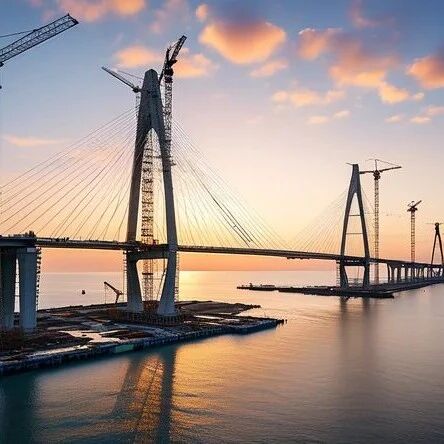
Group 1 - The Hangzhou Bay Cross-Sea Railway Bridge, the longest cross-sea railway bridge in the world, has reached a significant milestone with the successful topping of the main tower No. 8, which stands at 200 meters high [1] - The bridge is a key project of the Tongzhou-Ningbo High-Speed Railway, spanning 29.2 kilometers and featuring a dual-line ballastless track design for speeds of up to 350 km/h [1] - The bridge consists of three navigation bridges and a total of 26 kilometers of sea and shallow water approach bridges, with the northern navigation bridge being the largest span ballastless cable-stayed bridge under construction globally, measuring 932.7 meters in length and a main span of 450 meters [1] Group 2 - The main pier of the northern navigation bridge utilizes 52 piles with a diameter of 2.5 meters and a maximum depth of 150 meters, designed to penetrate complex seabed layers and ensure structural safety [2] - Innovative construction techniques, such as the "large double-wall steel caisson with full load and high-precision synchronous control," have been employed to create a stable working platform at sea [2] - The main tower is composed of multiple sections with high precision requirements, and the anchorage area for the stay cables employs a combination of steel anchor beams and steel brackets, requiring precise integration at significant heights [2]
世界最长跨海铁路大桥首座主塔封顶
Xin Lang Cai Jing· 2026-01-17 07:27
Core Viewpoint - The construction of the Hangzhou Bay Cross-Sea Railway Bridge, the world's longest cross-sea railway bridge, has reached a significant milestone with the successful topping of the main tower of the North Navigation Bridge, marking a major progress in this super engineering project [3][4]. Group 1: Project Overview - The Hangzhou Bay Cross-Sea Railway Bridge is a key project of the Tongzhou-Ningbo High-Speed Railway, spanning 29.2 kilometers and featuring three navigation bridges and a 26-kilometer long sea and shallow water approach bridge [4]. - The North Navigation Bridge, measuring 932.7 meters, is designed as the world's largest span ballastless track cable-stayed bridge, with a main span of 450 meters [4]. Group 2: Engineering Challenges - The bridge is located in a challenging marine environment characterized by strong tides, rapid currents, and frequent typhoons, with an average of 180 days of winds above level six annually and a maximum tidal range of nearly 9 meters [4]. - To ensure structural safety, the main pier of the North Navigation Bridge employs 52 drilled piles with a diameter of 2.5 meters and a maximum depth of 150 meters, effectively penetrating complex seabed layers [4]. Group 3: Innovative Construction Techniques - The project team has implemented innovative construction techniques, including a "large double-walled steel caisson" method, creating a robust "land-based working platform" at sea [5][6]. - A smart hydraulic climbing formwork system has been developed, integrating template, climbing, curing, and monitoring functions, ensuring high precision and safety during the construction of the tower columns [6]. Group 4: Future Developments - The construction plan for this year includes the comprehensive commencement of concrete precast box girder and steel girder installation, with segments weighing hundreds of tons being precisely assembled at heights of 60 meters [7]. - The Tongzhou-Ningbo High-Speed Railway is a crucial part of China's "eight vertical and eight horizontal" high-speed rail network along the coast, enhancing regional connectivity and promoting high-quality development in the Yangtze River Delta [7].
中铁大桥局承建世界最长跨海铁路大桥首座主塔封顶
Chang Jiang Ri Bao· 2026-01-17 01:00
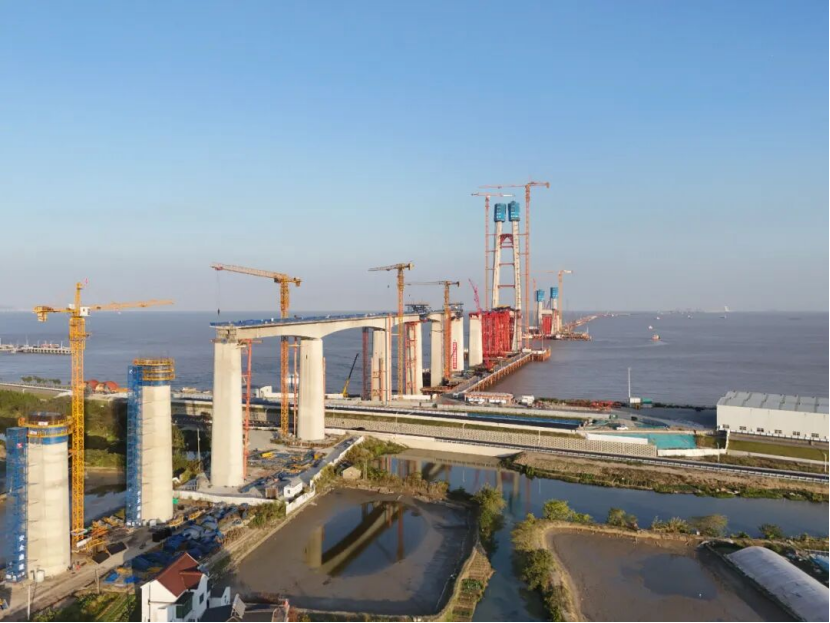
Core Insights - The Hangzhou Bay Cross-Sea Railway Bridge has reached a significant construction milestone with the successful topping of the 8th main tower, which stands at 200 meters high, marking it as the first main tower to be completed among the three navigation bridges and seven main towers along the bridge [1][6]. Group 1: Project Overview - The Hangzhou Bay Cross-Sea Railway Bridge is a key project for the Tongzhou-Ningbo High-Speed Railway, located north of the existing Hangzhou Bay Cross-Sea Highway Bridge, with a total length of 29.2 kilometers, making it the longest cross-sea railway bridge currently under construction in the world [6]. - The bridge consists of three navigation bridges (north, middle, and south) and 26 kilometers of sea and shallow water approach bridges, designed for a double-track ballastless track with a speed of 350 kilometers per hour, classifying it as a super-long high-speed railway bridge cluster project [6]. Group 2: Engineering Details - The North Navigation Bridge is 932.7 meters long with a main span of 450 meters, making it the largest span ballastless track cable-stayed bridge under construction globally [6]. - The main towers (8th and 9th) utilize a curved H-shaped reinforced concrete structure, both standing at 200 meters tall, with high precision construction requirements [6]. Group 3: Construction Challenges - The construction site is located in the Hangzhou Bay, known for its strong tides, swift currents, and frequent typhoons, presenting significant challenges for bridge construction [12]. - To ensure structural safety in the deep sea, the main pier of the North Navigation Bridge employs 52 piles with a diameter of 2.5 meters and a maximum depth of 150 meters, reinforced using a pile bottom grouting technique [12]. - A massive cap with an area of 1950 square meters, equivalent to five standard basketball courts, has been poured above a single main pier, providing stability against the turbulent sea conditions [12]. Group 4: Future Implications - The Hangzhou Bay Cross-Sea Railway Bridge is expected to be operational by 2027, forming an important part of China's "Eight Vertical and Eight Horizontal" high-speed rail network along the coast [12]. - Once completed, the project will connect with multiple railways, significantly enhancing the regional transportation network and facilitating the integration of the Yangtze River Delta region for high-quality development [12].
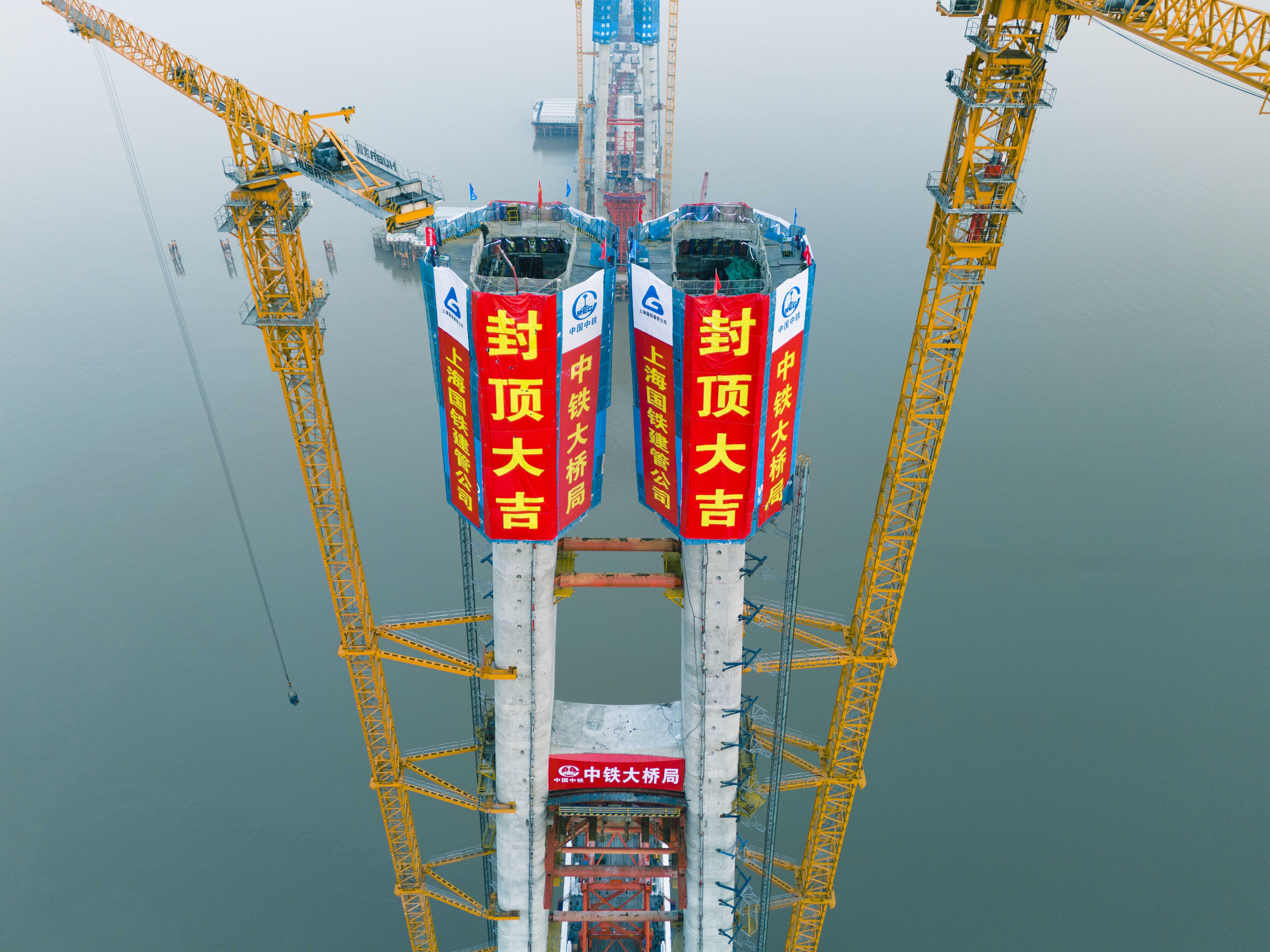
世界最长跨海铁路桥杭州湾铁路桥首个主塔封顶
Xin Lang Cai Jing· 2026-01-16 10:50
Group 1 - The Hangzhou Bay Cross-Sea Railway Bridge has achieved a significant milestone with the completion of the final concrete pouring for the main tower No. 8, which stands at 200 meters, marking the first tower to be topped among the seven main towers of the bridge [2] - The bridge, which is the longest cross-sea railway bridge under construction globally, is part of the new Nantong to Ningbo high-speed railway, an essential component of China's "eight vertical and eight horizontal" high-speed rail network [2] - The bridge's construction faces challenges due to the strong tidal currents and complex navigation environment of the Hangzhou Bay, necessitating a comprehensive safety system involving VTS, CCTV, patrol boats, and drones [2] Group 2 - The Wuxi International Life Science Innovation Park Phase III has been officially completed, covering an area of approximately 100,000 square meters, and is the first specialized park in Wuxi focusing on synthetic biology [4] - The park is designed to facilitate a seamless integration of research, small-scale testing, office, and living spaces, aiming to accelerate the development of the synthetic biology sector, which is projected to be a trillion-dollar industry [4] - The project is located in the Wuxi High-tech Zone and will focus on creating a headquarters research area for synthetic biology, providing quality space for upstream and downstream enterprises in the industry [4]

浙江海盐:世界最长跨海铁路桥顺利上梁
Zhong Guo Xin Wen Wang· 2025-09-28 02:56
Core Viewpoint - The successful installation of the first 80-meter precast concrete box girder marks a significant milestone in the construction of the Hangzhou Bay Cross-Sea Railway Bridge, entering a new phase of superstructure construction [1][2] Group 1: Project Milestones - The first 80-meter precast concrete box girder, weighing 2800 tons, has been successfully erected, setting a new world record for the largest span of precast concrete box girders [1] - The bridge construction is progressing as planned, with the main bridge structure expected to be completed by the end of 2026 and the entire project to be operational by the end of 2027 [2] Group 2: Engineering Challenges - The construction site presents complex challenges due to strong tidal currents, typhoons, and unstable seabed conditions, with a maximum tidal range of 8.96 meters and a maximum flow velocity of 5.3 m/s [1] - The "Tianyi" vessel, designed specifically for this project, has a maximum lifting capacity of 3600 tons and integrates the entire process of lifting, transporting, and erecting the girders [2] Group 3: Technological Innovations - The "Tianyi" vessel employs advanced technology, including 85 sets of smart sensors for real-time monitoring of vessel status, structural stress, and lifting actions, ensuring precise control during the construction process [2] - The construction team utilizes precise tidal calculations to optimize the timing of lifting and transporting girders, achieving millimeter-level accuracy in the installation process [2] Group 4: Strategic Importance - The Hangzhou Bay Cross-Sea Railway Bridge, with a total length of 29.2 kilometers and a design speed of 350 kilometers per hour, is set to enhance the transportation network in the Yangtze River Delta region, contributing to high-quality integrated development [2]
“通道效应”蕴藏发展动能
Ren Min Ri Bao· 2025-09-26 22:17
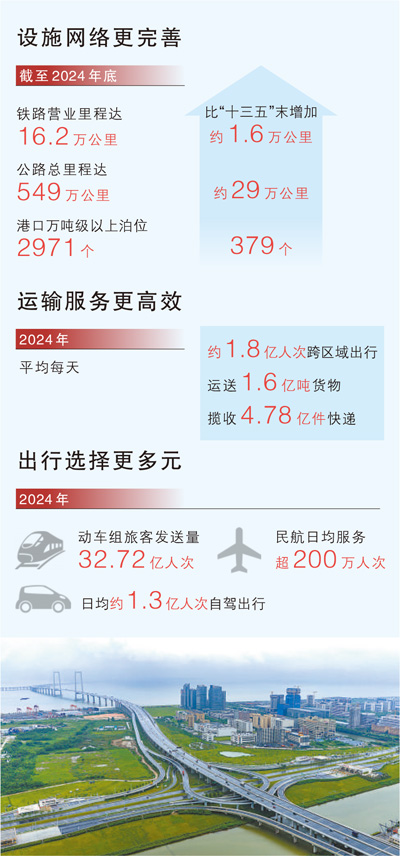
Core Points - The article highlights significant advancements in transportation infrastructure in China, including the expansion of railways, highways, and ports, which are expected to enhance economic connectivity and efficiency. Group 1: Transportation Infrastructure Expansion - The railway operating mileage has reached 162,000 kilometers, an increase of approximately 16,000 kilometers compared to the end of the 13th Five-Year Plan [1] - The total highway mileage has reached 5,490,000 kilometers, an increase of about 290,000 kilometers [1] - The number of port berths for vessels over 10,000 tons has reached 2,971, an increase of 379 [1] Group 2: Economic Impact of Infrastructure - Approximately 180 million people traveled across regions, and 160 million tons of goods were transported, along with 478 million express deliveries [2] - The successful construction of major underwater tunnels and bridges, such as the Jiaozhou Bay Second Undersea Tunnel and the Hangzhou Bay Cross-Sea Railway Bridge, is expected to significantly improve transportation efficiency [5][6] - The opening of the Shenzhen-Zhongshan Channel has led to a high volume of traffic, with over 3 million public transport passengers crossing cities within a year, and a 15% reduction in freight distance between Shenzhen and Zhongshan, resulting in a 20% decrease in transportation costs per shipment [6] Group 3: Regional Economic Development - The opening of the Huangmaohai Cross-Sea Channel has highlighted the regional advantages of Jiangmen, with over 11 million tourists and a tourism revenue of 11.74 billion yuan, reflecting year-on-year growth of 15.4% and 12.5% respectively [6] - The construction of the Shenzhen-Zhongshan Channel has encouraged Shenzhen enterprises to establish bases in Zhongshan, creating a "Shenzhen headquarters + Zhongshan base" development model [7] - The development of more cross-sea channels is anticipated to drive new economic and social advancements in the region [8]
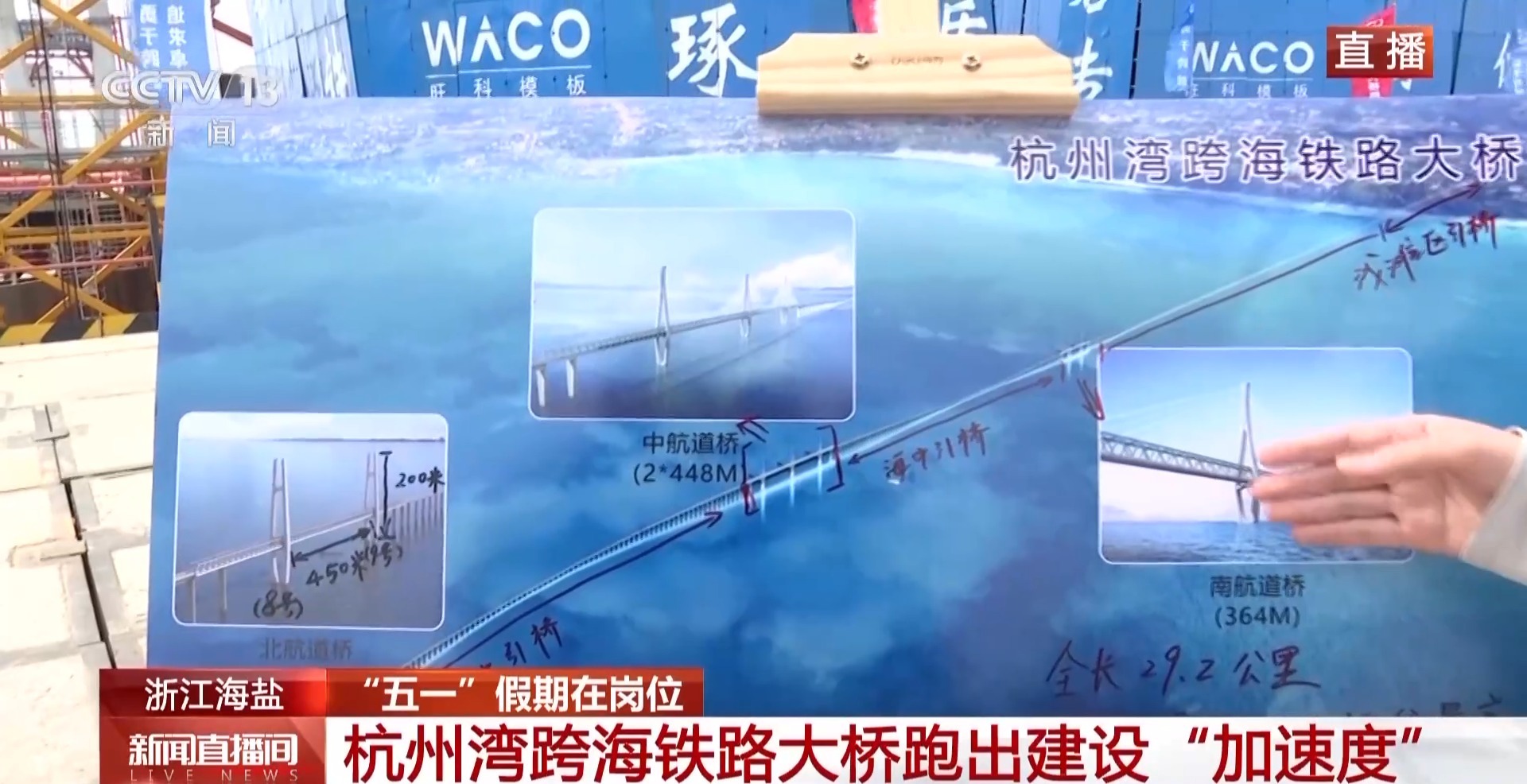
假期“不打烊” 这些大工程跑出建设“加速度”
Yang Shi Xin Wen Ke Hu Duan· 2025-05-05 01:36
Group 1: Hangzhou Bay Cross-Sea Railway Bridge - The Hangzhou Bay Cross-Sea Railway Bridge is a key project of the Tongsu-Jia-Ning High-Speed Railway, which is part of the national "eight vertical and eight horizontal" railway network, connecting four cities in the Yangtze River Delta [1] - The bridge spans 29.2 kilometers and consists of three main navigation bridges and several approach bridges [3] - As of now, approximately 50% of the construction progress has been completed, with 441 marine piers under varying degrees of construction [5] - The construction faces challenges due to the wide sea area, strong winds, and soft sediment at the bottom, necessitating careful planning for material transport based on tidal conditions [7] - A tidal dynamic database has been established to optimize marine transport and construction schedules [9] - To ensure zero delays in material supply, three transport devices have been set up to provide uninterrupted raw materials for concrete production [11] - The bridge is expected to be completed and operational by the end of 2027, improving travel convenience for residents along the route [13] Group 2: Harbin to Yichun High-Speed Railway - The Harbin to Yichun High-Speed Railway (Hayi High-Speed Railway) is an extension of the Beijing-Harbin to Beijing-Hong Kong-Macau corridor and is the highest latitude high-speed railway being constructed in China, traversing permafrost regions [1] - The railway consists of two segments: Harbin to Tieli and Tieli to Yichun, with track laying nearing completion on the Tieli to Yichun segment [1][19] - The construction of the bridge at Anbang River is being carried out using advanced machinery, allowing for the installation of a 32-meter long, 750-ton box girder in about 40 minutes [15] - The main challenge in construction is the pile foundation work, which must contend with low winter temperatures and a short effective working period [17] - High standards for material testing have been implemented to ensure quality, with real-time data recording in a high-standard, information-based laboratory [19] - The total length of the Hayi High-Speed Railway is 318 kilometers, with a design speed of 250 kilometers per hour; the Tieli to Yichun segment is expected to be completed by mid-August, and the Harbin to Tieli segment by the end of August [19] - Once completed, travel time for passengers between Harbin and Yichun will be reduced from 7 hours to approximately 2 hours [23]