递归式自我改进

Search documents
深度|马斯克万字访谈豪言:明年实现AGI,人形机器人数量将十倍于人类,我们将迎来全民高收入时代
Z Potentials· 2026-03-30 02:54
Core Insights - The conversation between Elon Musk and Peter Diamandis focuses on advancements in AI, robotics, and the future economic landscape, emphasizing the potential for a post-scarcity society with universal high income driven by technological progress [4][8][26]. Group 1: AI and Robotics Developments - Elon Musk indicates that the field of AI is currently in a "hard takeoff" phase, with significant breakthroughs occurring rapidly, potentially leading to AGI (Artificial General Intelligence) by 2027 [8][12]. - The Optimus 3 robot is nearing completion and is expected to be the most advanced robot globally, with production starting in the summer of this year and scaling up to mass production by next summer [24][25]. - Musk highlights that Grok, their AI model, is performing exceptionally well, particularly in predictive capabilities, and aims to enhance coding abilities by mid-year [13][24]. Group 2: Economic Predictions - Musk predicts that the global economy could grow tenfold within the next ten years, contingent on the absence of major global conflicts [19][20]. - The anticipated economic growth is expected to lead to a scenario where the production of goods and services far exceeds the money supply, resulting in deflation and a potential shift towards a post-capitalist society where currency loses its significance [27][28]. Group 3: Future of Work and Society - The discussion suggests that as AI and robotics take over production, humans may find themselves with less work to do, leading to a need for new economic models that support universal basic income or similar systems [26][27]. - Musk expresses optimism about the future, suggesting that the advancements in AI and robotics could significantly improve quality of life, including healthcare, and that the challenges ahead will require a balance of optimism and realism [35][36].



实测MiniMax M2.7:上能拆英伟达,下能演我爸妈
3 6 Ke· 2026-03-18 23:43
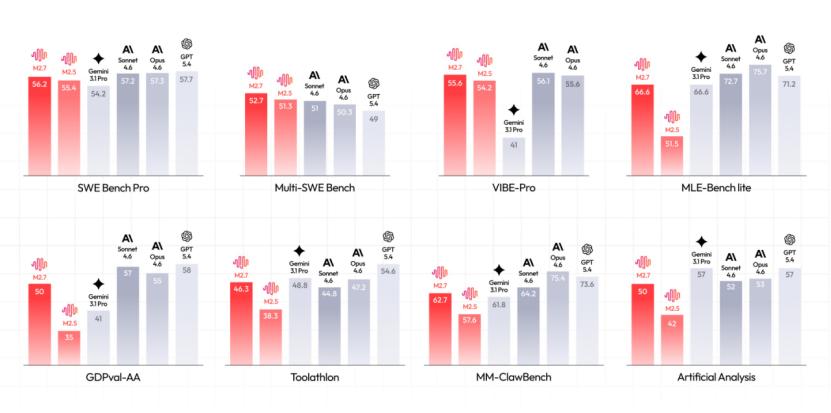
Core Insights - MiniMax has launched its M2.7 model, which emphasizes self-evolution in AI, marking a significant step in the industry towards recursive self-improvement and autonomous decision-making [1][2] - The model's capabilities have been benchmarked against various tasks, showing strong performance in software engineering and project execution, while still needing improvement in complex reasoning tasks [5][6] Group 1: Model Capabilities - M2.7 has demonstrated first-tier performance in engineering execution tasks, particularly in SWE Bench Pro and VIBE-Pro, indicating its ability to handle real-world coding challenges and end-to-end project tasks [5][6] - The model's performance in MM-ClawBench tests shows its capability to maintain context and execute multi-step tasks effectively, marking a significant advancement in its operational abilities [5][6] - However, M2.7 still has room for improvement in research-oriented tasks like MLE-Bench, which require higher levels of abstraction and systematic modeling [6] Group 2: Testing Scenarios - The model was tested in various scenarios, including simulating family conversations in a WeChat-like environment, showcasing its role-playing capabilities and understanding of character dynamics [8][9] - M2.7 successfully created a neon digital clock and a Snake game, demonstrating its ability to understand requirements, plan, code, and self-correct during the development process [22][25] - In a financial analysis task, M2.7 processed NVIDIA's FY2026 financial data to generate a comprehensive research report, interactive dashboard, and presentation, highlighting its proficiency in handling complex financial data and producing professional-grade outputs [41][43] Group 3: Future Directions - MiniMax is exploring new interactive systems like OpenRoom, which aims to enhance AI interaction in a web GUI space, indicating a shift towards more dynamic and engaging user experiences [44][45] - The evolution of M2.7 suggests a move away from traditional Q&A interactions towards a collaborative model where AI can autonomously progress tasks and self-correct, enhancing overall user experience [45][46]

Poetiq CEO:递归式自我改进是AI领域的终极目标
阿尔法工场研究院· 2026-03-03 00:05
Core Insights - The article discusses the development and application of artificial intelligence (AI), particularly focusing on the "poetic" system developed by Poetiq, which aims to enhance AI reasoning tools for large language models (LLMs) [1][2] - Ian Fischer emphasizes that large language models are not equivalent to reasoning engines, highlighting that the core bottleneck lies in the reasoning architecture rather than the scale of parameters [2] Group 1: Company Overview - Poetiq was co-founded by Ian Fischer and his partner in June 2025, successfully raising $45.8 million in seed funding within six months [1] - The company focuses on a meta-system architecture, aiming to improve reasoning efficiency without training larger models, but rather by enhancing existing models with a reasoning augmentation layer [2] Group 2: Technology and Innovation - The recursive self-improvement system developed by Poetiq allows for significant improvements in reasoning efficiency at a lower cost and higher compatibility, setting new records in authoritative reasoning tests [2] - Ian Fischer advocates for prioritizing engineering implementation and rapid iteration, encouraging practitioners to focus on reasoning efficiency and to build meta-systems using a systems thinking approach [2]

按参数算,我们1300克的人脑相当于多大的AI模型?
3 6 Ke· 2026-02-27 12:25
Group 1 - The human brain is estimated to have approximately 86 billion neurons, which translates to a model size of about 86 billion parameters, but when considering the 7,000 synapses per neuron, it equates to roughly 600 trillion parameters [1][2] - The processing capability of the human brain is complex, with neurons functioning more like processor cores rather than simple switches, and the synaptic gaps being around 20 to 40 nanometers, comparable to technology from 2012 [8][9] - The smallest unit of signal transmission in the human brain is the ion channel protein, which operates at an atomic level of 0.3 to 0.5 nanometers, surpassing current silicon-based chip technology [12] Group 2 - The human brain operates at a constant power consumption of about 20 watts, which includes managing various bodily functions, while high-intensity thinking only increases power consumption by approximately 1 watt [19][21] - In comparison, AI models like ChatGPT consume about 0.34 watt-hours per query, indicating that the human brain is still more energy-efficient by two orders of magnitude [22][23] - The efficiency of the human brain in processing information is significantly higher than that of AI models, with humans requiring far fewer data inputs to achieve high levels of generalization [58][60] Group 3 - The context window of advanced AI models like DeepSeek V3 is 128K tokens, while the human brain's short-term memory capacity is limited to about 7±2 chunks, but long-term memory can retain vast amounts of information [34][37][41] - The human brain excels in compression and abstraction, allowing it to distill experiences into essential judgments rather than relying on a fixed context window [42][44] - AI models are beginning to mimic human memory processes, such as using visual tokens for information compression, reflecting similarities in how both systems manage information [47][50] Group 4 - The training data for AI models like GPT-4 is around 130 trillion tokens, while a human child is estimated to encounter about 200 million words by adulthood, highlighting the vast difference in sample efficiency [55][56] - The human brain is pre-equipped with prior knowledge from evolution, allowing for rapid learning and recognition, unlike AI which starts from scratch [63] - The concept of embodied cognition suggests that human thought is influenced by the body, a factor that AI currently lacks, raising questions about the nature of intelligence [64][68] Group 5 - The human brain's capabilities are static, whereas AI models are rapidly evolving, with significant advancements in parameters and algorithms occurring within short timeframes [79][81] - Recursive self-improvement in AI, where AI designs better algorithms for itself, poses a potential challenge to the static nature of human intelligence [86] - The intersection of AI advancement and human cognitive capabilities remains uncertain, with the potential for AI to reach or surpass human intelligence in the future [12][86]
深度|谷歌前CEO:人形机器人或将由中国主导;世界将被廉价的中国机器人淹没,就像它将被廉价的中国电动汽车淹没一样
Z Potentials· 2025-10-03 02:09
Core Insights - The article discusses the competition between the US and China in the field of artificial intelligence (AI), emphasizing the differing approaches and potential outcomes of this rivalry [3][4][5]. - Eric Schmidt highlights the importance of energy supply in the US's ability to leverage its advantages in AI and AGI, suggesting that without sufficient energy, the US may struggle to maintain its lead [5][8]. - The conversation also touches on the potential risks associated with AI, including misinformation, cybersecurity threats, and biological safety concerns, and the need for proactive measures to mitigate these risks [9][10][11]. AI Competition - The US is perceived to be pursuing advanced AI and AGI, while China focuses on applying AI across various products and services in a more traditional manner [4]. - Schmidt believes that the hardware restrictions imposed by the US on China will hinder China's competitiveness in the AI race [4]. - The US has advantages in software development, but China is expected to dominate in the robotics sector, similar to its success in electric vehicles [6][7]. Energy Constraints - The US faces significant energy supply challenges, which could limit its ability to fully utilize its advantages in AI and AGI [5][8]. - Schmidt notes that the US will need to build an additional 92 gigawatts of power generation capacity by 2030 to meet the demands of data centers, highlighting the urgency of addressing energy supply issues [8]. AI Risks and Mitigation - The article discusses the potential for AI-related disasters and the importance of learning from past crises to implement effective regulations and controls [9][10]. - Schmidt identifies misinformation, cybersecurity, and biological safety as key threats that need to be addressed proactively [10][11]. Recommendations for Founders - Schmidt advises founders to focus on rapid action and learning, emphasizing that the barriers to starting a company are lower than ever [16][17]. - He stresses the importance of building scalable platforms that can leverage network effects to create significant wealth for founders [19][20]. Historical Significance - The emergence of AI is compared to historical inventions like electricity and transportation, suggesting that the next decade will be crucial in shaping the future [21][22]. - Companies and nations that embrace AI will likely emerge as winners, while those that lag behind may face significant challenges [22].

刚刚,OpenAI正式发布o3-pro!奥特曼激动更新博客:温和的奇点
机器之心· 2025-06-11 00:24
Core Insights - OpenAI has launched o3-pro, a new model that reportedly shows significant improvements over its predecessor, o3, particularly in areas such as science, education, programming, data analysis, and writing [5][9][22]. Performance Evaluation - The benchmark results indicate that o3-pro has a clear advantage over o3, with higher ratings in clarity, comprehensiveness, instruction adherence, and accuracy [9][11]. - The model has been evaluated using a strict "4/4 reliability" assessment, demonstrating outstanding performance [11][13]. - In the ARC-AGI semi-private evaluation dataset, o3-pro's performance was similar to o3, but at a higher cost [14]. Features and Capabilities - o3-pro supports both text and image input modalities, with a context window size of 200k and a maximum output token count of 100k [18]. - The model's knowledge cutoff is set for June 1, 2024, meaning it lacks information from the past year but can utilize tools for additional context [18]. - API pricing for o3-pro is set at $20 per million input tokens and $80 per million output tokens, which is 87% cheaper than o1-pro but still considered expensive [22]. User Feedback - Early user tests have shown that o3-pro is faster and more accurate than previous models, with notable improvements in programming tasks [29][34]. - Some users expressed disappointment, indicating that not all expectations were met [37]. Future Outlook - Sam Altman's blog post discusses the potential of AI to significantly enhance productivity and scientific progress, suggesting that the future may hold unprecedented advancements [40][44]. - The blog emphasizes the importance of making superintelligence widely accessible and affordable, while also addressing the need for societal discussions on the implications of such technology [59][60].