
虚假信息

Search documents
真相来了丨长晋高速大客车侧翻致人员伤亡?警方辟谣
Huan Qiu Wang· 2026-02-08 11:45
Core Viewpoint - A false news report about a bus accident on the Changjin Expressway, claiming two deaths and six serious injuries, was identified and debunked by the Shanxi police, highlighting the importance of verifying information before dissemination [1][5][7]. Group 1: Incident Verification - The police found no evidence of the reported accident upon arrival at the scene, confirming that traffic was normal and no emergency calls had been received [3]. - A comprehensive investigation was conducted, including checks with the Highway Traffic Police and a nationwide patrol, which revealed that no such incident occurred in any jurisdiction [5]. Group 2: Source Identification - The police successfully traced the origin of the false information to an individual who had used AI software to generate and publish the misleading content on social media without credible sources [7]. - Official statements were released by the Shanxi Highway Traffic Police and local authorities to clarify the situation and prevent any potential negative social impact from the rumors [7].


调查显示社交媒体成法国年轻人主要信息来源
Xin Hua She· 2026-01-30 04:36
Group 1 - The core finding of the report indicates that social media, video platforms, and artificial intelligence have become the primary sources of information for individuals under 34 years old in France [1] - Approximately 44% of the French population accesses information daily through social media, with 54% of those under 25 relying on these platforms compared to only 26% who depend on traditional media [1] - The report highlights that the accessibility of information, the presentation format of social media content, real-time updates, and diverse information sources contribute to the preference for social media among young people in France [1] Group 2 - The French National Assembly has passed a law prohibiting minors under 15 from using social media, a measure advocated by President Macron to protect children from the dangers of excessive electronic device usage [2]
马克龙:格陵兰岛局势为整个欧洲敲响战略警钟
Xin Hua She· 2026-01-28 16:03
Core Viewpoint - The recent events in Greenland have raised strategic alarms for Europe, emphasizing the need for European sovereignty and security in the Arctic region [1] Group 1 - French President Macron met with Danish Prime Minister Frederiksen and Greenland's Prime Minister Jens-Frederik Nielsen to discuss the situation in Greenland [1] - Macron highlighted the importance of addressing foreign interference and misinformation, responding to climate change, and establishing partnerships that promote sustainable development and reduce strategic dependencies [1] - Macron reaffirmed France's support for Denmark and Greenland's sovereignty and territorial integrity [1]
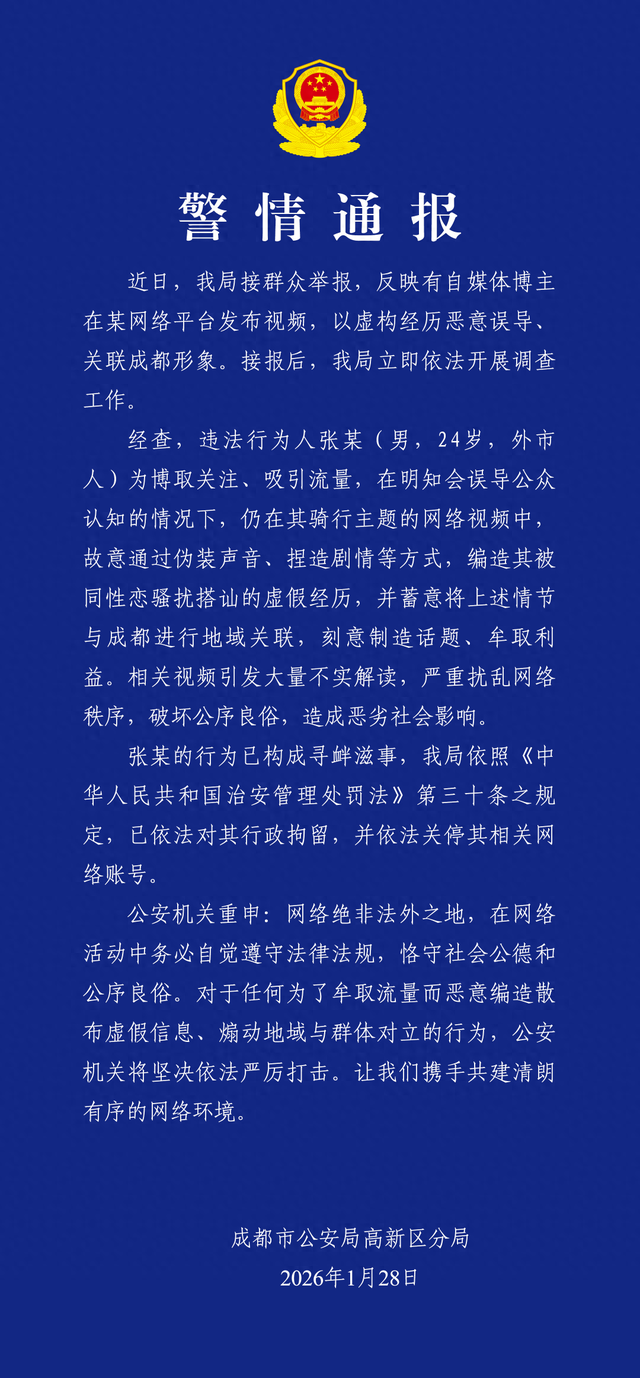
成都高新公安:自媒体博主编造被同性恋骚扰搭讪虚假经历,已构成寻衅滋事,已依法对其行政拘留
Xin Lang Cai Jing· 2026-01-28 09:27
Core Viewpoint - The article reports on the investigation and punishment of an individual, Zhang, who created misleading content on a social media platform, falsely associating his fabricated experiences with the city of Chengdu, which led to public misinformation and social disruption [1][2]. Group 1: Incident Overview - An individual named Zhang, aged 24, was found to have fabricated experiences of being harassed to gain attention and traffic on his cycling-themed videos [1]. - Zhang's actions included using voice alteration and creating fictional narratives to mislead the public, which he intentionally linked to Chengdu to generate controversy and profit [1]. Group 2: Legal Actions - The behavior of Zhang constituted a public disturbance, leading to administrative detention under Article 30 of the Public Security Administration Punishment Law of the People's Republic of China [1]. - Authorities have shut down Zhang's related online accounts as part of the legal repercussions for his actions [1]. Group 3: Law Enforcement Statement - The police emphasized that the internet is not a lawless space and urged individuals to adhere to laws and social ethics while engaging in online activities [2]. - There is a commitment from law enforcement to rigorously combat the malicious fabrication and dissemination of false information that incites regional and group conflicts [2].
特朗普发P图将委内瑞拉涂上星条旗,委政府呼吁民众发布官方地图打击“虚假信息”
Huan Qiu Wang· 2026-01-21 01:44
Group 1 - The core viewpoint of the news is the escalating tensions between the U.S. and Venezuela, highlighted by President Trump's social media post and the Venezuelan government's response [1][3] - President Trump shared an edited image on social media, depicting a map with the U.S. flag overlaid on Venezuela, which prompted a call from the Venezuelan government for citizens to defend their territorial integrity [1] - The Venezuelan government urged its citizens to unite and take symbolic actions by sharing the official map of Venezuela on social media to counteract what they termed as misinformation [1] Group 2 - The U.S. military conducted a large-scale military strike against Venezuela, forcibly detaining President Maduro and his wife, with the Trump administration claiming it would "manage" Venezuela and exploit its vast oil reserves [3]

学海拾珠系列之二百六十一:虚假信息可被容忍吗?解析其对波动的影响与边界
Huaan Securities· 2026-01-08 09:11
Quantitative Models and Construction Methods 1. Model Name: Predatory Trading Game with Disinformation - **Model Construction Idea**: This model incorporates disinformation into a predatory trading game framework, where participants act based on distorted information, leading to deviations in equilibrium and market volatility[3][16][23] - **Model Construction Process**: 1. The model builds on the microstructure frameworks of Carlin et al. (2007) and Carmona & Yang (2011), introducing a victim (forced to adjust risky asset positions) and predators (seeking profit from the victim's constraints)[23] 2. The trading rate of participant \( n \) is defined as: $$ X^{n}(t) = X^{n}(0) + \int_{0}^{t}\alpha^{n}(s)\mathrm{d}s \tag{1} $$ where \( \alpha^{n} \) represents the trading rate, constrained by: $$ \alpha_{t}^{n} \in \mathbb{A}^{n} = \left\{\alpha_{t}^{n} \mid \mathcal{H}_{[0,T]}^{2}, X_{T}^{n} = 0 \right\} $$ 3. Temporary price impact is modeled as: $$ P_{t} - X_{t}^{0} = \lambda \sum_{i=1}^{N}\alpha_{t}^{i} \tag{4} $$ where \( \lambda \) is the elasticity factor[24] 4. Permanent price impact is expressed as: $$ \mathrm{d}X_{t}^{0} = \gamma \sum_{i=1}^{N}a_{t}^{i}\mathrm{d}t + \sigma\mathrm{d}W_{t} \tag{5} $$ where \( \gamma \) represents market plasticity, and \( \sigma \) is the volatility parameter[24] 5. Participants aim to maximize profits: $$ J^{n}(\mathbf{\alpha}) = \mathbb{E}\left(\int_{0}^{T}\alpha^{n}\left(X_{t}^{0} + \lambda\sum_{i=1}^{N}\alpha_{t}^{i}\right)\mathrm{d}t\right) \tag{8} $$ 6. Disinformation is introduced as a random distortion \( \tilde{x}_{0,1} = x_{0,1} + \epsilon \), where \( \epsilon \) represents the distortion[27] 7. The price process under disinformation is given by: $$ X_{t}^{0} = X^{0}(0) - \frac{1-e^{-\frac{N-1}{N+1}\frac{T_{T}}{\lambda}}}{1-e^{-\frac{N-1}{N+1}\frac{T_{T}}{\lambda}}}\gamma\left(\sum_{i=1}^{N}x_{0}^{i}+\bar{\nu}\right) + \frac{e^{\frac{T t}{\lambda}}-1}{e^{\frac{T t}{\lambda}}-1}\gamma\bar{\nu} + \sigma\left(W_{t}-W_{0}\right) $$ where \( \bar{\nu} \) is the error factor[30][31] - **Model Evaluation**: The model effectively captures the impact of disinformation on market dynamics, highlighting its role in amplifying volatility and disrupting equilibrium[16][30] --- Model Backtesting Results 1. Predatory Trading Game with Disinformation - **Maximum Price Fluctuation (MPF)**: $$ MPF_{\nu}(t_{*},t^{*}) := \operatorname*{max}_{t_{1},t_{2}\in[t_{*},t^{*}]}\left|\mathbb{E}\left(X_{t_{1}}^{0}-X_{t_{2}}^{0}\right)\right| $$ The model demonstrates that disinformation increases MPF, with a lower bound determined by: $$ MPF_{\tilde{\nu}^{*}}(0,T) \geq \operatorname*{min}_{\tilde{\nu}\in\mathbb{R}} MPF_{\tilde{\nu}}(0,T) = \gamma\sum_{i=1}^{N}x_{0}^{i} $$[34][37] - **Error Factor Impact**: The error factor \( \nu \) significantly influences price trajectories, with higher \( \nu \) leading to greater volatility[30][33] - **Tolerance Thresholds**: The system tolerates disinformation within specific boundaries \( b_{1} \) and \( b_{2} \), beyond which volatility escalates[38][40] --- Quantitative Factors and Construction Methods 1. Factor Name: Error Factor (\( \nu \)) - **Factor Construction Idea**: The error factor quantifies the degree and spread of disinformation in the market, serving as a key determinant of price volatility[30][33] - **Factor Construction Process**: 1. Defined as: $$ \tilde{\nu} := \frac{N_{w}}{N}\left(\tilde{x}_{0}^{1} - x_{0}^{1}\right) $$ where \( N_{w} \) is the number of misinformed participants, and \( \tilde{x}_{0}^{1} - x_{0}^{1} \) represents the distortion magnitude[30] 2. Generalized for multiple distortions: $$ \nu := \frac{1}{N}\,\sum_{l=1}^{\kappa}N_{w_{l}}\left(\bar{x}_{0,w_{l}}^{1} - x_{0}^{1}\right) $$ where \( \kappa \) is the number of distinct distortions[56] - **Factor Evaluation**: The error factor effectively captures the interplay between disinformation magnitude and its spread, providing insights into its impact on market dynamics[30][56] --- Factor Backtesting Results 1. Error Factor (\( \nu \)) - **Maximum Price Fluctuation (MPF)**: Higher \( \nu \) values correspond to increased MPF, with a minimum threshold determined by: $$ MPF_{\nu}(0,T) \geq \gamma\sum_{i=1}^{N}x_{0}^{i} $$[34][37] - **Tolerance Thresholds**: The system tolerates \( \nu \) within boundaries \( b_{1} \) and \( b_{2} \), with specific dependencies on market parameters and game duration[38][40] - **Dynamic Evolution**: The tolerance for \( \nu \) increases over time, reducing the potential for disinformation to amplify volatility in the long term[90][91] --- Additional Insights - **Information Updates**: New information can mitigate the impact of disinformation by adjusting the error factor \( \nu \), with the timing of updates being critical to minimizing volatility[84][92][95] - **Randomness and Misjudgment**: Random price movements can lead even informed participants to misjudge their information, complicating the detection and correction of disinformation[100][101][103] - **Profit Implications**: Disinformation affects profit expectations, with informed participants benefiting under certain conditions, while widespread disinformation can erode these advantages[49][51][56]
为什么拥有强大品牌力至关重要?
Xin Lang Cai Jing· 2025-12-21 11:27
Core Viewpoint - A strong brand serves as a remedy for information overload, helping organizations navigate through the chaos of misinformation and establish trust with their audience [2][6][24] Group 1: Information Overload and Misinformation - The world is currently facing an overwhelming amount of information, generating approximately 400 million terabytes of data daily, which is difficult for the human brain to process [3] - Misinformation and disinformation are recognized as significant global risks, with the World Economic Forum reporting that misinformation costs the global economy around $78 billion annually [5][9] - Over 90% of individuals in the UK have encountered misinformation on social media, and 70% believe that leaders from businesses, governments, and media intentionally mislead the public [9] Group 2: Importance of Brand and Reputation - Distinguishing between brand and reputation is crucial; while reputation is shaped by external perceptions, a brand is a proactive expression of an organization's identity and values [10][15] - A strong, values-driven brand can help organizations shape public expectations and protect against harmful misinformation [12][24] - Trust has become a critical factor in driving key business outcomes, ranking second only to product and service quality [17] Group 3: Building a Strong Brand - Three key actions are essential for effective brand implementation: clarity, consistency, and credibility [20][22] - A clear brand narrative helps unify the organization and ensures that all external communications are aligned with the brand's core message [20] - Internalizing the brand within the organization is vital, as employees serve as the best brand ambassadors, ensuring that everyone communicates the same message from day one [26] Group 4: Continuous Brand Evolution - Brands are dynamic ecosystems that evolve with organizational growth and stakeholder needs, necessitating ongoing assessment and adaptation [23] - Establishing a brand health dashboard can help measure internal and external perceptions of the brand, ensuring that the organization remains responsive to its audience [23] - The ultimate success of a brand lies in the collective understanding of its importance among all employees, rather than merely repeating the same narrative [23]

谁在给你的脑子「投毒」
投资界· 2025-11-25 07:23
Core Viewpoint - The article discusses the pervasive issue of false information on the internet, highlighting how it is generated and disseminated through various channels, including social media and AI technologies, creating a complex gray industry that profits from misinformation [4][5][20]. Group 1: Information Pollution - The average Chinese individual spends nearly 8 hours online daily, encountering around 1,000 pieces of information, with a conservative estimate suggesting that hundreds of these are false [4]. - In June 2025, there were approximately 1.85 million reports of online illegal and harmful information across the country [4]. - False content acts like a mental fog, subtly contaminating public perception and trust [4]. Group 2: Mechanisms of Misinformation - The article details how individuals and companies create false narratives, including scriptwriting and video production, with some earning between 70,000 to 900,000 yuan monthly [5][12]. - A specific case involves a character named "Taozi," who produces videos that appear authentic but are scripted and staged, often involving actors portraying delivery personnel and customers in fabricated scenarios [6][9]. - The content often exploits emotional narratives to engage viewers, leading to significant interaction and shares on social media platforms [7][8]. Group 3: Economic Incentives - The production of false narratives is driven by financial incentives, with creators earning money through advertisements and viewer engagement [20][21]. - For instance, "Taozi" can earn around 70,000 yuan monthly from advertisements alone, in addition to revenue from viewer interactions [20]. - The article also mentions a company that utilizes AI to generate and distribute misleading content, highlighting the profitability of such operations [35][36]. Group 4: Social Impact - The spread of false information not only misrepresents individuals but also fosters societal divisions and stigmatizes certain groups, such as delivery workers [22][24]. - The article cites specific incidents where misinformation led to public outrage and personal harm, illustrating the real-world consequences of online falsehoods [23][25]. - It emphasizes the challenge of fact-checking, as misinformation often spreads faster and more widely than corrections can be issued [43][44]. Group 5: AI's Role in Misinformation - AI technologies are increasingly used to generate false information, with studies indicating that even a small percentage of false data in training sets can significantly increase harmful outputs [26][32]. - The article discusses how AI-generated content can manipulate public perception and even influence international relations, as seen in the context of the Ukraine conflict [33][34]. - Companies are leveraging AI to automate the creation of misleading narratives, further complicating the landscape of information integrity [35][36].

谁在给你的脑子「投毒」?
36氪· 2025-11-23 02:08
Core Viewpoint - The article discusses the pervasive issue of misinformation on the internet, highlighting how fake content is produced and disseminated, often for profit, and the detrimental effects it has on public perception and trust in information sources [3][22][54]. Group 1: Information Pollution - The average Chinese individual spends nearly 8 hours online daily, encountering approximately 1,000 pieces of information, with a conservative estimate suggesting that hundreds of these are false [3][4]. - Misinformation spreads rapidly through social media and short videos, often misleading millions within minutes [4][22]. - The article identifies a gray industry behind the creation of fake content, where individuals script, film, and distribute misleading videos, earning substantial incomes [5][22][30]. Group 2: Fake Content Production - The production of fake videos often involves actors portraying scenarios that evoke sympathy or moral outrage, which are then monetized through views and advertisements [9][21][22]. - A specific example includes a character named "Taozi," who creates scripted videos featuring fake delivery scenarios that mislead viewers into believing they are real [7][9][18]. - The article reveals that these fake narratives are designed to provoke emotional responses, leading to increased engagement and revenue from advertisements [14][20][22]. Group 3: The Role of AI - AI technology is increasingly used to generate and spread misinformation, with studies indicating that even a small percentage of false data in training sets can significantly increase harmful outputs [26][30]. - Companies are leveraging AI to automate the creation of misleading content, which can be distributed across various platforms for profit [30][32]. - The use of AI in misinformation not only affects individual reputations but can also disrupt public discourse and influence societal perceptions [29][30]. Group 4: Impact on Society - The proliferation of fake information contributes to societal divisions and the stigmatization of certain groups, such as delivery workers, by fabricating narratives that create conflict [22][44]. - Misinformation can lead to real-world consequences, including public outrage and harm to individuals' reputations, as seen in various high-profile cases [25][44]. - The article emphasizes the challenge of fact-checking in the face of overwhelming misinformation, where false narratives often gain traction faster than corrections can be disseminated [46][54].

X @外汇交易员
外汇交易员· 2025-10-31 06:16
Regulatory Focus - The Securities Fund Institutional Supervision Department issued a regulatory notice regarding fabricated and disseminated false information by securities fund institutions [1] - The China Securities Regulatory Commission (CSRC) organized investigations into individual industry institutions and personnel involved in creating and spreading false information [1] - The CSRC took strict administrative regulatory measures against relevant institutions and personnel [1]