酶催化

Search documents
清华大学化学工程系戈钧教授课题组招聘博士后及科研助理
生物世界· 2026-03-16 10:30
Group 1 - The Tsinghua University Department of Chemical Engineering is recruiting 3 postdoctoral researchers and 2 research assistants for the 2025-2026 academic year, focusing on areas such as enzyme catalysis, metal-organic catalysis, perovskite solar cells, and polyolefin material synthesis [2][3] - Professor Ge Jun, a long-term professor and doctoral supervisor at Tsinghua University, leads the research group, which has developed innovative enzyme-metal cooperative catalysis technologies for applications in fine chemicals, nutritional chemicals, and new materials [2][4] - The research group has received numerous prestigious awards and funding, including the National Outstanding Youth Science Fund and the National Key R&D Program, and has published over 110 papers in high-impact journals [2][4] Group 2 - Applicants for postdoctoral positions must meet Tsinghua University's basic requirements, including holding a PhD or being close to graduation, being under 35 years old, and having relevant research experience in specified fields [4][5] - Research assistants are required to have a master's degree or equivalent, relevant research experience, and strong communication skills, with a preference for those with industrial project experience [7][9] - The benefits for postdoctoral researchers include a competitive salary, housing subsidies, and support for applying to various talent support programs, with potential funding up to 600,000 yuan for outstanding candidates [5][9]


江大张荣珍教授团队:突破胆红素合成瓶颈,实现克级高效生物制造
合成生物学与绿色生物制造· 2025-12-26 01:33
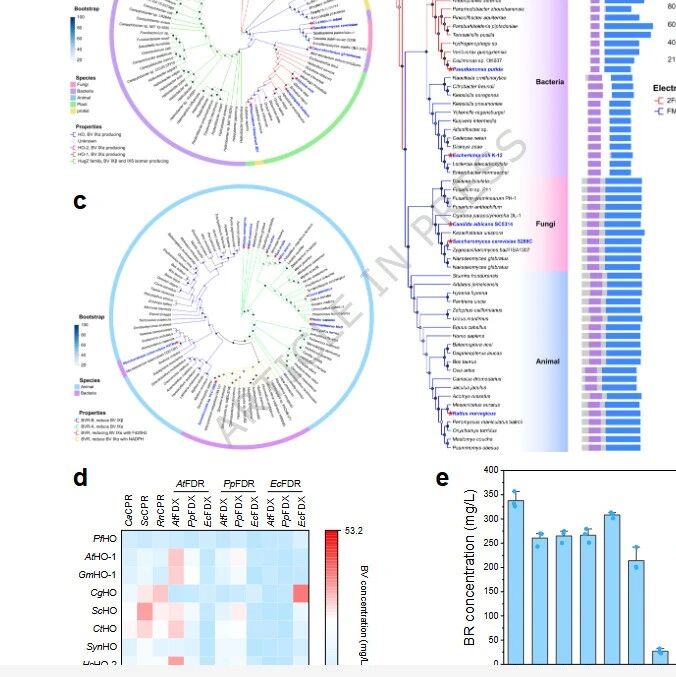
Core Viewpoint - The research led by Professor Zhang Rongzhen's team has successfully developed an efficient in vitro enzyme-catalyzed system for high-level bilirubin biosynthesis, achieving a yield of 1.7 g/L and a conversion rate of 95.8%, laying a solid foundation for industrial production [2][4]. Group 1: Enzyme Optimization - The study clarified the classical two-enzyme catalytic pathway from heme to bilirubin and identified the most efficient enzyme combinations through systematic evolutionary analysis [4]. - The combination of rat HO-1 and its specific cytochrome P450 reductase (CPR) showed the highest efficiency in converting heme to biliverdin, while the rat BVR-A subtype performed best in reducing biliverdin to bilirubin [4]. - Structural analysis of key enzymes led to the development of soluble truncated variants RnCPRΔ54 and RnHO-1Δ22, which maintained substrate affinity and catalytic efficiency while improving solubility [4][5]. Group 2: Addressing Inhibitory Factors - Initial one-pot reactions showed a heme conversion rate of 83.9%, but bilirubin yield was only 48.1%, indicating material loss due to bottlenecks in the first step of heme oxygenase catalysis [5]. - The study identified Fe²⁺ as a negative factor affecting product stability, as it formed complexes with deprotonated biliverdin or bilirubin, leading to degradation [7]. - The researchers developed a dual strategy to stabilize the reaction, using HEDP to chelate Fe²⁺ and lowering the reaction pH to suppress deprotonation, which together increased bilirubin yield to 80.1% [7][8]. Group 3: Integrated Multi-Enzyme System - The research revealed carbon monoxide (CO) as another inhibitory factor, as it formed stable complexes with heme, obstructing substrate binding and enzyme activity [8]. - To eliminate all inhibitory factors, the team constructed a fully integrated multi-enzyme system, incorporating a CO dehydrogenase and a formate dehydrogenase for in situ NADPH regeneration [8]. - This integrated system successfully converted 3 mM of heme to 2.87 mM of bilirubin in a 1-liter reaction, achieving a yield of 95.8%, confirmed as the bioactive bilirubin IXα isomer [8].
南京大学发表最新Nature论文
生物世界· 2025-05-29 00:11
Core Viewpoint - The article discusses the revival of electrochemistry in synthetic chemistry, highlighting its potential in enzyme applications and the challenges faced in utilizing electrochemistry to unlock new catalytic modes for enzymes [2]. Group 1: Research Findings - A research team from Nanjing University published a paper in Nature on May 28, 2025, demonstrating a new catalytic function of ThDP-dependent enzymes through the integration of electrocatalysis and enzyme catalysis, achieving dynamic kinetic oxidation of aldehydes to chiral carboxylic acids [2]. - The study reported a robust electroenzymatic method for the efficient synthesis of ten (S)-arylpropionic acid anti-inflammatory drugs, such as ibuprofen and naproxen, with enantiomeric selectivity reaching 99% ee and enzyme loading as low as 0.05 mol% [4]. - Mechanistic studies revealed that the electroenzyme plays multiple roles in precise substrate recognition, accelerating racemization, and facilitating electron transfer events for kinetic matching [5]. Group 2: Recent Publications - The research team has published three papers in Nature over the past two years, including a study on December 18, 2023, that developed a dual catalytic system combining ThDP-dependent enzymes and photocatalysis, significantly expanding enzyme catalytic functions and providing new strategies for chiral precision control in chemical fields [7]. - Another publication on November 22, 2024, introduced a synergistic photobiocatalysis system for enantioselective triple radical sorting, overcoming the limitations of natural enzymes that typically catalyze only 1-2 substrates, thus empowering green biomanufacturing [10].