量增价跌

Search documents
2025快递之城出炉:粤浙苏守擂成功 西部跑出“黑马”
2 1 Shi Ji Jing Ji Bao Dao· 2026-01-29 14:41
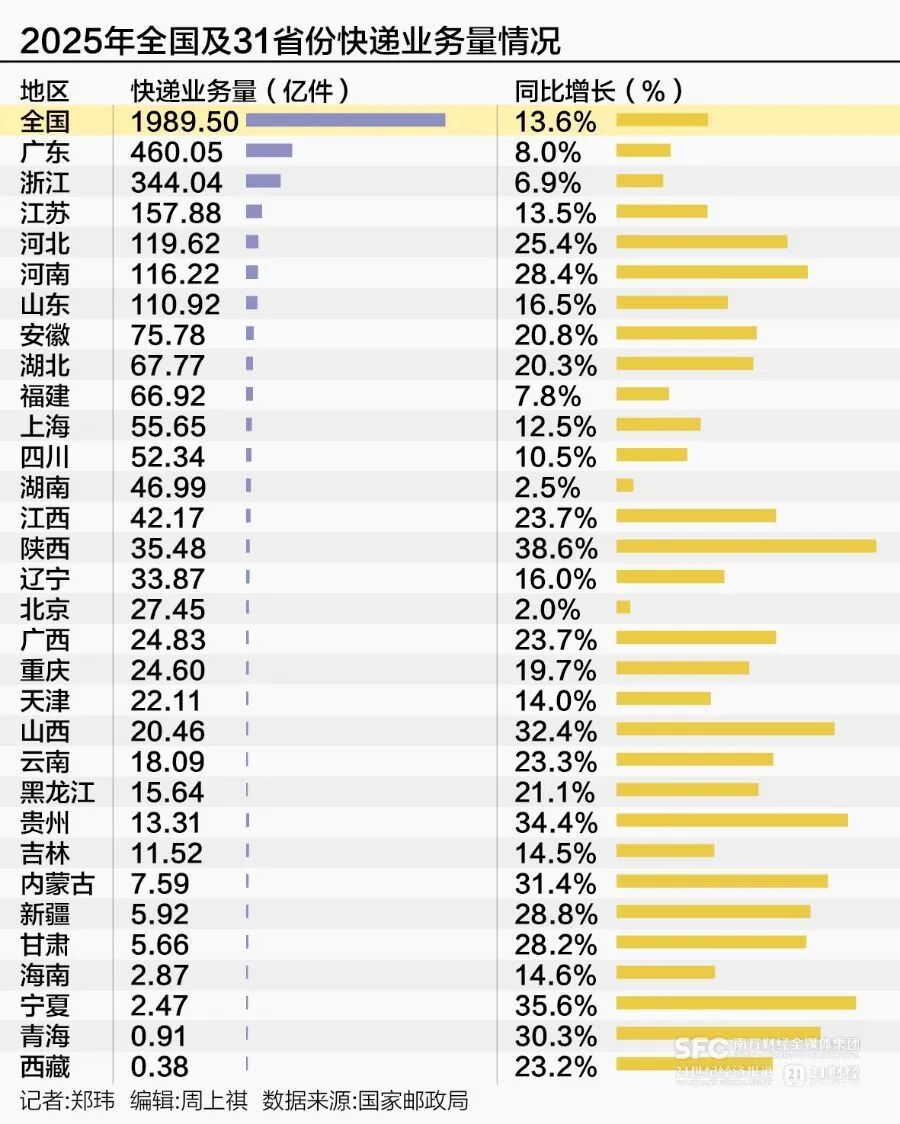
Core Insights - China has established the world's largest and most widely utilized express delivery network, with 2025 express delivery volume reaching 1989.5 billion pieces, a year-on-year increase of 13.6%, and revenue totaling 1.5 trillion yuan, up 6.5%, both setting historical records [1][9]. Express Delivery Volume - In 2025, Guangdong, Zhejiang, and Jiangsu ranked as the top three provinces in express delivery volume, achieving 460.05 billion, 344.04 billion, and 157.88 billion pieces respectively [1][6]. - Western provinces such as Shaanxi, Ningxia, and Guizhou exhibited remarkable growth rates of 38.6%, 35.6%, and 34.4%, leading the national growth [1][7]. Express Delivery Revenue - Guangdong, Shanghai, Zhejiang, and Jiangsu led in express delivery revenue, generating 300.18 billion, 271.33 billion, 154.3 billion, and 108.39 billion yuan respectively [3][10]. - Notably, Guangdong experienced a decline in revenue by 1.3% despite an 8% increase in volume, indicating a "volume increase but price drop" phenomenon [3][12]. Growth Trends - The express delivery market in western provinces is rapidly expanding, driven by e-commerce and local support policies, with Shaanxi leading the national growth in express delivery volume [8][9]. - A total of 17 provinces achieved double-digit growth in express delivery revenue, with Shaanxi, Hebei, and Anhui leading at 19.3%, 17.1%, and 15% respectively [11]. Policy and Infrastructure Development - Shaanxi has implemented policies to enhance rural logistics, establishing numerous processing centers and service stations to improve delivery coverage [8]. - Various provinces, including Guangdong and Sichuan, are focusing on reducing logistics costs and enhancing service quality through new policies and initiatives [14][15].


2025快递之城出炉:广东、浙江、江苏稳居前三
2 1 Shi Ji Jing Ji Bao Dao· 2026-01-29 14:40
Core Insights - China has established the world's largest and most widely utilized express delivery network, with 1989.5 billion packages delivered in 2025, marking a 13.6% year-on-year increase, and total revenue reaching 1.5 trillion yuan, up 6.5% year-on-year, both setting historical records [1][11]. Group 1: Express Delivery Volume - In 2025, Guangdong, Zhejiang, and Jiangsu were the top three provinces in express delivery volume, with 460.05 billion, 344.04 billion, and 157.88 billion packages respectively [2][7]. - Western provinces such as Shaanxi, Ningxia, and Guizhou exhibited remarkable growth rates of 38.6%, 35.6%, and 34.4% respectively, leading the national growth [2][8]. - The overall express delivery volume in China reached 1989.5 billion packages, with a historical growth rate of 13.6% [6][11]. Group 2: Express Delivery Revenue - In terms of revenue, Guangdong, Shanghai, Zhejiang, and Jiangsu led the nation with revenues of 300.18 billion yuan, 271.33 billion yuan, 154.3 billion yuan, and 108.39 billion yuan respectively [12][13]. - The total express delivery revenue in China reached 1.5 trillion yuan, reflecting a growth of 6.5% year-on-year, although this was a slowdown compared to the previous year's growth of 13.8% [11][12]. - Notably, 17 provinces achieved double-digit growth in express delivery revenue, with Shaanxi, Hebei, and Anhui leading at 19.3%, 17.1%, and 15% respectively [13][14]. Group 3: Regional Dynamics - Guangdong remains the only province with express delivery volume exceeding 400 billion packages, accounting for 23% of the national total [6][8]. - The express delivery market in western provinces is rapidly expanding, driven by e-commerce and local support policies, with significant infrastructure developments in Shaanxi, including 303 county-level processing centers and 1.73 million village-level logistics service stations [9][10]. - The logistics cost in Guangdong has decreased, with the ratio of social logistics costs to GDP dropping to approximately 13.6% [14][15].
2025快递之城出炉:粤浙苏守擂成功,西部跑出“黑马”
2 1 Shi Ji Jing Ji Bao Dao· 2026-01-29 13:18
Core Insights - China has established the world's largest and most widely utilized express delivery network, with 2025 express delivery volume reaching 1989.5 billion pieces, a year-on-year increase of 13.6%, and revenue totaling 1.5 trillion yuan, up 6.5%, both hitting historical highs [1][8]. Express Delivery Volume - In 2025, Guangdong, Zhejiang, and Jiangsu ranked as the top three provinces in express delivery volume, achieving 460.05 billion, 344.04 billion, and 157.88 billion pieces respectively [1][5]. - Western provinces such as Shaanxi, Ningxia, and Guizhou exhibited remarkable growth rates of 38.6%, 35.6%, and 34.4%, leading the national growth [1][6]. Express Delivery Revenue - The top four provinces in express delivery revenue for 2025 were Guangdong (300.18 billion yuan), Shanghai (271.33 billion yuan), Zhejiang (154.3 billion yuan), and Jiangsu (108.39 billion yuan), with significant gaps between them and the fifth-ranked Shandong (69.56 billion yuan) [2][9]. - National express delivery revenue growth has slowed, with a 6.5% increase in 2025 compared to 13.8% in 2024 [8][10]. Regional Growth Trends - The express delivery market in western provinces is rapidly expanding, driven by e-commerce and local support policies, with Shaanxi leading the growth [7][6]. - In 2025, 17 provinces achieved double-digit growth in express delivery revenue, with Shaanxi, Hebei, and Anhui leading at 19.3%, 17.1%, and 15% respectively [10][11]. Price Dynamics - Some provinces experienced a "volume increase but price drop" phenomenon, notably Guangdong, where express delivery volume grew by 8% while revenue declined by 1.3% [3][11]. - Overall, 30 provinces saw a slowdown in express delivery revenue growth compared to 2024, indicating a shift towards a more quality-focused growth model [11][13]. Policy and Infrastructure Development - Provinces like Sichuan and Shandong are implementing new policies to reduce logistics costs and enhance the express delivery industry, aiming for lower logistics costs as a percentage of GDP [13][14]. - Guangdong is focusing on sectors such as 3C electronics and new energy vehicles to develop comprehensive logistics services [14].
三大航空股回落 机票价格大跳水
Ge Long Hui· 2026-01-09 03:54
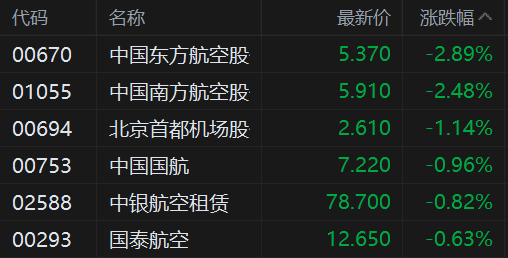
Group 1 - The core viewpoint of the article highlights a collective decline in Hong Kong airline stocks, with China Eastern Airlines and China Southern Airlines dropping over 3%, and Air China falling over 1% [1] - Specific stock performance includes China Eastern Airlines at 5.370 with a decrease of 2.89%, China Southern Airlines at 5.910 down by 2.48%, and Air China at 7.220 down by 0.96% [2] - Following the New Year, domestic air ticket prices have significantly dropped, with some prices as low as 10% of their original cost, indicating a "volume increase and price drop" phenomenon, which is seen as a short-term negative for airline stocks [2] Group 2 - The lowest ticket price from Guangzhou to Shanghai was reported at 210 yuan (excluding tax), equivalent to 11% of the original price, reflecting a drastic reduction in airfares [2] - Industry experts suggest that as students begin their winter break in mid to late January, air ticket prices are expected to fluctuate, indicating potential volatility in the market [2] - The analysis emphasizes that while the current price drop is a short-term negative for airline stocks, the long-term industry fundamentals remain crucial [2]



港股异动丨三大航空股回落 东航、南航跌超3% 机票价格大跳水
Ge Long Hui· 2026-01-09 03:28
Group 1 - The core viewpoint of the news is that Hong Kong airline stocks have collectively declined, with specific airlines experiencing significant drops in their stock prices due to a sharp decrease in domestic flight ticket prices after the New Year [1] - China Eastern Airlines and China Southern Airlines saw their stock prices drop over 3%, while Air China fell over 1% and Cathay Pacific decreased by 0.6% [2] - The ticket prices for several domestic routes have plummeted, with some fares as low as 10% of their original price, indicating a "volume increase and price drop" phenomenon that is expected to negatively impact airline stocks in the short term [1] Group 2 - On January 7, the lowest ticket price from Guangzhou to Shanghai was reported at 210 yuan (excluding tax), equivalent to 11% of the original price [1] - Industry insiders suggest that ticket prices will fluctuate as students begin their winter vacations in mid to late January, which may further affect the market [1] - Analysts emphasize that while the current price drop is a short-term negative for airline stocks, the long-term industry fundamentals will be more critical [1]
中国国航前三季度净利增37% 拟定增募资不超200亿元
Zhong Guo Jing Ying Bao· 2025-11-03 09:17
Core Viewpoint - China International Airlines (Air China) reported a revenue of 129.826 billion yuan for the first three quarters of 2025, a year-on-year increase of 1.31%, and a net profit of 1.87 billion yuan, a significant year-on-year increase of 37.31% [2] Financial Performance - In the first half of 2025, Air China generated a revenue of 80.76 billion yuan, a year-on-year increase of 1.6%, but reported a net loss of 1.806 billion yuan, the largest loss among the three major state-owned airlines [2] - In the third quarter of 2025, Air China's revenue was 49.07 billion yuan, a year-on-year increase of 0.9%, and a net profit of 3.676 billion yuan, marking a turnaround from losses [2] - The gross profit margin for the third quarter was 13.78%, an increase of 0.7% year-on-year, while the net profit decreased by 11.3% year-on-year [2] Capacity and Utilization - Air China invested 98.2 billion available seat kilometers (ASK) in the third quarter, a year-on-year increase of 1.9%, with a passenger load factor of 82.3%, up 1.3 percentage points year-on-year [2] - The unit revenue per ASK was 0.499 yuan, a decrease of 1% year-on-year [2] Industry Context - The civil aviation industry in China saw a total of 371 million passengers in the first half of 2025, a year-on-year increase of 6%, with an average ticket price for economy class decreasing by 6.9% year-on-year [3] - The industry is facing challenges of oversupply, with high-speed rail (HSR) increasingly competing for market share, particularly in short to medium-haul routes [3][6] Strategic Initiatives - Air China plans to raise up to 20 billion yuan through a private placement to repay debts and enhance liquidity, with a share price set at 6.57 yuan per share [6][7] - The company aims to improve its operational efficiency and safety standards, optimize its capital structure, and enhance its profitability and risk resilience [7] Debt Management - As of the third quarter of 2025, Air China's debt-to-asset ratio was 87.88%, showing a declining trend from previous years [7]

飞猪国庆大促正式启动
Zheng Quan Shi Bao Wang· 2025-09-05 08:17
Group 1 - The upcoming National Day holiday in 2025 will feature an extended 8-day vacation, prompting a surge in travel bookings as early as now [1] - Fliggy has launched a promotional campaign for National Day travel, with prices as low as 30% off, and the number of participating merchants and products has exceeded historical records for the same period [1] - Fliggy's "F4 Membership Fast Upgrade Challenge" allows 88VIP users to gain F4 membership benefits by spending a total of 5000 yuan on travel bookings during the promotional period [1] Group 2 - Major hotel brands such as Marriott, Hilton, Accor, and Wanda Hotels are participating in Fliggy's National Day flash sales, offering significant discounts and loyalty points [2] - The outbound travel market is experiencing significant growth, with bookings for this year's National Day holiday exceeding 130% compared to the same period in 2024, and GMV increasing by over 120% [3] - Notable increases in outbound travel include over 80% growth for Europe and over 207% for North America, while Southeast Asia and Northeast Asia have seen increases of 380% and 216% respectively [3]
黄山谷捷营利双降,陷量增价跌困境,研发投入不足问题未解
Zheng Quan Zhi Xing· 2025-05-28 06:04
Core Viewpoint - Huangshan Gujie (301581.SZ) reported a disappointing first financial statement post-IPO, with both revenue and net profit declining due to falling product prices and rising raw material costs [1][2]. Financial Performance - In 2024, the company achieved revenue of 725 million yuan, a year-on-year decrease of 4.53%, and a net profit of 112 million yuan, down 28.84% [2]. - The main product, copper pin heat dissipation substrates, contributed over 70% of revenue, generating 548 million yuan, which represents a 7.11% decline compared to the previous year [2][3]. - The revenue from copper flat heat dissipation substrates was only 2.89 million yuan, accounting for less than 1% of total revenue [2]. Product Segmentation - The company’s revenue breakdown shows that copper pin heat dissipation substrates are critical, while copper flat heat dissipation substrates and other businesses contribute minimally [3]. - The revenue from by-products, such as copper scrap, was 156 million yuan, making up 21.65% of total revenue, but with a very low gross margin of 0.69% [3]. Cash Flow and Accounts Receivable - Accounts receivable increased by 32% year-on-year to 218 million yuan, representing 30% of total revenue, indicating cash flow pressure [5][6]. - The net cash flow from operating activities fell by 45.62% to 51 million yuan [5]. Profitability and Cost Structure - The gross margin for the company dropped to 22.5%, down 6.2 percentage points year-on-year, primarily due to a decrease in product prices and an increase in raw material costs [6][8]. - The average selling price of products decreased by 8%, while sales volume increased by only 1.05% [6][7]. Research and Development - The company’s R&D expense ratio remains below the industry average, with 2024 R&D expenses at 211 million yuan, representing only 2.92% of revenue [8][9]. - A significant portion of the R&D team, over 70%, has a college degree or lower, raising concerns about the quality of research personnel [9][10]. Market Expansion - The company has made efforts to expand into international markets, including Germany, Hungary, and Malaysia, but revenue from overseas operations fell by 45.67% to 137 million yuan [5].

快递业“量增价跌” 上市公司积极探寻新增量
news flash· 2025-05-21 19:15
Group 1 - The express delivery industry in China has shown impressive growth in 2023, with a total business volume of 61.45 billion pieces from January to April, representing a year-on-year increase of 20.9% [1] - Major listed express companies such as SF Express, YTO Express, and Yunda Express have reported a continuous decline in revenue per package this year, indicating intensified market competition [1] - In response to the challenges of increasing volume but decreasing prices, express companies are focusing on new growth areas such as parcel delivery, reverse logistics, and customized industry solutions, aiming to reduce costs and improve efficiency [1]