
钢铁产能调控

Search documents
钢铁“瘦身”:减量之后,如何新生?
2 1 Shi Ji Jing Ji Bao Dao· 2025-12-26 12:00
Core Viewpoint - The steel industry is facing a significant challenge in balancing supply and demand, with a projected decline in steel demand to approximately 800 million tons by 2026, a drop of 1.0% year-on-year, which exceeds previous market expectations [1][3]. Group 1: Demand Forecast - The demand for steel in China is expected to decrease, with 2025 consumption projected at 808 million tons, a decline of 5.4% year-on-year, and 2026 demand at 800 million tons, a decline of 1.0% year-on-year [3]. - Specific sectors such as construction and containers are anticipated to see significant declines in steel demand, with construction consumption expected to drop to 3.84 million tons in 2026, a decrease of 4.1% year-on-year [3][4]. - Conversely, some sectors like automotive, shipbuilding, and household appliances are projected to experience growth in steel demand, with automotive demand expected to reach 6.67 million tons in 2026, an increase of 4.4% year-on-year [4]. Group 2: Policy and Structural Issues - The steel industry's capacity adjustments have been ongoing for nearly a decade, with multiple policies aimed at addressing overcapacity, yet the imbalance persists due to "policy-market-structure" misalignments [6][7]. - Experts indicate that policy execution has been diluted, leading to the reactivation of previously inactive capacities, which undermines efforts to reduce actual supply [7][8]. - The industry structure remains fragmented and low-end, with a concentration ratio of crude steel production (CR10) only increasing slightly from 41.4% in 2021 to 42.0% in 2024, indicating a lack of consolidation among smaller firms [7][11]. Group 3: Industry Upgrading Initiatives - The "14th Five-Year Plan" emphasizes the need for upgrading the steel industry, with ten provinces outlining strategies for transformation, particularly in Hebei, which aims to shift from raw material production to material-level competitiveness [1][9][10]. - The Ministry of Industry and Information Technology has proposed a growth plan for the steel industry, targeting an average annual increase of 4% in value added from 2025 to 2026, alongside improvements in supply-demand balance and structural optimization [12].
中钢协:受淡季效应影响 11月份钢价继续呈现震荡偏弱运行态势
智通财经网· 2025-11-20 12:14
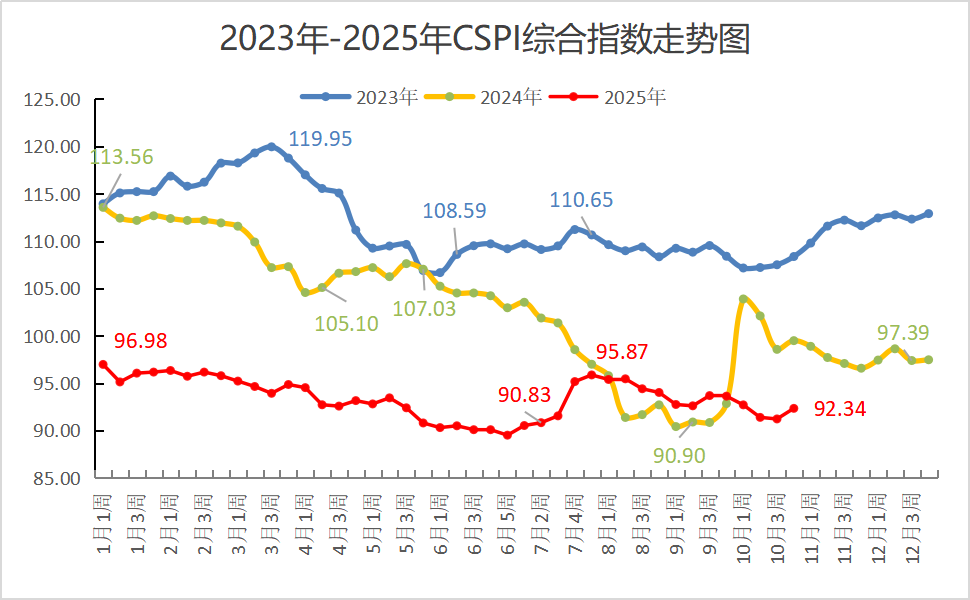
Core Viewpoint - The domestic steel market in China is experiencing a downward trend, with prices showing signs of weakness due to seasonal demand decline and overall market conditions [1][12]. Group 1: Steel Price Index Trends - In October 2025, the average CSPI (China Steel Price Index) was 91.92 points, a decrease of 1.26 points or 1.35% month-on-month, and a year-on-year decline of 9.10 points or 9.01% [2][8]. - The long product index averaged 92.23 points, down 1.49 points or 1.58% month-on-month, and down 13.04 points or 12.39% year-on-year [4][8]. - The plate index averaged 91.17 points, down 1.15 points or 1.25% month-on-month, and down 6.80 points or 6.94% year-on-year [4][8]. Group 2: Price Changes by Product Type - In October, most monitored steel products saw price declines, with hot-rolled coil prices dropping by 63 CNY/ton, while seamless pipe prices fell by 25 CNY/ton [9][10]. - The average price of rebar was 3098 CNY/ton, down 51 CNY/ton from the previous month, reflecting a decrease of 1.46% [9][10]. - The average price of galvanized sheet was 4166 CNY/ton, down 44 CNY/ton, indicating a decline of 1.03% [9][10]. Group 3: Regional Price Index Variations - In October 2025, all six major regions in China saw a month-on-month decline in the CSPI, with the Central South region experiencing the largest drop of 1.72% [14][16]. - The average rebar price index in the Western region was 3110 CNY/ton, down 82 CNY/ton or 2.58% from the previous month [14][16]. Group 4: Investment and Economic Indicators - From January to October 2025, fixed asset investment in China was 408914 billion CNY, down 1.7% year-on-year, with infrastructure investment showing a negative growth for the first time this year [17][20]. - Manufacturing investment grew by 2.7%, but the growth rate slowed compared to previous months, indicating weakening demand in the steel sector [17][20]. - The real estate sector continued to show signs of weakness, with cumulative investment down 14.7% year-on-year, exacerbating the oversupply pressure in the steel market [19][20]. Group 5: Supply and Demand Dynamics - In the first ten months of 2025, crude steel production was 81787 million tons, down 3.9% year-on-year, while apparent consumption fell by 6.5% [21][22]. - The average price of major raw materials increased, with coking coal rising by 3.82%, providing some support to steel prices [22][23]. - The steel export volume in October was 978.2 million tons, a decrease of 6.5% from the previous month, indicating pressure from global market conditions [43][44]. Group 6: Future Outlook - The steel industry is expected to face increased supply-demand imbalance as the traditional off-season approaches, necessitating self-discipline in production to stabilize prices [44]. - The government is likely to implement policies to control crude steel production, aiming to alleviate the oversupply issue and improve market conditions [39][40].

市场情绪改善 铁矿石价格有望实现今年首次月度连涨
Zhi Tong Cai Jing· 2025-08-29 07:34
Group 1 - The core viewpoint of the articles indicates that iron ore prices are expected to rise for the second consecutive month due to production cuts in steel mills and a new regulatory framework from the Chinese government aimed at controlling steel production capacity and output [1][2] - The Singapore iron ore futures price is stable at around $104 per ton, with an increase of nearly 5% in August, while the Dalian Commodity Exchange's iron ore main contract is likely to achieve a third consecutive month of gains [1] - China's plan to strictly control steel production and reduce output has led to a nearly 2% surge in futures prices, which may improve the financial situation of struggling steel mills and subsequently boost iron ore prices [1] Group 2 - Mysteel's data indicates that overall demand and inventory pressure for five major steel products are moderate, which is favorable for production expectations in September and October [1] - As of the latest report, the Singapore iron ore futures price remains at $104.20 per ton, with an increase of over 4.5% this month, while Dalian iron ore futures prices have decreased by 0.4% but increased by 1.1% in August [2] - In the black metal market, hot-rolled coil and rebar futures contracts show mixed performance, while Dalian coking coal futures contracts have decreased by 2% [2]