锌市供需平衡

Search documents
ILZSG:2025年全球锌市为供应短缺3.3万吨
Wen Hua Cai Jing· 2026-02-25 02:18
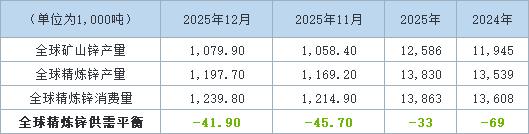
Group 1 - The global refined zinc consumption is projected to reach 1,239.8 thousand tons by December 2025, an increase from 1,214.9 thousand tons in November 2025, driven by rising demand in regions such as China, India, the US, Saudi Arabia, Thailand, and Europe [1][2] - Global refined zinc production is expected to grow by 2.1% in 2025, primarily due to a 6.1% increase in production from China, while production outside of China is projected to decline by 1.6% [1] - The global zinc market is anticipated to experience a supply shortage of 41.9 thousand tons in December 2025, slightly improved from a shortage of 45.7 thousand tons in November 2025 [1][3] Group 2 - The global mined zinc production is forecasted to increase by 5.4% in 2025, supported by production growth in Australia, China, India, Iran, Peru, South Africa, and the Democratic Republic of the Congo [1] - In Europe, mined zinc production has risen due to the reopening of the Tara mine in Ireland and increased output from Russia, Bosnia, and Herzegovina, offsetting declines in Brazil, Eritrea, Kazakhstan, and the US [2] - China's zinc concentrate imports surged by 29.8% to 2.58 million tons, while net imports of refined zinc halved to 210 thousand tons [2]

南华期货有色金属锌2026年度展望:外援破局,韧性重估
Nan Hua Qi Huo· 2025-12-21 12:25
Report Industry Investment Rating - Not provided in the content Core Viewpoints of the Report - The zinc price will maintain a wide - range oscillation throughout 2026. The price will be relatively strong in the first half of the year due to the structural shortage of domestic raw materials, and the center of gravity may move slightly downward in the second half as the incremental supply is fully transmitted to zinc ingots [1]. - The global zinc mine is entering an expansion cycle (with an expected increase of 290,000 tons), but the domestic market will still be in a tight - balance state in the first half of the year. Driven by the repair of TC, the smelting output will show a trend of "first decreasing and then increasing", with an expected year - on - year growth of over 4.5% for the whole year, and the supply pressure will gradually shift from the mine end to the ingot end [1]. - Although affected by the real estate industry, at the beginning of the "15th Five - Year Plan", infrastructure (UHV, wind power) and high - end manufacturing (new energy vehicle exports) will significantly increase the zinc consumption density, effectively offsetting the decline in real estate. The actual consumption is expected to maintain positive growth and achieve a soft landing [1]. - The core fluctuation range of the SHFE Shanghai zinc main contract in 2026 is predicted to be between 21,500 - 24,800 yuan/ton, and the LME zinc will fluctuate between 2,750 - 3,350 US dollars/ton. In the first half of the year, the domestic market will be stronger than the overseas market, and the price is likely to rise. In the second half, with the arrival of imported ores, the increase in TC will drive smelters to release production. Coupled with the potential drag from the real estate completion end, supply - demand pressure will gradually emerge, and the price center of gravity may decline under pressure [1]. Summary by Relevant Catalog Chapter 2: Market Review - In the first three quarters of 2025, zinc prices fluctuated widely due to repeated macro - expectations and mismatches in industrial supply - demand rhythms. In Q1, the shortage of mines supported the price increase. In Q2, trade frictions and the strong US dollar led to a significant price correction. In Q3, the supply - demand mismatch between domestic and overseas markets led to a resistance - style upward trend with the overseas market stronger than the domestic one [3]. - In Q4, the structural contradiction in the global zinc market reached an extreme. The market shifted from unilateral gambling to cross - market arbitrage. The large gap between domestic and overseas inventories opened the export profit window for Chinese zinc ingots. The export - driven marginal inventory reduction became the core variable affecting price fluctuations, and the market established a pattern of re - balance through exports [5]. Chapter 3: Supply Side 3.1 Zinc Concentrate - In 2025, global zinc mine supply recovered. The annual output is expected to reach 12.51 million tons, a year - on - year increase of 4.6%. In 2026, the output is expected to continue to grow by 2.27% to 12.61 million tons [12]. - Overseas mine production is growing steadily, driven by the resumption of old capacities and the ramping - up of new mines. Key mining enterprises such as Glencore, Ivanhoe Mines, and Teck Resources have good production performance. In 2026, the global new zinc mine increment is about 290,000 tons, and the market will be in a tight - balance state [14][15]. - The overall cost center of global zinc mines has shifted upward. The 90 - percentile line (about $2,400 - $2,550/ton) is considered a long - term "price bottom". If the zinc price falls below this line, about 10% of high - cost mines will face cash - flow losses and trigger passive production cuts [17]. - In 2025, domestic zinc concentrate supply was sufficient in general, but production was affected by environmental and safety inspections at the end of the year. In 2026, new and resumed projects are expected to contribute about 60,000 tons of output (excluding Huoshaoyun). The Huoshaoyun lead - zinc mine needs attention regarding the commissioning of supporting smelters [22]. 3.2 Smelting End - From 2024 to the first half of 2025, the global zinc smelting industry was in a difficult situation due to the extreme shortage of mine supply. In the second half of 2025, with the supplement of imported ores and the increase in TC, domestic smelters' production willingness was positive. The cumulative zinc ingot output from January to October was 5.686 million tons, a year - on - year increase of 10.1%, and the annual output is expected to be 5.9 million tons, a year - on - year increase of 11.5% [35]. - In 2026, the long - term benchmark TC is expected to rise significantly. Domestic smelting capacity can be released with high elasticity, but the supply pressure is expected to be less than that in 2025 [35]. - For overseas smelters, high and volatile energy costs in Europe are a major risk. Other regions such as South Korea, Japan, and Canada are expected to maintain high and stable operating rates. Globally, the refined zinc output is expected to grow by 3% to 14.12 million tons in 2026, indicating a gradual entry into the inventory accumulation cycle [38]. 3.3 Import and Export and Internal - External Price Ratio - In 2025, the zinc import window was mostly in a deep - loss state, especially in the second half of the year. From January to October, China's cumulative refined zinc imports were 2.77 million tons, a year - on - year decrease of 26.6%. The reason is the difference in the fundamentals of domestic and overseas markets, with overseas smelters having difficulty in restoring production due to high costs [39]. - In the future, the repair of the price ratio may be a prerequisite for the reversal of TC. With the increase in overseas mine supply and the resumption of smelter production, the shortage of LME zinc will be alleviated, the premium will decline, the price structure will turn to Contango, and the SHFE - LME price ratio will rise, narrowing the import loss [40][41]. Chapter 4: Demand Side - In 2026, China's refined zinc consumption is expected to show a slight increase of 0.5% - 1.5%, and the demand side is expected to be more resilient than the market's concerns about the drag from the real estate industry, achieving a soft landing [43]. 4.1 Real Estate - In 2025, real estate indicators such as new construction, construction, and completion areas all declined. In 2026, the real estate market will continue to drag down the zinc market. The new construction area is expected to maintain a negative growth of - 10% to - 15%, and the decline in the completion area is expected to narrow significantly to about - 10%. The direct drag on zinc consumption is expected to be about - 2.3% to - 2.7% [47][48]. 4.2 Infrastructure - In 2026, infrastructure investment will benefit from the "15th Five - Year Plan" and is expected to maintain a year - on - year growth of 6.8%. UHV grid construction will be a major highlight, and the demand for high - quality hot - dip galvanized pipes will increase significantly, making the infrastructure sector a key factor in stabilizing the demand base [50]. 4.3 Automobile - In 2025, the Chinese automobile market grew strongly, especially in terms of exports and new energy vehicle penetration. In 2026, although the new energy vehicle purchase tax will be reduced from full exemption to half exemption, the decline in battery costs and price competition among car companies will offset the impact of the policy. The output of new energy vehicles is expected to grow by 22.0%. The high - growth of automobile exports will reshape the zinc consumption structure, as export - oriented vehicles have a higher demand for zinc [52][53][54]. 4.4 Home Appliances - In 2026, the home appliance sector is expected to show a stable growth in zinc consumption, with an expected growth rate of 2.5% - 3.0%. This is mainly due to policy - driven replacement demand, the lagging dividend of real - estate completion, and the increasing demand for anti - corrosion materials in emerging markets [59][60]. 4.5 Photovoltaic and Emerging Fields - In 2026, although the growth rate of new photovoltaic installations is expected to decline to 18.0%, the absolute increment is still high. The penetration rate of Zn - Al - Mg alloy - coated brackets will further increase, and the expansion of application scenarios will ensure that the photovoltaic sector continues to contribute to zinc consumption [69]. 4.6 Downstream High - Frequency Demand Indicators - Various downstream high - frequency demand indicators such as galvanized sheet coil inventory, production, and zinc downstream consumption index show certain seasonal trends, which reflect the real - time demand situation in the zinc market [75][77]. 4.7 Inventory - In the first half of 2025, the inventory was at a historical low, and in the second half, the social inventory began to accumulate, but the accumulation rate was lower than expected. This is mainly due to stronger - than - expected demand, the integration of zinc alloy smelting capacity, and the opening of the export window. In 2026, factors affecting inventory include the recovery of the internal - external price ratio and the increase in overseas smelter production due to the rise in TC [79]. Chapter 5: Supply - Demand Balance Sheet 5.1 Global Zinc Concentrate Balance - In 2026, the global zinc concentrate supply is expected to be 12.6094 million tons, a year - on - year increase of 2.27%, and the demand is expected to be 12.6342 million tons, a year - on - year increase of 2.59%. The market will be in a tight - balance state [81]. 5.2 Global Refined Zinc Balance - In 2026, the global refined zinc output is expected to be 14.1215 million tons, a year - on - year increase of 3.01%, and the consumption is expected to be 13.9837 million tons, a year - on - year increase of 1.49%. The market will turn from a shortage to a surplus [82]. 5.3 China's Refined Zinc Balance - In 2026, China's refined zinc output is expected to be 7.172 million tons, a year - on - year increase of 4.55%. The net import is expected to decrease by 100%. The apparent consumption is expected to be 7.172 million tons, a year - on - year increase of 0.84%, and the actual consumption is expected to be 7.07 million tons, a year - on - year increase of 1.00%. The supply - demand surplus is expected to decrease by 8.92% [83].
ILZSG:2025年1-10月全球锌市为供应过剩7.6万吨
Wen Hua Cai Jing· 2025-12-18 01:51
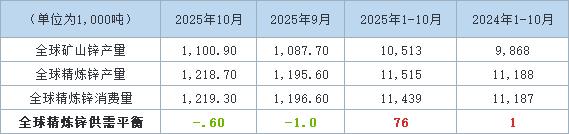
Core Insights - The International Lead and Zinc Study Group (ILZSG) reported an increase in global refined zinc consumption in October 2025, reaching 1,219.3 thousand tons, up from 1,196.6 thousand tons in September 2025 [1] - The global zinc market experienced a supply shortage of 0.06 thousand tons in October 2025, an improvement from a shortage of 0.10 thousand tons in September 2025 [1] Consumption and Production Data - Global refined zinc consumption for January to October 2025 totaled 1,143.9 thousand tons, compared to 1,118.7 thousand tons during the same period in 2024, indicating a year-on-year increase [1] - Global refined zinc production in October 2025 was 1,218.7 thousand tons, up from 1,195.6 thousand tons in September 2025 [1] - Global zinc mine production in October 2025 reached 1,100.9 thousand tons, an increase from 1,087.7 thousand tons in September 2025 [1] Supply and Demand Balance - The supply-demand balance for refined zinc showed a surplus of 76 thousand tons for January to October 2025, compared to a surplus of 1 thousand tons in the same period of 2024 [1] - The refined zinc supply-demand balance in October 2025 was a deficit of 0.60 thousand tons, an improvement from a deficit of 1.0 thousand tons in September 2025 [1]
海外锌精矿季度追踪报告八:2025Q3
Hong Yuan Qi Huo· 2025-11-14 10:43
1. Report Industry Investment Rating No relevant content provided. 2. Core Viewpoints of the Report - Zinc prices are under pressure from above and supported from below, with no clear direction. The short - term is expected to maintain range consolidation. Unilateral strategies should focus on high - selling and low - buying, and arbitrage strategies can consider going long on the Shanghai - London ratio [3][65][66]. - The tight pattern of the zinc ore end is expected to continue until the first quarter of next year. The TC has changed from rising to falling, and the industrial chain profit has shifted from the smelter end to the ore end again. The inventory trends at home and abroad are diverging [2][62][63]. 3. Summary by Directory 3.1 Total Overview - In August 2025, the global zinc market supply surplus expanded to 47,900 tons. From January to August 2025, the global refined zinc supply surplus was 154,000 tons. From July to August 2025, the global zinc concentrate cumulative output was 2.1712 million tons, a year - on - year increase of 11.57%. From January to August 2025, the global refined zinc output was 9.1482 million tons, basically the same as the cumulative output of last year [11]. - The statistical sample of this report shows that the zinc concentrate output in the third quarter of 2025 was 1.4424 million tons, a quarter - on - quarter decrease of 0.95% and a year - on - year increase of 8.20%. The cumulative output in the first three quarters was 4.254 million tons, a cumulative year - on - year increase of 6.31% [11]. 3.2 Glencore - In 2025, Glencore's zinc concentrate production guidance was adjusted to 94 - 980,000 tons. In the third quarter, the zinc concentrate output was 244,200 tons, a quarter - on - quarter decrease of 2.94% and a year - on - year increase of 7.86%. The cumulative output in the first three quarters was 709,400 tons, a cumulative year - on - year increase of 10.22% [19]. 3.3 Teck - In 2025, Teck's zinc concentrate production guidance was 525,000 - 575,000 tons. In the third quarter, the zinc concentrate output was 150,500 tons, a quarter - on - quarter decrease of 10.68% and a year - on - year decrease of 4.59%. The cumulative output in the first three quarters was 456,400 tons, a cumulative year - on - year decrease of 2.81% [24]. 3.4 Boliden - In the third quarter of 2025, Boliden's zinc concentrate output was 108,000 tons, a quarter - on - quarter increase of 5.08% and a year - on - year increase of 17.75%. The cumulative output in the first three quarters was 317,600 tons, a cumulative year - on - year increase of 21.12% [27]. 3.5 Vedanta - In the third quarter of 2025, Vedanta's zinc concentrate output was 262,000 tons, a quarter - on - quarter increase of 1.16% and a year - on - year increase of 8.26%. The cumulative output in the first three quarters was 785,000 tons, a cumulative year - on - year increase of 5.65% [32]. 3.6 Nexa - In 2025, Nexa's zinc concentrate production guidance was 300,000 - 336,000 tons. In the third quarter, the zinc concentrate output was 83,700 tons, a quarter - on - quarter increase of 13.88% and a year - on - year increase of 1.21%. The cumulative output in the first three quarters was 224,500 tons, a cumulative year - on - year decrease of 11.05% [37]. 3.7 MMG - In 2025, MMG's zinc concentrate production guidance was 215,000 - 240,000 tons. In the third quarter, the zinc concentrate output was 58,700 tons, a quarter - on - quarter increase of 4.58% and a year - on - year increase of 26.49%. The cumulative output in the first three quarters was 166,700 tons, a cumulative year - on - year increase of 6.85% [44]. 3.8 Newmont Goldcorp - In 2025, Newmont's zinc concentrate production guidance was 236,000 tons. In the third quarter, the zinc concentrate output was 59,000 tons, a quarter - on - quarter decrease of 11.52% and a year - on - year increase of 2.42%. The cumulative output in the first three quarters was 184,700 tons, a cumulative year - on - year increase of 2.30% [47][48]. 3.9 BHP - In the 2025 fiscal year, BHP's zinc concentrate production guidance was 90,000 - 110,000 tons. In the third quarter, the zinc concentrate output was 36,000 tons, a quarter - on - quarter decrease of 10.95% and a year - on - year increase of 85.77%. The cumulative output in the first three quarters was 102,400 tons, a cumulative year - on - year increase of 91.03% [49]. 3.10 South32 - In the 2026 fiscal year, South32's zinc concentrate production guidance was 40,000 tons, a decrease compared with the 2025 fiscal year. In the third quarter of 2025, the zinc concentrate output was 8,300 tons, a quarter - on - quarter decrease of 21.70% and a year - on - year decrease of 31.40%. The cumulative output in the first three quarters was 29,900 tons, a cumulative year - on - year decrease of 31.74% [50][51]. 3.11 Grupo Mexico - SCC - In 2025, SCC's zinc concentrate production guidance was 174,700 tons, a slight increase compared with the previous period. In the third quarter, the zinc concentrate output was 45,500 tons, a quarter - on - quarter decrease of 0.89% and a year - on - year increase of 46.42%. The cumulative output in the first three quarters was 130,800 tons, a cumulative year - on - year increase of 50.55% [52]. 3.12 Industrials Pelones - In the third quarter of 2025, Pelones' zinc concentrate output was 63,200 tons, a quarter - on - quarter increase of 5.02% and a year - on - year decrease of 11.33%. The cumulative output in the first three quarters was 181,000 tons, a cumulative year - on - year decrease of 13.68% [54]. 3.13 Fresnillo plc - In 2025, Fresnillo plc's zinc concentrate production guidance was 93,000 - 103,000 tons. In the third quarter, the zinc concentrate output was 24,700 tons, a quarter - on - quarter decrease of 12.91% and a year - on - year decrease of 23.41%. The cumulative output in the first three quarters was 78,400 tons, a cumulative year - on - year decrease of 10.61% [57]. 3.14 Market Outlook - The tight pattern of the ore end is expected to continue until the first quarter of next year. The TC has changed from rising to falling, and the industrial chain profit has shifted from the smelter end to the ore end again. The domestic and foreign inventory trends are diverging. Zinc prices are under pressure from above and supported from below, with no clear direction [62][63][65].