锡价上涨

Search documents
节后复工潮来袭!锡价站上 41 万关口,回收商该 “囤货” 还是 “快出”?
Xin Lang Cai Jing· 2026-02-26 10:25
Price Performance - On February 26, the price of tin surged by 11,500 yuan, reaching an average of 415,250 yuan per ton, marking a nearly 2.86% increase from the previous trading day [1] - The tin market experienced a strong opening, with a "supply shortage" leading to heightened trading activity, although the price increase showed signs of slowing down in the afternoon [1] Core Drivers - Supply constraints are evident as the resumption of tin mining in Myanmar is below expectations, logistics in major production areas are recovering slowly, and domestic refined tin production remains low, contributing to a "shortage" in the market [2] - Positive macroeconomic sentiment is reflected in the decline of the US dollar index to 97.66, easing pressure on commodity pricing, while US stock indices rose, enhancing global industrial recovery expectations [2] - Post-holiday demand from domestic electronics and photovoltaic welding companies has increased, with a notable rise in demand from the semiconductor and AI server sectors [2] Limitations on Price Increase - Despite multiple positive factors, the price increase is limited by the current reality of demand, as the electronics industry is still in a traditional off-season, and order recovery is not meeting expectations [3] Macro and Geopolitical Factors - Global macroeconomic and geopolitical uncertainties are impacting the tin market, with expectations of potential adjustments in export tariffs for key minerals by some countries, which could tighten global tin supply [4] - Ongoing regional conflicts may disrupt global supply chains, increasing transportation and trade costs for tin [4] Supply and Demand Dynamics - Supply remains tight due to slow recovery in Myanmar's tin mining and low domestic refined tin production, indicating that the "shortage" situation will persist [5] - Demand is recovering due to post-holiday activity in the electronics and photovoltaic sectors, but the pace of order recovery is still uncertain, with a focus on "small batch, frequent purchases" [6] Operational Recommendations - For recyclers, it is advised to adopt a "quick in and out" strategy due to the current high tin prices and short-term volatility risks [6] - Investors are encouraged to consider light positions supported by the 410,000 yuan level, targeting 420,000 yuan, while closely monitoring the recovery of orders and macroeconomic policies [6]


宏观共振引爆锡价,供应紧缩暗藏回调
Xin Lang Cai Jing· 2026-02-26 04:13
Core Viewpoint - The price of tin has surged significantly, driven by a combination of macroeconomic factors and supply constraints, indicating a strong bullish trend in the market [1][2][6]. Macroeconomic Factors - The US dollar index has weakened to 97.57, while the Chinese yuan has strengthened past the 6.85 mark, benefiting industrial metals [1]. - US stock markets have shown strong performance, with the Nasdaq rising by 1.26%, which has positively impacted demand for tin as a core metal in the electronics industry [1]. Supply Constraints - Indonesia is considering a complete ban on refined tin exports, following previous restrictions on tin ore exports, leading to expectations of a contraction in global tin supply [2]. - Tight supply conditions are further exacerbated by reduced supply from Myanmar and declining LME tin inventories, solidifying the global tin market's supply shortage [2]. Demand Dynamics - The domestic market has seen a recovery in transactions for tin, with downstream sectors such as electronics, photovoltaics, and semiconductors ramping up operations, leading to increased purchasing activity [3][4]. - The recovery in demand coincides with the traditional consumption peak in March, further supporting high tin prices [4]. Short-term Price Outlook - Tin prices are expected to remain strong, with projections indicating a continued upward trend and minimal room for correction, supported by multiple positive factors including the anticipated Indonesian export ban and recovering demand [5][6]. Summary of Market Conditions - The current market for tin is characterized by a significant price increase, with the price of 1 tin reaching 415,250 CNY per ton, reflecting a daily increase of 11,500 CNY [1][6]. - The combination of external drivers such as a weak dollar and strong US stock performance, along with internal support from recovering demand and tight supply, suggests that the bullish trend in tin prices is likely to continue [6].
伦锡日内涨幅达7.32%,现报50150.00美元/吨
Mei Ri Jing Ji Xin Wen· 2026-02-03 13:46
Group 1 - The core point of the article is that the price of LME tin has increased by 7.32%, reaching $50,150.00 per ton on February 3rd [1] Group 2 - The article is sourced from Daily Economic News, indicating a focus on market updates and financial news [1] - The report does not provide any additional context or analysis regarding the factors influencing the price change of LME tin [1]
伦锡涨4%
Ge Long Hui A P P· 2026-01-29 13:20
Core Viewpoint - The price of LME tin has increased by 4.00%, currently reported at $58,250.00 per ton [1] Group 1 - The current price of LME tin is $58,250.00 per ton [1] - The increase in price reflects a significant movement in the market, indicating potential demand or supply changes [1] - The percentage increase of 4.00% suggests a notable shift in trading activity for tin [1]
LME 3个月锡价涨幅扩大至7%,报55504美元/吨,再创历史新高
Mei Ri Jing Ji Xin Wen· 2026-01-23 15:47
Group 1 - The core point of the article is that the LME three-month tin price has increased by 7%, reaching a record high of $55,504 per ton on January 23 [1] Group 2 - The significant price increase indicates strong demand or supply constraints in the tin market, which could impact related industries [1] - The historical high price may attract more investors and traders to the tin market, potentially leading to increased volatility [1] - This price movement could have implications for companies that rely on tin for production, affecting their cost structures and profit margins [1]
LME三个月锡价创下每吨55,355美元的历史新高,较前一日上涨6.5%
Mei Ri Jing Ji Xin Wen· 2026-01-23 14:35
Core Insights - LME three-month tin prices reached a record high of $55,355 per ton, marking a 6.5% increase from the previous day and a cumulative rise of 37% since the beginning of the year [1] Group 1 - The significant increase in tin prices indicates strong demand and potential supply constraints in the market [1] - The record high price reflects broader trends in commodity markets, where various metals have seen price surges [1]
伦锡日内涨幅达6.00%,现报52245.00美元/吨
Mei Ri Jing Ji Xin Wen· 2026-01-21 06:54
Group 1 - The core point of the article is that the price of LME tin has increased by 6.00%, reaching $52,245.00 per ton [1]
三箭齐发!上期所:调整锡期货交易保证金比例、涨跌停板幅度及交易限额
券商中国· 2026-01-15 14:27
Core Viewpoint - The Shanghai Futures Exchange has announced adjustments to the margin ratio, price fluctuation limits, and trading limits for tin futures, aiming to guide market participants towards rational and cautious participation, ensuring stable market operations [4]. Group 1: Market Adjustments - Starting from January 15, 2026, the price fluctuation limit for tin futures contracts will be adjusted to 11%, with the margin ratio for hedging transactions set at 12% and for general positions at 13% [3]. - From January 16, 2026, the maximum number of contracts for day trading by non-futures company members and special overseas non-broker participants will be limited to 800 contracts, while hedging and market-making transactions will not be subject to this restriction [3]. Group 2: Price Trends and Influencing Factors - Tin prices have recently surged, breaking historical highs and surpassing the 2022 peak, reaching above 400,000 yuan/ton, with a cumulative increase of 33% within just half a month [5]. - Factors influencing the rise in tin prices include tight supply due to delayed production recovery in Myanmar, export issues in Indonesia, and production reduction expectations in regions like the Democratic Republic of the Congo due to conflicts [3]. - Domestic inventory levels are at a historical mid-range, with recent accumulation in futures inventory, while the market remains optimistic about long-term consumption driven by electronic products and solder materials [3]. Group 3: Analyst Insights - Analysts suggest that 2026 is likely to be a turning point for tin concentrate supply, with expectations of a gradual easing of supply by the second quarter [4]. - Despite the ongoing demand growth for semiconductor solder, the rapid price increase may be overextending long-term expectations, leading to potential volatility in the market [4]. - The recent price surge has positively impacted related company stock prices, with Huaxi Nonferrous rising by 2.2% and Yunnan Tin Company increasing by 1.5% as of January 15, 2026 [5].

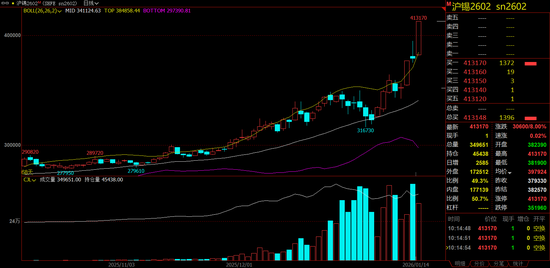
锡突破新高,强势涨停
Guo Tai Jun An Qi Huo· 2026-01-14 10:29
Group 1: Industry Investment Rating - No information provided Group 2: Core Viewpoints - Tin prices recently broke through the historical high of 395,000 yuan/ton in 2022, reaching above 400,000 yuan/ton and hitting the daily limit with an 8% increase today [2] - The recent rise in tin prices is due to tight supply, low inventory, and smooth price transmission to downstream [2] - Tin prices are expected to continue rising, with the next target around 450,000 yuan/ton [2] Group 3: Strategy Suggestions - In the case of lack of liquidity in the futures market's daily limit, consider buying call options to hedge risks, while controlling the purchase cost of strike price + premium [3] - For customers with long positions planning to gradually reduce positions, consider arranging some short - term and wide - range Phoenix accumulator put options to reduce positions when the price surges and increase income during fluctuations [4]
沪锡期货再度涨停、刷新历史高位!这一轮上涨究竟还能走多远?
Xin Lang Cai Jing· 2026-01-14 02:39
Core Viewpoint - The recent surge in Shanghai tin futures prices is attributed to strong external tin prices, ongoing global supply disruptions, limited inventory pressure, and improved macroeconomic sentiment, making tin one of the most prominent performers in the non-ferrous sector [1][8]. Group 1: Market Sentiment and Price Dynamics - The bullish sentiment in the market remains strong, with overnight external tin prices continuing to rise, leading to a historical high for the Shanghai tin main contract [3][10]. - Speculative funds are influencing price volatility, with a notable increase in trading activity and a bullish market structure characterized by rising volume and open interest [3][10]. - The overall sentiment in the non-ferrous sector is exuberant, driven by geopolitical tensions and a renewed focus on resource commodities, with tin demonstrating significant price elasticity [3][10]. Group 2: Supply Chain and Production Factors - Supply-side factors are seen as crucial for the upward movement in tin prices, with tight supply conditions due to delayed production recovery in Myanmar and export issues in Indonesia [4][11]. - The ongoing instability in the Democratic Republic of Congo raises concerns about the operations of the Alphamin-owned Bisie mine, further contributing to supply worries [4][11]. - Data indicates that China's tin ore imports decreased by 21.7% year-on-year in the first 11 months of 2025, with imports from Congo and Myanmar significantly below pre-production levels, providing strong support for high tin prices [4][11]. Group 3: Inventory and Demand Structure - Recent trends show a slight decrease in inventory levels, indicating no significant supply pressure, although the spot market lacks vitality due to cautious trading sentiment [5][13]. - Despite high tin prices, the "invisible inventory" of domestic tin mines and ingots is relatively low, with inventory accumulation falling short of expectations [6][13]. - The apparent demand for tin is gradually weakening, but recent macroeconomic optimism has led to speculative demand shifting visible inventory to hidden inventory [6][13]. Group 4: Macroeconomic Environment - The macroeconomic landscape appears positive, with U.S. non-farm payrolls showing a decline in new jobs and a drop in the unemployment rate, interpreted as a moderately positive economic signal [7][14]. - The easing of U.S. monetary policy under the new Federal Reserve chair is expected to bolster macroeconomic sentiment, providing additional elasticity for tin prices [7][14].