
锡焊料

Search documents
贵色齐飞,沪锡强势涨停
Xin Lang Cai Jing· 2026-01-14 08:51
Core Viewpoint - The recent strong performance of the non-ferrous metals sector, particularly tin, is driven by various factors including supply constraints and rising demand in emerging sectors [2][3][15] Industry Overview - Tin prices have seen a significant increase, with London tin prices rising over 6% to exceed $52,000, breaking the 2022 high, while Shanghai tin reached a limit-up, surpassing the 400,000 yuan mark [2][10] - The tin industry chain consists of three segments: upstream (tin mining and selection), midstream (smelting and processing), and downstream (various applications) [2][11] - Major tin-producing countries include China, Indonesia, Myanmar, Peru, and the Democratic Republic of the Congo, with China being highly dependent on tin imports [10][11] Fundamental Analysis - Global macroeconomic expectations are warming, leading to increased market risk appetite, which benefits the precious metals and non-ferrous sectors [3][15] - Supply-side growth is weak due to delays in Myanmar's production recovery, Indonesia's crackdown on illegal mining, and ongoing geopolitical tensions in the Democratic Republic of the Congo, which raise expectations of production cuts [3][15] - Demand in traditional sectors is slowing, while emerging sectors such as new energy, new materials, and artificial intelligence show strong demand, particularly for soldering materials [3][15] - Recent geopolitical tensions have heightened concerns over resource supply stability, further increasing the strategic premium of tin [3][15] Price Trends and Market Sentiment - Tin prices are expected to continue their upward trend in the short term, but caution is advised due to potential market sentiment shifts caused by macroeconomic and geopolitical changes [4][12] - The 400,000 yuan mark is seen as a critical support level for tin prices [4][12]


供应扰动频繁,AI+半导体催化需求增长
Zhong Guo Neng Yuan Wang· 2026-01-13 01:01
Core Viewpoint - The global tin market is experiencing structural shortages, with supply heavily reliant on a few resource-rich countries. In 2024, global tin production is projected to be 300,000 tons, a decrease of 1.63% year-on-year, with Myanmar, Indonesia, and China accounting for 51% of this production. Limited new capacity is expected due to declining ore grades and mining policies. On the demand side, global tin demand is expected to reach 385,200 tons in 2024, an increase of 3.33% year-on-year, with electronic soldering accounting for 154,100 tons, or 40.01% of total demand [2]. Supply and Demand Analysis - Supply is concentrated and incremental growth is limited, while demand remains robust. The structural shortage in the global tin market is driven by weak supply and strong demand. Since early 2025, Myanmar's mining operations have been suspended longer than expected, leading to a forced reduction in smelter operating rates. Additionally, conflicts in the Democratic Republic of Congo have halted tin concentrate production, affecting approximately 6% of global tin supply, exacerbating material shortages. On the demand side, the expansion of tin solder demand from AI servers and photovoltaics continues to tighten the supply-demand balance, driving tin prices upward [2]. Related Companies - Xiyang Co., Ltd. (000960): Positioned in the tin-rich region of Yunnan, it has established an integrated tin industry chain and ranks first globally in tin production and sales [2]. - Xingye Silver Tin (000426): Both silver and tin production are increasing, with its subsidiary, Yinman Mining, being the second-largest producer of tin concentrate in China, and ongoing acquisitions of overseas tin resources [2]. - Huaxi Nonferrous Metals (600301): Engaged in both tin and antimony, the company benefits from the integration of mining rights and industrial clustering in Guangxi, serving as a platform for state-owned nonferrous metals [2].


长江有色:12日锡价暴涨 被动补库引发抢购潮持货方强势挺价
Xin Lang Cai Jing· 2026-01-12 07:42
Group 1 - The core viewpoint of the articles highlights a strong upward trend in tin prices driven by macroeconomic, geopolitical, and industrial factors, with significant price increases observed in both futures and spot markets [1][2] - The Shanghai tin contract 2602 experienced a notable increase, closing at 376,920 yuan/ton, marking an increase of 27,920 yuan and an 8% rise [1] - The current tin market is characterized by a tight balance between limited supply and upgraded demand structure, with global production constraints and low visible inventories providing strong price support [2] Group 2 - Supply-side constraints are evident due to production disruptions in major global regions such as Indonesia, Myanmar, and the Democratic Republic of the Congo, alongside domestic smelting limitations [2] - Demand is shifting structurally, with strong performance in emerging industries like AI computing power, new energy vehicles, and photovoltaic welding strips, which are supporting tin consumption despite a seasonal slowdown in traditional electronics [2] - Leading companies in the industry, such as Tin Industry Co., are experiencing significant growth in performance, reflecting the overall improvement in industry sentiment and the positive correlation with tin prices [2]

锡月报:短期宏观氛围积极,预计锡价震荡运行-20260104
Wu Kuang Qi Huo· 2026-01-04 13:30
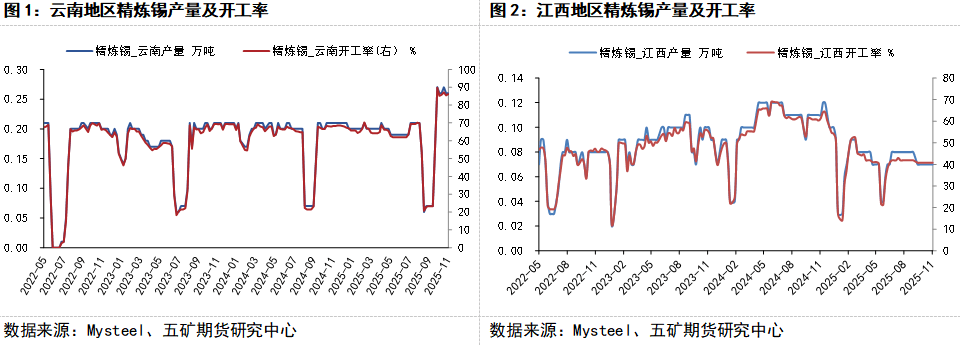
1. Report Industry Investment Rating - Not provided in the content 2. Core Viewpoints of the Report - In December 2025, tin prices were high and strong. In terms of supply, the operation of tin ingot smelters in Jiangxi and Yunnan remained stable at a high level. In terms of demand, the demand for consumer electronics entered the traditional off - season at the end of the year, but the operating rate of tin solder enterprises remained stable supported by new - energy vehicles and AI servers. In the spot market, downstream enterprises adopted a low - inventory strategy with weak purchasing willingness. Tin inventory increased for three consecutive weeks. High prices significantly inhibited tin demand, and it is expected that tin prices will fluctuate and weaken in the future [11][13] 3. Summaries According to Relevant Catalogs 3.1 Monthly Evaluation and Strategy Recommendation - Cost side: In November 2025, the import of tin concentrates in China increased significantly, and the shortage of raw material supply was alleviated. The import volume of tin ore and its concentrates was 15,099 tons, a month - on - month increase of 29.81% and a year - on - year increase of 24.42%. The imports from Myanmar (the largest source) and the Democratic Republic of the Congo (the second - largest source) changed differently [12] - Supply side: The resumption of tin mines in Wa State, Myanmar, advanced, and the export volume increased significantly. However, the shortage of raw materials for smelting enterprises in Yunnan still existed, and the short - term operating rate remained stable with limited upward momentum. In Jiangxi, due to the significant reduction in scrap, the supply of crude tin was insufficient, and the output of refined tin remained at a low level. Overall, it is difficult to further improve the operating level of smelters in the short term [12] - Demand side: At the end of the year, the demand for consumer electronics entered the traditional off - season, but the operating rate of tin solder enterprises remained stable supported by new - energy vehicles and AI servers. In November, the output of tin solder of sample enterprises increased by 0.95% month - on - month, and the operating rate rose slightly by 0.69% compared with October. In the现货 market, downstream enterprises adopted a low - inventory strategy, resulting in a three - week increase in tin inventory. As of December 26, 2025, the social inventory of tin ingots in major domestic markets was 10,367 tons, an increase of 186 tons from the previous Friday [12] 3.2 Futures and Spot Market - Not provided with specific text analysis content, only relevant data graphs are presented, including the basis of Shanghai tin main contract and the LME tin premium (0 - 3) [19][20] 3.3 Cost Side - Not provided with specific text analysis content, only relevant data graphs are presented, including China's monthly tin ore production, tin ore import volume, tin concentrate price, and tin concentrate processing fee [24][26] 3.4 Supply Side - Not provided with specific text analysis content, only relevant data graphs are presented, including domestic refined tin monthly output, domestic recycled tin monthly output, tin output and operating rate in Yunnan and Jiangxi regions, refined tin export and import profits, domestic refined tin import volume, and Indonesia's refined tin import and export [30][32][35] 3.5 Demand Side - The year - on - year growth rate of China's semiconductor sales rebounded slightly, and the global semiconductor sales maintained high growth. The report also presented data graphs of domestic computer production, smartphone production, output of household appliances (washing machines, air conditioners, refrigerators, color TVs), China's photovoltaic cell production, domestic key enterprise tin - plated strip production, domestic PVC monthly output, downstream solder enterprise operating rate, and domestic tin apparent consumption [43][44][46] 3.6 Supply - Demand Balance (Inventory) - Not provided with specific text analysis content, only relevant data graphs are presented, including China's social inventory and LME inventory [60]
国内库存明显攀升 短期锡价或震荡回调
Jin Tou Wang· 2025-12-25 08:54
Core Viewpoint - The current tin market is experiencing a mixed scenario with increasing supply from Indonesia and Myanmar, while domestic demand remains weak, leading to potential price fluctuations in the short term [3][4]. Group 1: Price Information - On December 25, the spot price for Shanghai 1 tin ingot was quoted at 332,750.00 CNY/ton, which is 3,130.0 CNY/ton lower than the futures main price of 335,880.00 CNY/ton [1]. - The futures market closed on December 25 with the main contract for tin at 335,880.00 CNY/ton, reflecting a decline of 1.18%, with a daily trading volume of 298,226 contracts [2]. Group 2: Supply and Demand Dynamics - Indonesia's exports in November increased nearly twofold, contradicting previous expectations of a decline, while Myanmar's Wa State is ramping up production, with imports of tin ore from Myanmar expected to reach around 8,000 tons in November and December, exceeding earlier forecasts of 4,000-5,000 tons [3]. - Domestic tin solder enterprises are maintaining stable operating rates, with a 0.95% month-on-month increase in production in November, supported by orders from emerging sectors such as new energy vehicles and AI servers [3]. Group 3: Market Analysis - According to New Lake Futures research, while supply is increasing due to the recovery in Myanmar and a significant rise in Indonesian exports, domestic tin ore supply remains tight, and smelting plants have not shown a notable increase in production, keeping output relatively stable [4]. - There is a clear sign of weak consumption in the terminal market, with reduced orders from downstream solder enterprises leading to a decline in operating rates, and domestic inventory levels are rising, which may exert downward pressure on prices [4].
大宗周期-有色金属行业主题报告
2025-12-17 02:27
Summary of Key Points from Conference Call Records Industry Overview - The reports focus on the non-ferrous metals industry, particularly gold, copper, aluminum, tin, lithium carbonate, and cobalt markets for the year 2026 [1][2][3][4][5][6][7][8][9][10][11][12][13]. Core Insights and Arguments Gold Market - Gold prices are expected to benefit from a weakening US dollar, anticipated Federal Reserve interest rate cuts, and potential policy uncertainties following Powell's departure, alongside ongoing global central bank gold purchases [1][4]. - The macroeconomic environment is projected to support gold's monetary and financial attributes, driving prices upward [2][3]. Copper Market - Supply constraints are anticipated due to diminishing resource endowments and stricter policies affecting overseas copper mining projects, limiting capacity expansion [1][5]. - Demand for copper is expected to rise significantly due to AI hardware and infrastructure development, with a projected compound annual growth rate of 50% in global computing power from 2025 to 2030 [5]. Aluminum Market - Domestic aluminum production capacity is nearing its limit, while high electricity prices overseas are increasing operational uncertainties [6][7]. - Strong growth in electric vehicle demand and historically low aluminum inventories suggest potential price elasticity for aluminum [6][7]. Tin Market - The tin supply is under pressure due to Indonesia's crackdown on illegal mining, slow recovery in Myanmar, and conflicts in the Democratic Republic of Congo, leading to a tightening global supply [8][9]. - Despite low processing fees in Yunnan and Guangxi, future demand for tin is expected to remain robust, particularly driven by the semiconductor industry and AI applications [9]. Lithium Carbonate Market - The lithium carbonate market is projected to maintain strong momentum in 2026, supported by rapid growth in electric vehicles and energy storage demand [1][10]. - Supply risks from domestic mica mines and a slowdown in overseas lithium resource expansion are noted, but demand is expected to remain strong [10]. Cobalt Market - The cobalt market is facing supply concerns due to tightened export policies from the Democratic Republic of Congo, which is expected to significantly reduce export volumes [3][11][12]. - The anticipated structural supply tightness is likely to persist, affecting global cobalt availability [12]. Additional Important Insights - The overall outlook for the industrial and energy metals sector is positive, with expectations of improved fundamentals and macroeconomic support driving growth [2][3][13]. - Companies with strong cost advantages and clear future prospects are recommended for investment, as they are expected to achieve significant volume increases and provide potential returns for investors [13].
——2025年锡市场回顾与2026年展望:锡:灼华未央,价韧其章
Fang Zheng Zhong Qi Qi Huo· 2025-12-15 05:23
1. Report Industry Investment Rating No relevant information provided. 2. Core Viewpoints of the Report - In 2025, the tin price showed an overall upward - trending oscillation. In 2026, the tight supply situation at the mine end is expected to ease, with a likely front - tight and back - loose pattern. The smelting end's operating rate is expected to gradually recover, and processing fees may slightly rebound. The tin solder sector, which performed well in 2025, is expected to continue to grow in 2026, benefiting from the semiconductor industry. The tin price in 2026 is expected to remain strong, showing a trend of rising first and then falling with an overall upward - shifted center. The main operating range of Shanghai Tin is expected to be between 250,000 - 350,000 yuan/ton, and that of LME Tin is expected to be between 30,000 - 48,000 US dollars/ton [2][90][92]. 3. Summary According to the Table of Contents 3.1 2025 Tin Market Review 3.1.1 Long - term Tin Price Trend Review - Since 2011, the tin price has gone through eight stages: a continuous decline from the second half of 2011 to the end of 2015 due to global economic concerns; a sharp rise from the end of 2015 to the end of 2016 due to supply - side structural reforms; an oscillatory trend from early 2017 to April 2019 as supply exceeded demand; a continuous decline from April 2019 to March 2020 due to trade disputes and the COVID - 19 pandemic; a new high from April 2021 to March 2022 due to loose policies and supply - demand imbalance; a sharp fall from March to October 2022 due to Fed rate hikes; an oscillatory trend from November 2022 to March 2024 under the influence of supply - side disturbances and a falling US dollar index; and a strong rise and subsequent high - level oscillation from March 2024 to the present [10][11][13]. 3.1.2 2025 Tin Market Review - **Tin Futures Price Review**: The tin price in 2025 showed a pattern of rising first, then falling, and then rising again. In the first quarter, it rose due to tight mine - end supply. In mid - March, the civil unrest in the Democratic Republic of the Congo pushed up bullish sentiment. After the Tomb - sweeping Festival, there was a systemic risk, followed by a narrow - range oscillation. In September, the price rose again due to supply issues and the Indonesian government's crackdown on illegal tin smuggling [15]. - **Tin Spot and Premium/Discount**: In 2025, the domestic tin spot was at a discount, while the LME tin premium/discount hovered around 0 [19]. 3.2 Macro - analysis - In 2025, the eurozone economy was relatively sluggish, with controllable inflation and a loose European Central Bank. The US economy had some resilience, but its growth momentum weakened, and the risk of recession increased. The Chinese economy showed resilience, but faced deflationary pressure. In 2026, the inflation in Europe and the US is expected to gradually decline, and major central banks are likely to continue the rate - cut cycle. The US economy may see moderate growth, while the eurozone's growth may remain low. China's macro - economic policies are expected to be more proactive, and the inflation environment may gradually improve [20]. 3.3 Tin Market Supply Analysis 3.3.1 Tin Ore Supply May Be Front - tight and Back - loose - In 2025, there were many disruptions in tin ore supply, such as the suspension of mines in the Democratic Republic of the Congo and the slow resumption of production in Myanmar's Wa State. From 2025 - 2026, new projects are few, and the ore increment is limited. In 2026, the global tin ore production is expected to increase slightly by about 4,500 metal tons, reaching about 360,000 tons. China's tin ore production has been gradually decreasing in recent years, but showed a small increase in 2025. China's tin ore imports are expected to gradually increase in 2026. The tin ore price showed an upward - trending oscillation in 2025, and the processing fee was at a low level [24][25][26]. 3.3.2 Refined Tin Production Will Maintain Growth - In 2025, the domestic refined tin production of sample enterprises increased year - on - year. Overseas, there was a supply shortage in the first 9 months of 2025. In general, the tight mine - end supply in the past two years affected the smelting capacity. The smelting operating rate is expected to gradually rebound in 2026, with a slightly higher growth rate than in 2025. In 2025, the refined tin import window was mostly closed, and China became a net exporter of refined tin. The short - term import window is difficult to open [38][42][43]. 3.4 Tin Market Demand Analysis 3.4.1 Tin - plated Sheet Production Declined While Exports Increased - In 2024, China's tin - plated sheet production increased steadily. In 2025, it declined significantly due to the substitution of chrome - plated sheets and weak domestic demand. However, exports increased, mainly due to strong external demand and China's cost - advantage. But the future export situation may be affected by the substitution of new materials and trade - relief investigations [47][48]. 3.4.2 Lead - acid Battery Production Increased Significantly - In recent years, the rapid development of the e - bike, express delivery, and takeout industries supported the consumption of lead - acid batteries. In 2025, the production growth rate accelerated, but exports declined year - on - year [56]. 3.4.3 The Growth Cycle of Electronic Products May Be Near the End - In 2023, the downward cycle of electronic products turned around. In 2024, they showed positive growth. In 2025, the growth rate of computer and smartphone production slowed down. In 2026, the growth rate of production and sales of computers and mobile phones is expected to slow down but remain positive [60]. 3.4.4 Integrated Circuit Production Will Maintain Rapid Growth - Since 2024, China's integrated circuit production has increased significantly. The growth rate accelerated in the second half of the second quarter and then declined in the third - quarter off - season. With the recovery of the global semiconductor industry, the production and sales of integrated circuits are expected to maintain high - speed growth in the medium and long term [63]. 3.4.5 The Photovoltaic Industry Is in a Transition from the High - speed Development Stage - In 2024 and 2025, China's photovoltaic installed capacity increased significantly. However, the industry faces over - capacity. In 2026, the industry will face resource integration, and capacity growth will be more orderly. The global new - installed photovoltaic capacity is expected to reach 665GW, and the new tin demand is expected to reach about 43,000 tons [66]. 3.4.6 The New - energy Vehicle Industry Maintains Growth - In 2025, the production and sales of new - energy vehicles increased significantly. Due to the cost - advantage and policy support, the sales will continue to grow. In the long - term, the growth rate will slow down, but the marginal increment is still significant. In 2026, the production and sales growth rate is expected to be between 15 - 20% [71]. 3.5 Tin Inventory First Rose and Then Fell - In 2024, the inventories of the two major exchanges showed different trends. In 2025, the SHFE inventory first increased, then decreased, and then increased again. The LME inventory decreased first and then increased. As of December 1, the total inventory of the two exchanges was at a medium level. The LME tin premium/discount narrowed in 2025, and the import window was intermittently open [74][77]. 3.6 Global Refined Tin Supply - Demand Balance Sheet Forecast - Since 2018, the global tin market has been in a supply - shortage situation for most months. In 2025, the supply was tight in the first half and loose in the second half, while demand continued to grow. In 2026, the supply is expected to increase slightly, and demand will also grow moderately, maintaining a tight - balance situation [80]. 3.7 Seasonal and Technical Analysis 3.7.1 Seasonal Analysis - Historically, the tin price is weakest in March, and the probability of decline is high in March, August, September, and October. It often performs strongly in January, July, and December. In 2025, the tin price showed a wide - range oscillation, with most months showing a decline except April [83]. 3.7.2 Technical Analysis - From the daily K - line of the Shanghai Tin main contract, in March 2025, the price broke through the 270,000 - yuan mark and then fell back. In August, it accelerated its rise, filled the gap after the Tomb - sweeping Festival, and broke through the previous high of the year. In the short - term, the upward momentum is not exhausted, and it may approach the historical high in 2022 [87]. 3.8 LME Position Analysis - In the past three years, the tin price has maintained a wide - range oscillation. Investment funds generally held a net - long position, which increased significantly in the second half of 2025. Investment companies, credit institutions, and commercial enterprises held different positions. As of November 28, 2025, investment companies and credit institutions had a net - long position of 2,309 lots, investment funds had a net - long position of 5,002 lots, and commercial enterprises had a net - long position of - 6,339 lots [89]. 3.9 Conclusion and Operational Suggestions - In 2025, the tin price showed an upward - trending oscillation. In 2026, the supply at the mine end is expected to ease, the smelting operating rate may recover, and the processing fee may slightly rebound. The tin solder sector is expected to continue to grow. The tin price in 2026 is expected to be strong, showing a trend of rising first and then falling with an overall upward - shifted center. The main operating range of Shanghai Tin is expected to be between 250,000 - 350,000 yuan/ton, and that of LME Tin is expected to be between 30,000 - 48,000 US dollars/ton [90][92]. 3.10 Related Stocks - Stocks such as Yunnan Tin Industry Co., Ltd. (000960.SZ), Xingye Co., Ltd. (603928.SH), Yintai Gold Co., Ltd. (000975.SZ), and others are related to the tin industry. Their stock prices showed different monthly and annual growth rates [93].
期货看“五”评 | 价格再创短期新高,如何看待锡价后续走势?
Sou Hu Cai Jing· 2025-12-12 02:09
Supply Side - In October 2025, domestic tin ore imports increased to 11,600 tons (approximately 5,050 metal tons), a month-on-month rise of 33.49% but a year-on-year decline of 22.54% [1] - Cumulative imports from January to October reached 103,000 tons, reflecting a year-on-year decrease of 26.23% [1] - Tin ingot imports in October were 526 tons, down 58.55% month-on-month and 82.72% year-on-year, with cumulative imports for the year at 16,552 tons, showing a year-on-year increase of 10.84% [1] - Imports from Congo (DRC) showed a recovery, while imports from Myanmar slightly declined but are expected to increase by over 2,000 tons in November due to mining permit approvals [1] Production Side - November's refined tin production is expected to remain stable, with Yunnan and Jiangxi's smelting enterprises maintaining high operating rates [2] - Yunnan's large smelting plants have resumed operations after seasonal maintenance, while Jiangxi faces a shortage of recycled raw materials, leading to lower production levels [2] - Overall, production recovery is constrained by raw material supply bottlenecks and weak demand, with no significant short-term increase in operating levels anticipated [2] Demand Side - The semiconductor industry continues to show resilience, with tin solder enterprises maintaining stable operating rates; November production increased by 0.95% month-on-month [4] - Southern China’s tin solder manufacturers are performing better due to their integration into emerging sectors like automotive and AI servers, which have robust order expectations [4] - In contrast, Eastern China’s tin solder enterprises are facing pressure due to slower order recovery in traditional consumer electronics, leading to weaker trading sentiment [4] Price Outlook - The tin market is currently in a tight balance, with improved supply from increased domestic imports in October, although concerns remain due to worsening conflicts in Congo affecting transport [10] - Traditional sectors like consumer electronics show signs of fatigue, while long-term demand from new sectors like electric vehicles and AI servers supports tin prices [10] - As Myanmar's tin ore supply gradually increases and demand weakens slightly, the supply-demand situation is expected to improve, potentially putting pressure on tin prices [10]
锡行业专题:矿端紧缺,库存低位
Guoxin Securities· 2025-12-10 09:11
Investment Rating - The investment rating for the tin industry is "Outperform the Market" (maintained) [1] Core Insights - Tin is an essential minor metal with increasing resource scarcity. As of the end of 2024, global tin reserves are estimated at 4.2 million tons, with a production of 300,000 tons. The reserve-to-production ratio has decreased from around 20 years in 2010 to 14 years in 2024, indicating a low level of reserves compared to production [2][21] - Global tin supply is expected to decline significantly by 2025 due to decreasing ore grades and various unpredictable factors affecting major production areas. China, the largest producer, has seen a decline in domestic production since 2015 due to lower ore grades and stricter environmental regulations [2][21] - Demand for tin is projected to remain stable or increase, driven by the semiconductor industry and other applications. The global demand for tin is expected to reach 386,000 tons in 2025, with a steady growth forecast through 2027 [2][21] - A significant shortage of refined tin is anticipated in 2025, with a projected supply-demand gap of approximately 16,000 tons. This gap may narrow in subsequent years as production resumes in Myanmar and new projects come online [2][21] - Key companies in the industry include Xiyang Co., Xingye Yinxin, and Huaxi Nonferrous [2] Summary by Sections Industry Overview - Tin is characterized by its low melting point and good conductivity, making it irreplaceable in solder applications. The global distribution of tin reserves is concentrated in a few countries, with China holding the largest share [2][21] Supply Dynamics - The global tin supply has been stable around 300,000 tons in recent years, but significant declines are expected due to various factors affecting major production areas, including environmental regulations and resource depletion [2][21] Demand Dynamics - The semiconductor sector is a major driver of tin demand, with a strong correlation to electronic product production. The demand for tin in solder applications is expected to grow, supported by a recovery in semiconductor sales [2][21] Price Trends - Tin prices have seen significant fluctuations, with a notable increase of 46% since early 2024. The average price for tin in 2024 is projected to be 248,300 yuan per ton, reflecting a year-on-year increase of 16.92% [12][21] Regional Insights - China's tin production has been on a downward trend, with production expected to be 69,000 tons in 2024, down from previous highs. Despite this, China remains the largest producer and holder of tin reserves globally [34][21]
锡月报:短期供给扰动,预计锡价偏强震荡-20251205
Wu Kuang Qi Huo· 2025-12-05 14:21
1. Report Industry Investment Rating No information provided. 2. Core View of the Report - In November, tin prices continued to strengthen under the influence of supply disturbances at the mine end, reaching a new high for the year. Although the current demand in the tin market is weak, with low downstream inventories and limited bargaining power, supply - side disturbances are the determining factor for short - term prices. Therefore, it is more likely that tin prices will fluctuate strongly in the short term [11][13]. 3. Summary of Each Section According to the Table of Contents 3.1 Monthly Evaluation and Strategy Recommendation - Cost side: In October, the import volume of tin concentrates in China increased significantly, and the shortage of raw material supply was slightly alleviated. However, the recent deterioration of the conflict in the Democratic Republic of the Congo has disrupted tin ore transportation, raising market concerns. In October, the import volume of tin ore and concentrates was 11,632 physical tons (equivalent to about 4,938 metal tons), a year - on - year decrease of 15.74% and a month - on - month increase of 43.36% [12]. - Supply side: The resumption of tin mines in Wa State, Myanmar, has been slow, with low export volumes. Smelting enterprises in Yunnan still face a shortage of raw materials, and their short - term operating rates are stable but lack further upward momentum. In Jiangxi, due to a significant reduction in scrap materials, the supply of crude tin is insufficient, and refined tin production remains at a low level. Overall, it is expected that the overall operating level of smelters in the two regions will be difficult to further improve in the short term [11][12]. - Demand side: Although the consumption in traditional fields such as consumer electronics and tinplate is slightly weak, the long - term demand expectations brought by emerging fields such as new energy vehicles and AI servers support tin prices. In the peak season, the operating rate of domestic tin solder enterprises showed a slight recovery in October. In October, the domestic integrated circuit output was 4.18 billion pieces, with a year - on - year growth rate of 17.7%. Downstream enterprises mainly replenish inventory at low prices. Recently, due to the large short - term price increase, downstream acceptance is limited, and inventories have increased significantly. This week, the total social inventory of tin ingots in major Chinese regions was 8,245 tons, an increase of 311 tons from last week [11][12]. 3.2 Futures and Spot Market No specific text analysis content provided, only relevant data graphs are presented [17][19][20]. 3.3 Cost Side No specific text analysis content provided, only relevant data graphs are presented, including the monthly output of Chinese tin ore, import volume, tin concentrate price, and tin concentrate processing fee [22][24][26]. 3.4 Supply Side No specific text analysis content provided, only relevant data graphs are presented, including domestic refined tin monthly output, domestic recycled tin monthly output, tin production and operating rate in Yunnan and Jiangxi regions, refined tin export and import profits, domestic refined tin import volume, and Indonesia's refined tin import and export [28][30][32][36][38][39]. 3.5 Demand Side - The year - on - year growth rate of China's semiconductor sales has rebounded slightly, and global semiconductor sales have maintained high growth [45]. - No specific text analysis content provided for other indicators, only relevant data graphs are presented, including domestic computer and smartphone production, output of household appliances (washing machines, air conditioners, refrigerators, color TVs), China's photovoltaic cell output and photovoltaic installation, domestic key enterprise tin - plated strip production, domestic PVC monthly output, downstream solder enterprise operating rate, and domestic apparent tin consumption [42][44][47][49][51][53][55][57]. 3.6 Supply - Demand Balance (Inventory) No specific text analysis content provided, only relevant data graphs are presented, including Chinese social inventory and LME inventory [59][60][61].