
闪电配售

Search documents
港股再融资热潮涌动,新经济企业成绝对主角
Zheng Quan Shi Bao· 2025-09-26 15:42
Core Insights - The Hong Kong stock market is experiencing a significant surge in refinancing activities, driven by ample liquidity, valuation recovery, and corporate strategic expansion needs [1][4][5] Group 1: Refunding Scale - Hong Kong listed companies have raised over 280 billion HKD through various refinancing methods this year, marking a year-on-year increase of over 400% compared to 2022 [1][4] - The total amount raised has already surpassed the entire annual figure for 2024, which was 990.73 billion HKD [4] - Placement of shares has become the primary method for refinancing, accounting for 87.81% of the total, with 249.5 billion HKD raised through this method [4] Group 2: New Economy Enterprises - New economy enterprises are leading the refinancing trend, with BYD raising 43.38 billion HKD, marking the largest equity refinancing project in the global automotive industry in the past decade [6][7] - Xiaomi Group follows closely with 42.6 billion HKD raised, surpassing its total fundraising since its 2019 IPO and setting a record for Chinese tech hardware companies in overseas equity refinancing [7] - Other tech companies like Horizon Robotics and WuXi AppTec have also raised significant amounts, focusing on sectors such as biomedicine and artificial intelligence [7] Group 3: International Capital Involvement - The current refinancing wave has seen unprecedented participation from international institutional investors, including GIC and Al-Futtaim family office [9][10] - BYD's placement attracted numerous top long-term investors, with Al-Futtaim investing 3.5 billion HKD as a strategic investor [9] - Notable long-term funds like Wujin Capital have been actively investing in various companies, indicating strong international interest in the Hong Kong market [10]




港股再融资热潮涌动 新经济企业成绝对主角
Zheng Quan Shi Bao· 2025-09-26 15:20
Core Insights - The Hong Kong stock market is experiencing explosive growth in refinancing, driven by ample liquidity, valuation recovery, and corporate strategic expansion needs [1][3] - New economy enterprises are leading the refinancing trend, with significant fundraising amounts from companies like BYD and Xiaomi [4][7] Group 1: Refinancing Growth - Hong Kong listed companies have raised over 280 billion HKD through various refinancing methods this year, marking a year-on-year increase of over 400% compared to 2022 [1][3] - The total amount raised has already surpassed the entire 2024 forecast of 990.73 billion HKD [3] - Placement of shares is the primary method for refinancing, accounting for 87.81% of the total amount raised [3] Group 2: New Economy Enterprises - BYD leads the refinancing efforts with 433.83 billion HKD, marking the largest equity refinancing project in the global automotive industry in the past decade [4] - Xiaomi follows closely with 426 billion HKD, setting a record for overseas equity refinancing in China's tech hardware sector [4] - Other notable companies like Horizon Robotics and WuXi AppTec have also raised significant amounts, focusing on sectors such as biomedicine and artificial intelligence [4] Group 3: International Capital Involvement - International institutional investors are heavily participating in this refinancing wave, with notable investments from entities like GIC and Al-Futtaim family office [7] - BYD's placement attracted numerous top long-term investors, including a strategic investment of 35 billion HKD from Al-Futtaim [7] - WuXi AppTec's fundraising of 76.47 billion HKD also saw participation from prominent sovereign funds [7] Group 4: Market Dynamics - The flexible nature of Hong Kong's placement rules, including options for "lightning placements," allows for rapid capital raising [2][5] - The current market environment is conducive to refinancing, with companies showing strong intent to raise funds for business expansion and R&D [1][3]
港股再融资热潮涌动,新经济企业成绝对主角
证券时报· 2025-09-26 15:17
Core Viewpoint - The Hong Kong stock market is experiencing explosive growth in refinancing due to ample liquidity, valuation recovery, and corporate strategic expansion needs, with total fundraising exceeding 280 billion HKD this year, a year-on-year increase of over 400% [1][4]. Group 1: Refunding Scale Surge - Hong Kong listed companies have raised a total of 284.15 billion HKD through various refinancing methods, marking a 439.37% increase compared to 52.68 billion HKD in the same period last year [4]. - The primary method of refinancing has been through share placements, accounting for 87.81% of the total, with 249.50 billion HKD raised [4]. Group 2: Dominance of New Economy Enterprises - New economy enterprises are leading the refinancing trend, with BYD raising 43.38 billion HKD, marking the largest equity refinancing project in the global automotive industry in the past decade [6]. - Xiaomi Group follows closely with 42.60 billion HKD raised, surpassing its total fundraising since its 2019 IPO and setting a record for Chinese tech hardware companies in overseas equity refinancing [7]. - The financing needs of these enterprises have shifted from "survival expansion" to "technology positioning," necessitating rapid capital leverage to build technological barriers [7]. Group 3: International Capital Involvement - International institutional investors are significantly participating in this refinancing wave, with notable entities like GIC and Al-Futtaim family office investing heavily [9][10]. - BYD's placement attracted numerous top long-term investors, including Al-Futtaim, which subscribed for 3.5 billion HKD [9]. - Wuji Capital has been actively investing in various companies, indicating a strong interest from international funds in the Hong Kong market [10].

港股IPO爆了!内地企业抢滩,硬科技新消费赛道最火
Guang Zhou Ri Bao· 2025-05-29 16:46
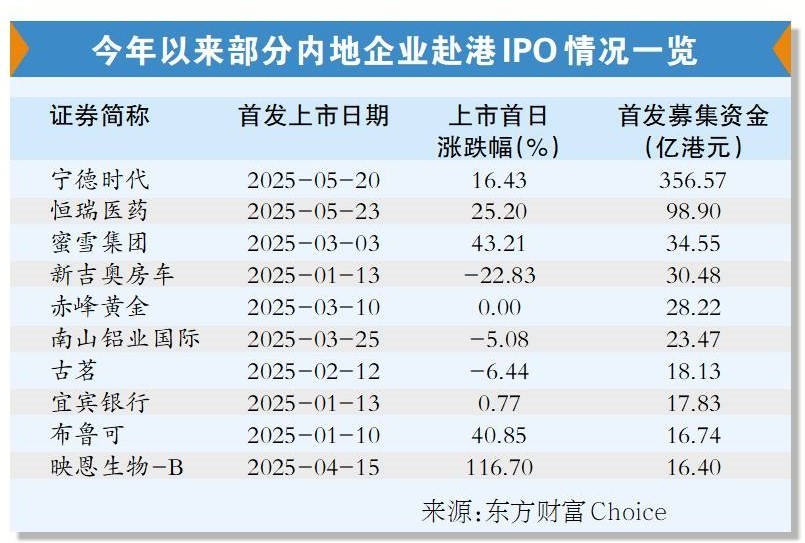
Core Insights - The Hong Kong IPO market is experiencing a capital boom in 2025, with nearly $10 billion raised in the first five months, approaching last year's total of $11.3 billion [1] - Major companies like CATL and Hansoh Pharma are accelerating their "A+H" strategy, focusing on hard technology and new consumption sectors [1][2] - Over 150 companies are currently waiting to list in Hong Kong, with many planning to raise over $1 billion [1] - The attractiveness of Hong Kong stocks is expected to increase, with the AH premium likely to narrow [1] Market Trends - 26 mainland companies have listed in Hong Kong this year, raising approximately HKD 74 billion, with A-share companies making up over 57% of this total [2] - The trend of mainland companies listing in Hong Kong has significantly increased compared to the same period in 2024, where only 19 companies raised HKD 9 billion [2] - The hard technology sector is seeing a surge in interest, with companies like Yujing Technology and Horizon Robotics going public [2] IPO Performance - Notable IPOs include CATL, which raised HKD 35.657 billion, and Hansoh Pharma, which raised HKD 9.89 billion [2][4] - The performance of H-shares has occasionally surpassed A-shares, as seen with CATL's H-share price being higher than its A-share price, resulting in an AH premium of -11.06% [3][11] Policy and Market Dynamics - Policy incentives and mechanisms like "flash placements" are attracting mainland companies to Hong Kong [5] - The collaboration between domestic and international regulatory bodies is enhancing the efficiency of overseas listings [5] - The global capital allocation landscape is shifting, making Hong Kong a preferred channel for international long-term capital [5] Future Outlook - The IPO momentum is expected to continue, with a focus on hard technology and new consumption sectors [10] - The trend of Chinese companies seeking international capital through Hong Kong listings is likely to grow, especially as A-share financing becomes more restrictive [9][10] - The narrowing of the AH premium indicates a potential revaluation of Hong Kong stocks, with increased liquidity and improved market conditions [13][14] Investment Opportunities - Investors are encouraged to focus on sectors such as technology, new consumption, and dividend-paying assets [17][18] - The narrowing AH premium can serve as a reference for investment decisions, with technology and consumer sectors showing strong potential [19][22]


“闪电”配售!蔚来、小米、比亚迪,都来了
Zhong Guo Ji Jin Bao· 2025-03-27 13:10
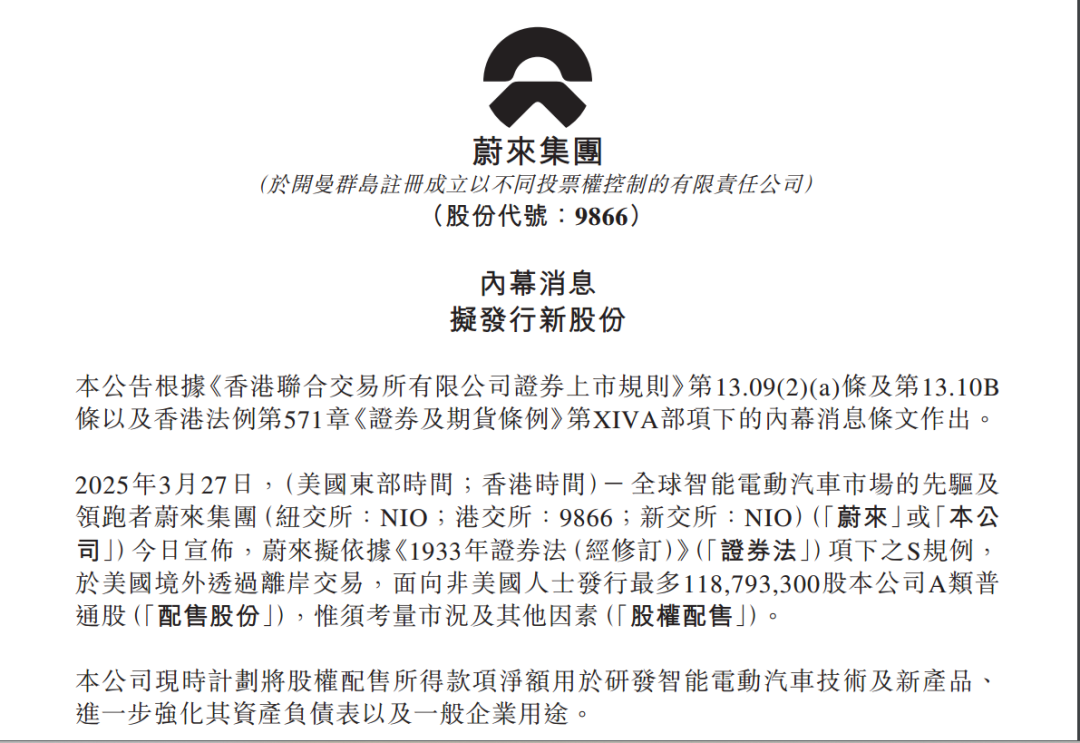
Group 1 - NIO plans to issue up to 119 million Class A ordinary shares to raise funds for R&D in smart electric vehicle technology, strengthening its balance sheet, and general corporate purposes [1][2] - The company aims to maintain a quarterly investment of 3 billion yuan in R&D, with a total R&D investment of 13.037 billion yuan for 2024, surpassing competitors like XPeng and Li Auto [4][5] - As of December 31, 2024, NIO's total cash reserves, including cash equivalents and short-term investments, amount to 41.9 billion yuan, highlighting the importance of cash flow for survival and development in the competitive automotive industry [5][12] Group 2 - Multiple automakers, including BYD and Xiaomi, are planning "lightning" placements, a method for rapid financing in the Hong Kong market, with share placements not exceeding 20% of their total shares [8] - BYD's recent placement raised approximately 43.383 billion HKD for R&D, overseas business development, and working capital [10] - Xiaomi plans to raise around 42.5 billion HKD through the placement of 800 million existing shares to accelerate business expansion and enhance technological capabilities [10][12]

比亚迪,巨额融资落地
证券时报· 2025-03-12 04:22
Core Viewpoint - BYD successfully completed a significant H-share placement, raising approximately HKD 43.38 billion, marking the largest equity refinancing project in the global automotive industry in the past decade and the largest ever "lightning placement" in the sector [1][2][5]. Financing Details - The placement involved issuing around 130 million new H-shares at a price of HKD 335.2 per share, representing 10.57% of the expanded total issued H-shares post-placement [5]. - The funds raised will support overseas expansion, research and development, and general corporate purposes, allowing BYD to invest in AI and robotics while pursuing large-scale international growth [6]. Market Dynamics - The Chinese automotive market is experiencing intensified competition, reflected in extreme stock price differentiation in the secondary market [3][13]. - In February, BYD maintained its leading position in wholesale sales, achieving 318,200 units sold, a year-on-year increase of 161.4% [14]. Investor Sentiment - The placement attracted significant interest from global institutional investors, including sovereign funds and strategic investors from the Middle East, indicating strong international confidence in BYD's strategic outlook [9]. - Recent data shows that BYD has received substantial net inflows from overseas investors, with net purchases of USD 7.12 million in Hong Kong stocks since February [10]. Competitive Landscape - The automotive market is characterized by aggressive pricing strategies, with 28 models experiencing price cuts in early 2025, including 20 electric vehicle models, averaging a reduction of HKD 30,000 [14]. - Despite the competitive pressures, BYD's stock has shown resilience, with a year-to-date increase of over 30%, while other electric vehicle manufacturers have also seen significant stock price gains [15].
汽车行业史上最大!比亚迪,重磅来袭!
Zheng Quan Shi Bao Wang· 2025-03-11 23:39
Core Viewpoint - BYD successfully completed a significant H-share placement, raising approximately HKD 43.38 billion, marking the largest equity refinancing project in the global automotive industry in the past decade and the largest ever "lightning placement" in the sector [1][2]. Group 1: Financing and Strategic Implications - The placement involved issuing around 130 million new H-shares at a price of HKD 335.2 per share, representing 10.57% of the expanded total issued H-shares after the placement [1]. - The funds raised will support BYD's overseas expansion, research and development, operational funding, and general corporate purposes, enabling the company to invest in AI and robotics while pursuing large-scale international growth [2][3]. - The financing is expected to accelerate BYD's strategic layout in the international electric vehicle market, enhancing its production capacity, channel development, and brand strength [3]. Group 2: Market Dynamics and Competition - The Chinese automotive market is experiencing intensified competition, with BYD leading in wholesale sales, achieving 318,200 units sold in February, a year-on-year increase of 161.4% [7]. - Price reductions have become a significant strategy in the market, with an average price drop of HKD 30,000 across new models, particularly in the electric vehicle segment [7]. - The market is characterized by a mixed performance among automotive stocks, with BYD's shares increasing over 30% year-to-date, while other companies like NIO and XPeng have seen even higher gains [8]. Group 3: Investor Sentiment and Market Reactions - The placement attracted significant interest from global institutional investors, including sovereign funds and strategic investors from the Middle East, indicating strong international confidence in BYD's strategic outlook [4]. - Despite the successful placement, BYD's H-share price fell by 6.77% on the day of the announcement, reflecting market concerns over potential share dilution and increased competition [6]. - Recent data shows that BYD has been a top choice for foreign investment, with net purchases of USD 71.24 million in Hong Kong stocks since February, second only to Xiaomi [5].