防御性策略

Search documents
道达尔能源回购缩减股价仍创新高,市场解读为防御性策略
Jing Ji Guan Cha Wang· 2026-02-11 15:09
Core Viewpoint - TotalEnergies (TTE.N) stock price reached a 60-day high despite announcing a reduction in stock buyback, supported by resilient performance, production growth expectations, and a strong balance sheet [1]. Stock Performance - As of February 11, 2026, TotalEnergies' stock closed at $75.75, up 1.50% for the day, marking a 15.79% increase year-to-date. The company announced a reduction in the first quarter 2026 stock buyback from $1.5 billion in Q4 2025 to $750 million, yet the stock price continued to rise [2]. Financial Performance - In Q4 2025, adjusted net profit was $3.84 billion, a 13% year-over-year decline but slightly above analyst expectations. Refining business profits surged 215% to $1 billion, partially offsetting the negative impact of falling oil and gas prices. The company maintained a quarterly dividend of €0.85 per share and did not adjust its annual buyback target range [3]. Project Development - TotalEnergies expects oil and gas production to exceed 2.6 million barrels per day in Q1 2026, a year-over-year increase of approximately 3%, driven by new project launches. The company plans to reduce net investment from $17.1 billion in 2025 to $15 billion, focusing on low-cost and low-carbon projects to enhance capital efficiency [4]. Industry Policy and Environment - Brent crude oil prices recently rose to $69 per barrel, above the company's assumed benchmark of $60 per barrel, alleviating cash flow pressure concerns. Jefferies reported that TotalEnergies has a lower debt-to-equity ratio compared to European peers, indicating a robust balance sheet. The overall oil and gas sector rose by 1.71%, with active buying driving a volume ratio of 0.78, reinforcing short-term upward momentum [5]. Event Impact - The adjustment in buyback size is viewed as a defensive strategy during a period of low oil prices rather than a sign of fundamental deterioration. CEO Pouyanne emphasized that this move aims to "balance cash generation with expenditures" and maintain financial flexibility. Compared to peers, TotalEnergies continues to uphold shareholder return consistency, supporting valuation recovery [6].
QQ 突然回归经典版!8090 后 DNA 动了。网友:咳嗽滴滴滴声还远么?
程序员的那些事· 2025-12-19 00:48
Core Viewpoint - Tencent's QQ has reintroduced a classic mode in its latest update, aiming to attract and retain users from the 80s and 90s generations by evoking nostalgia while also enhancing practical functionalities [2][3][5]. User Experience and Features - The update allows users to switch between a simplified efficiency mode and a classic mode that resembles the early 2000s QQ interface, which has been dubbed a "moyu tool" by users [3][4]. - New features include free access to a color palette for customization, the ability to batch import emoji packs, and migration of historical chat records, addressing previous user pain points [4][5]. User Engagement and Market Data - As of Q3 2025, QQ's mobile active user accounts have declined to 517 million, a drop of 8% year-on-year, while WeChat's combined active accounts reached 1.414 billion, marking a 2% increase [5][6]. - Historical data shows a steady decline in QQ's mobile active users from 800 million in 2018 to 517 million in 2025, indicating a need for strategic changes to retain users [6]. Strategic Implications - The reintroduction of the classic mode is seen as a defensive strategy to retain older users and attract them back to the platform through nostalgia and enhanced features [5][6].



万科又一笔债券拟展期
财联社· 2025-12-05 23:52
Core Viewpoint - Vanke is facing significant financial pressure, leading to strategic decisions such as postponing bond redemptions and terminating credit ratings to manage liquidity and reduce external scrutiny [1][9][10]. Financial Decisions - On December 5, Vanke announced the decision to forgo the redemption option for the "21 Vanke 02" corporate bond, which has a balance of 1.1 billion yuan and a coupon rate of 3.98% [5][6][7]. - The company aims to delay repayment pressures until the bond's natural maturity, allowing for better cash flow management [7][8]. - Vanke also terminated its credit ratings with two agencies, which may reduce costs and limit negative market sentiment [9][10]. Debt Pressure - Vanke's total interest-bearing liabilities reached 362.93 billion yuan, with cash reserves of 65.68 billion yuan, resulting in a cash-to-short-term debt ratio of less than 1 [8]. - The company is under pressure to manage upcoming debt obligations, including a 3.0% coupon bond maturing in December 2025 with a balance of 3.7 billion yuan [2][3]. - The decision to extend the maturity of the "22 Vanke MTN 004" bond, originally due in December 2025, reflects ongoing liquidity concerns [12][13]. Financial Performance - For the first three quarters of 2025, Vanke reported total revenue of 161.39 billion yuan, a year-on-year decline of 26.61%, and a net loss of 28.24 billion yuan, an increase of 72.19% in losses [14]. - The support from the major shareholder, Shenzhen Metro Group, has shifted from unconditional backing to more structured financial arrangements, indicating a change in the nature of support [15][16]. Market Reactions - Following the announcement of the bond extension, Vanke's stock and bonds experienced declines, reflecting market concerns about its liquidity and financial health [12][13]. - Analysts suggest that the termination of credit ratings may lead to increased uncertainty in investment decisions, but it could also prevent further negative impacts from potential downgrades [11].


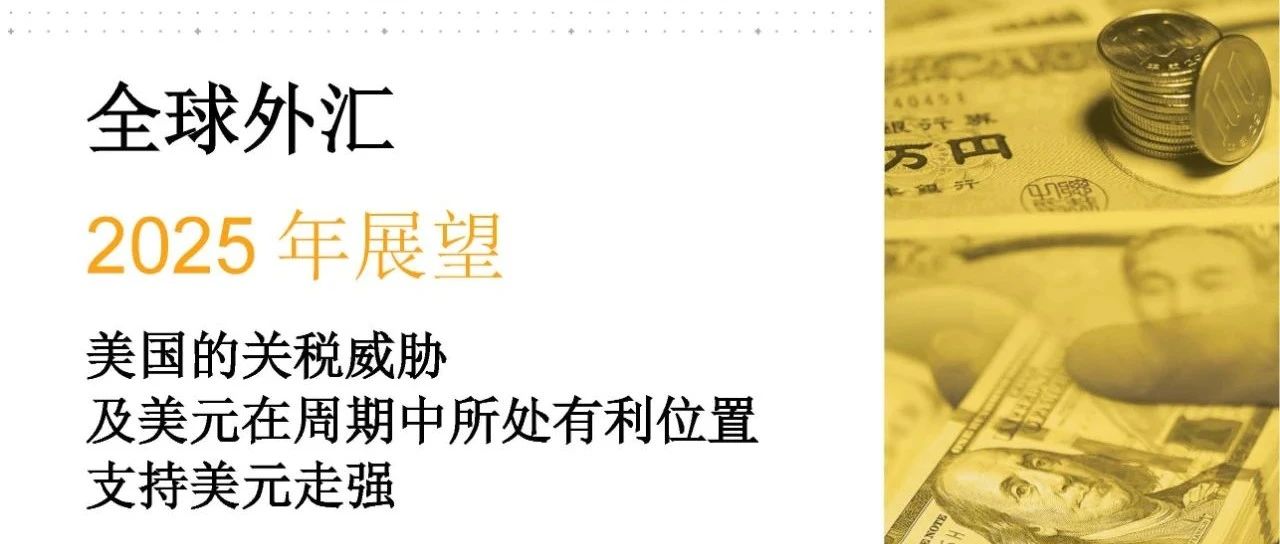
报告下载 | 2025全球外汇展望:关税时代,美元是否持续走强?亚洲货币多会承压?
彭博Bloomberg· 2025-03-28 05:37
Core Insights - The article emphasizes a bullish outlook for the US dollar in early 2025, driven by cyclical and geopolitical factors, while also highlighting the attractiveness of defensive strategies such as going long on the Japanese yen and Swiss franc due to ongoing global economic and political uncertainties [2][7]. G10 Currency Outlook - The US dollar (DXY) is projected to appreciate by 6.5% from January 2, 2024, to January 2, 2025, supported by a strong US economy and favorable policies under a potential Trump administration [9]. - The euro (EUR) is expected to decline by 5.7%, influenced by negative economic and political factors [9]. - The Japanese yen (JPY) is forecasted to decrease by 9.6%, although it remains a strong defensive currency [9]. - The Swiss franc (CHF) is anticipated to drop by 6.3%, with concerns about the Swiss National Bank's tolerance for a strong currency [9]. - The British pound (GBP) is projected to fall by 1.6%, lacking fresh catalysts for growth [9]. - The Canadian dollar (CAD) is expected to decline by 7.6%, while the Australian dollar (AUD) and New Zealand dollar (NZD) are forecasted to decrease by 8.1% and 10.3%, respectively, due to trade tensions with China [9]. Emerging Market Currency Outlook - The Turkish lira (TRY) is expected to remain resilient due to anti-inflation policies and high interest rates, with a projected decline of 16.5% [14]. - The Brazilian real (BRL) is anticipated to appreciate by 17.2%, benefiting from a favorable fiscal outlook and interest rate advantages [16]. - The South African rand (ZAR) is projected to decline by 2.6%, facing pressures from higher tariffs and concerns over China's growth [14]. - The Chilean peso (CLP) is expected to underperform due to low interest rates and reliance on copper exports [16]. Geopolitical and Economic Factors - The article notes that the performance of currencies in the Euro-Middle East and Africa region will depend on responses to US policy adjustments and potential tariff increases, particularly affecting currencies sensitive to the euro [13]. - The article highlights that the potential re-election of Trump could reignite concerns over the Chinese yuan, with a possible depreciation if trade tensions escalate [10].