
集群

Search documents
公布技术参数“颗粒度” 大厂接连“秀肌肉” 自研AI芯片为何不再“闷声干”?
Nan Fang Du Shi Bao· 2025-11-25 23:09
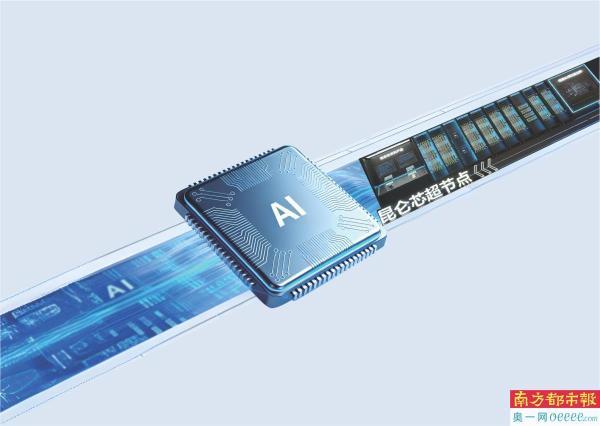
Core Viewpoint - The recent announcements from major Chinese tech companies like Huawei and Baidu regarding their AI chip development signify a shift in the domestic semiconductor landscape, aiming to fill the gap left by Nvidia and enhance the competitiveness of Chinese AI chips [3][4][5]. Group 1: AI Chip Development - Major Chinese companies are increasingly revealing their AI chip roadmaps, with Huawei planning to release four Ascend AI chips over the next three years, while Baidu is set to launch two Kunlun AI chips in the next two years [2][3]. - Huawei's detailed disclosure of technical parameters for its chips, including bandwidth, computing power, and memory, marks a significant change in the traditionally low-profile approach of Chinese chipmakers [2][7]. - The introduction of supernodes and clusters is seen as a critical strategy for overcoming the limitations of China's semiconductor manufacturing processes, which are currently capped at the 7nm node [10][12]. Group 2: Competitive Landscape - The competition in the global AI chip market is characterized as asymmetric, with Chinese chips lagging behind North American counterparts like Nvidia in various technical specifications, yet capable of leveraging networking capabilities to surpass them in performance [5][6]. - Huawei's Ascend series has been recognized as a formidable competitor, with its first chip released in 2018 and subsequent iterations showing significant performance improvements despite challenges posed by U.S. sanctions [6][8]. - Baidu's Kunlun chip, while still behind in performance compared to Nvidia's offerings, is focusing on cost-effectiveness and specific use cases, indicating a strategic approach to market entry [8][9]. Group 3: Market Dynamics - The domestic AI chip market is witnessing a shift towards inference tasks, with inference scenarios accounting for 42% of the GenAI IaaS service market, while training scenarios have decreased to 58% [14][15]. - The challenges of using domestic AI chips for large model training are acknowledged, with companies like Huawei and Baidu working to adapt their technologies to meet these demands [14][15]. - The push for self-developed chips by major cloud providers is seen as a way to reduce costs and improve performance, with companies like Kunlun seeking to penetrate external markets [16][17].

从超节点到集群,华为亮出AI算力全家桶
2 1 Shi Ji Jing Ji Bao Dao· 2025-09-18 13:17
Core Insights - Huawei is making significant advancements in AI computing power, showcasing a comprehensive AI computing architecture at the Huawei Connect Conference [1][3] - The company aims to establish a sustainable computing ecosystem based on its proprietary Ascend chips and Kunpeng CPUs, positioning itself as a key player in the AI market [5][8] Group 1: AI Computing Strategy - Huawei's AI computing strategy is centered around the Ascend chip series, with a roadmap for iterative upgrades over the next three years, aiming for a doubling of computing power annually [3][5] - The upcoming Ascend 950 series is designed to enhance training efficiency and support various low-precision data formats, indicating a focus on optimizing AI workloads [3][4] Group 2: Supernodes and Clusters - Huawei introduced new supernode products, Atlas 950 SuperPoD and Atlas 960 SuperPoD, which support 8192 and 15488 Ascend cards respectively, positioning them as leaders in global computing power [6][7] - The Atlas 950 SuperCluster and Atlas 960 SuperCluster are set to exceed 500,000 and 1 million cards, respectively, further solidifying Huawei's dominance in AI infrastructure [6] Group 3: Competitive Landscape - Despite NVIDIA's current dominance in the AI chip market, Huawei is rapidly developing its Ascend and Kunpeng chips to compete effectively within the Chinese AI landscape [5][6] - Huawei's approach includes a focus on system-level engineering and innovation, aiming to create a competitive edge in the evolving AI computing sector [7][9]
“被误解”的任正非:芯片“断章取义”报道何时休?
Sou Hu Cai Jing· 2025-06-11 02:11
Core Viewpoint - Ren Zhengfei, the founder of Huawei, emphasizes that concerns over chip issues are unnecessary, suggesting that China can achieve comparable results to advanced levels through methods like stacking and clustering, despite being behind in single-chip performance [1][2]. Group 1: Misinterpretation of Statements - Ren Zhengfei's comments have been misrepresented by foreign media, which claim he believes China should not worry about U.S. chip sanctions; however, his original statements reflect a more humble and realistic perspective on the state of China's chip industry [1][2]. - The phrase "just do it" was taken out of context, as Ren intended to convey a sense of resignation to external pressures while focusing on improving Huawei's core operations [2][10]. Group 2: Current State of Chinese Chip Industry - Ren acknowledges that many Chinese chip companies are performing well, but Huawei is still one generation behind U.S. chips in single-chip performance; he advocates for using mathematical methods to compensate for physical limitations [2][3]. - Huawei invests approximately 180 billion yuan annually in R&D, with 60 billion yuan dedicated to foundational theoretical research, which is crucial for long-term breakthroughs [3]. Group 3: Technological Innovations - Huawei has introduced the CloudMatrix 384 super-node cluster, which utilizes 384 Ascend chips to achieve a bandwidth of 2.8 Tbps and a BF16 computing power of 300 PFLOPs, nearly double that of NVIDIA's GB200 NVL72 system [8]. - The company is focusing on innovative solutions for its Ascend computing cluster infrastructure, addressing issues like high availability, linearity, and fault tolerance, which are critical for large-scale AI applications [9]. Group 4: Media Reporting Practices - There is a trend of sensationalized reporting in the chip industry, where media often misrepresent facts or omit critical information, leading to a loss of trust in news sources [10]. - The chip sector is characterized by a focus on technology and product development rather than hype, and it is essential to maintain a commitment to factual reporting to foster confidence in the industry [10].
