食品安全治理现代化

Search documents
烟台创新“三位一体”监管模式,筑牢食品安全治理现代化防线
Qi Lu Wan Bao· 2026-02-08 07:50
Core Insights - Yantai Market Supervision Administration has established a comprehensive food production supervision model focusing on "source prevention, process management, and risk control" since 2025, achieving significant results through a responsibility system and inter-departmental coordination [1] Group 1: Regulatory Framework - The administration has innovatively constructed a "regulation + sampling + law enforcement" model to enhance food safety [1] - A closed-loop regulatory system has been developed, integrating pre-judgment, real-time coordination, and post-implementation consolidation, ensuring immediate response to identified risks [2] Group 2: Inspection and Compliance - Over 7,000 meat production and operation units have been inspected since 2025, contributing to a cleaner market environment [2] - A linkage mechanism has been established where sampling data informs regulatory decisions, helping companies improve their production processes [3] Group 3: Risk Management - A total of 44 key regulatory accounts and 30 risk regulatory accounts have been set up for companies with sampling failures, effectively enhancing quality management [3] - The administration employs a "three-step work method" to ensure compliance, including responsibility talks, full-process checks, and follow-up inspections [3] Group 4: Consumer Safety - A holiday safety mechanism has been integrated into the regulatory model, focusing on risk warnings, joint inspections, and rapid law enforcement during peak consumption periods [4] - Targeted sampling and inspections are conducted on specialty products to prevent the circulation of substandard food, ensuring consumer safety during holidays [4]
鼓励投保健全体系 食安险迎新机遇
Bei Jing Shang Bao· 2025-12-04 16:13
Core Viewpoint - The introduction of food safety responsibility insurance (referred to as "food safety insurance") is expected to be promoted significantly to address consumer concerns regarding food safety issues in the market [1][3]. Group 1: Encouragement of Food Safety Insurance - The State Administration for Market Regulation has revised the draft emergency response plan for food safety incidents, encouraging food producers and operators to participate in food safety insurance [3]. - Food safety insurance is designed to cover civil liability for damages caused by defective food products sold by food producers, providing a safety net for both businesses and consumers [3][4]. - The rise of the food delivery industry, driven by the integration of the internet and digital economy, has led to increased awareness and familiarity with food safety insurance among market participants [3]. Group 2: Importance for the Prepared Dish Industry - The recent concerns surrounding the prepared dish industry highlight the need for enhanced safety measures, with food safety insurance playing a crucial role in providing economic protection against food safety issues [4]. - The introduction of food safety insurance can lead to improved food safety management practices among prepared dish companies, thereby reducing risks associated with food safety incidents [4]. Group 3: Challenges in Activation of Insurance Demand - Compared to developed countries, the development of food safety insurance in China is relatively nascent, having gone through stages of policy exploration, mandatory promotion, and encouragement [5]. - There is significant room for growth in the food safety insurance market, primarily due to limited perceived risks for businesses and existing disputes over liability recognition and compensation amounts [5]. - Challenges such as narrow coverage, information asymmetry among delivery platforms, merchants, and consumers, and complex claims processes hinder the development of food safety insurance in the food delivery sector [5]. Group 4: Solutions for Improvement - To overcome existing challenges, insurance companies can optimize product design and service processes, potentially offering a combination of basic and additional insurance products [6]. - Implementing a floating rate mechanism based on food safety ratings could dynamically adjust premiums, enhancing the appeal of food safety insurance [6]. - The promotion of food safety insurance is seen as a modern approach to food safety governance, aiming to connect government, businesses, and consumers effectively [6].

拟鼓励投保、建体系,食安险或迎新机遇
Bei Jing Shang Bao· 2025-12-04 13:07
Core Viewpoint - The introduction of food safety liability insurance (referred to as "food safety insurance") is expected to be promoted significantly in response to consumer concerns about food safety issues, particularly in the context of the food production and service industry [1][3]. Group 1: Policy and Regulatory Framework - The State Administration for Market Regulation has initiated the revision of the "National Food Safety Incident Emergency Plan (Draft for Comments)," encouraging food producers and operators to participate in food safety insurance [3][4]. - The draft emphasizes the establishment and improvement of the food safety insurance system, aiming to ensure timely insurance claims for food safety incidents [3][4]. Group 2: Market Dynamics and Trends - Food safety insurance is becoming increasingly recognized as a risk management mechanism, particularly in the rapidly growing food delivery service sector, which has seen significant scale development due to the integration of the internet and digital economy [3][4]. - Currently, the variety and number of food safety insurance products in the market are relatively limited, with most offerings focused on food delivery services, primarily through collaborations between delivery platforms and insurance companies [3][4]. Group 3: Challenges and Opportunities - Despite the potential for growth, food safety insurance in China is still in its early stages compared to developed countries, having gone through policy exploration, mandatory promotion, and now encouragement phases [5][6]. - There are significant challenges in the claims process, including disputes over accident recognition and compensation amounts, as well as difficulties consumers face in proving claims [6]. - The insurance product's coverage is narrow, and there is a notable information asymmetry among delivery platforms, merchants, and consumers, complicating the claims process and limiting the development of the food delivery industry [6]. Group 4: Recommendations for Improvement - To stimulate demand for food safety insurance, it is suggested that insurance companies optimize product design and service processes, potentially developing a combination of basic and additional insurance products [6]. - Implementing a floating rate mechanism based on the food safety rating of enterprises could dynamically adjust premiums, enhancing the attractiveness of food safety insurance [6]. - The promotion of food safety insurance is viewed not only as a risk management tool but also as a modernization of food safety governance, aiming to create a robust safety net connecting government, enterprises, and consumers [6].
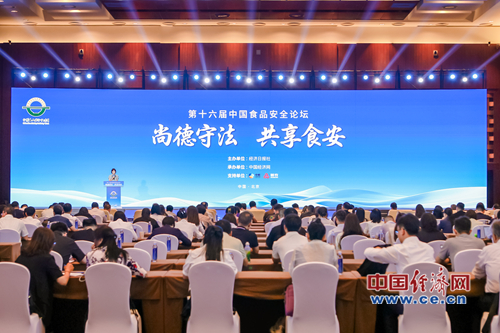
“尚德守法 共享食安”——第十六届中国食品安全论坛在京举行
Zhong Guo Jing Ji Wang· 2025-09-11 13:09
Group 1 - The 16th China Food Safety Forum was held on September 11 in Beijing, focusing on the theme "Integrity and Lawfulness, Sharing Food Safety" [2] - The forum aims to promote high-quality development in China's food industry by gathering government departments, industry experts, research institutions, and corporate representatives to discuss food safety issues [2] - The forum has been instrumental in enhancing public awareness and trust in food safety over the past 16 years [2] Group 2 - The Director of the Food Coordination Department of the State Administration for Market Regulation emphasized the need for social participation and governance in addressing complex food safety issues [3] - The media plays a crucial role in enhancing public confidence and promoting transparency in food safety information [3] Group 3 - Beijing's food safety governance capabilities have improved, leading to increased public satisfaction regarding food safety [4] - The city is implementing stricter and higher standards for food safety to ensure the safety of its citizens [4] Group 4 - The Director of the Nutrition and Health Research Institute at China Agricultural University proposed three strategies for food safety governance: leveraging technology, solidifying industry responsibility, and promoting collaborative governance [6] - As of now, China has released 1,725 national food safety standards covering over 340 food categories, with 126 new standards published this year [6] Group 5 - Major companies like COFCO and Mengniu are adopting advanced technologies such as big data and AI to enhance food safety across their supply chains [6][7] - The implementation of a "zero-risk" strategy by Ferrero China aims to ensure comprehensive risk management throughout the food production process [9][10] Group 6 - The forum highlighted the importance of reducing food waste and promoting sustainable practices, with initiatives like the "KFC Food Station" providing surplus food to those in need [8] - The event also discussed the internal motivation of food companies to take responsibility for food safety, emphasizing the need for proactive participation rather than reactive compliance [9]