高品质住房

Search documents
市场周报 | 30城第12周成交环比增16%,苏州对青年人才公积金贷款贴息50%
克而瑞地产研究· 2026-03-30 10:16
Core Viewpoint - The article emphasizes the ongoing efforts at the central and local levels to enhance the quality of housing development in China, transitioning from basic housing needs to a focus on quality and sustainability in housing projects [1][2]. Central Level Initiatives - The Ministry of Housing and Urban-Rural Development is soliciting opinions on the "Good House" construction guidelines, which cover five key areas: safety and durability, health and comfort, green and low-carbon, smart convenience, and implementation pathways [1]. - The guidelines represent a significant upgrade in housing policy, aiming to meet the new market demands post-2023 by integrating full lifecycle management into housing projects [1]. - The guidelines are designed to establish a new supply-demand order in the real estate market, ensuring a clear framework for transitioning from "housing for all" to "quality housing" [1]. Local Level Policies - Eleven provinces and cities have introduced new policies to stabilize the housing market, primarily focusing on optimizing housing provident funds [2]. - For instance, Suzhou offers a 50% interest subsidy on provident fund loans for young talents, with a maximum limit of 50,000 yuan, effectively lowering the threshold for home purchases [2]. - These local policies aim to attract and retain young talent while stimulating housing consumption, providing practical examples of the transition from basic housing to quality housing [2]. Market Performance - In the 12th week of 2026, the transaction volume of new residential properties in 30 key cities increased by 16% compared to the previous week, marking a significant recovery from the previous year [5][6]. - The total transaction area reached 1.563 million square meters, with a year-on-year decline of 33%, indicating a strong rebound in the market compared to earlier weeks in the year [9]. - First-tier cities saw a robust recovery, with transaction volumes increasing by 44%, while some second and third-tier cities experienced growth rates exceeding 40% [8][9].


如不出意外,2026年房产或将面临3大转变,王石的预测应验了?
Sou Hu Cai Jing· 2026-02-19 10:33
Core Viewpoint - The article discusses the changing dynamics of the real estate market, highlighting that those who truly understand market trends are often not reliant on selling properties for profit. It emphasizes the shift from speculative growth driven by high leverage to a focus on quality and sustainability in the industry. Group 1: Market Dynamics - The era of reckless borrowing and speculative building in the real estate sector is over, with many companies previously operating under high debt levels now forced to reduce their liabilities due to regulatory measures [10][11] - The survival of real estate companies in the future will depend on maintaining clean financial records rather than taking excessive risks [11][12] - The shift towards selling completed properties rather than pre-sold units is becoming a significant trend, driven by buyer dissatisfaction with unfinished projects [13][14] Group 2: Quality Standards - The definition of a "good house" is evolving into a concrete standard, moving beyond mere quantity to emphasize quality in construction [20][21] - New construction standards are being implemented to address common issues such as low ceiling heights and poor sound insulation, reflecting a fundamental shift in the industry towards better living conditions [21][22] - As the market transitions, competition will increasingly focus on the quality of housing rather than the volume of units built, leading to the potential elimination of companies that do not adapt [22][24]

事关房地产,政治局会议最新定调
3 6 Ke· 2025-04-28 02:09
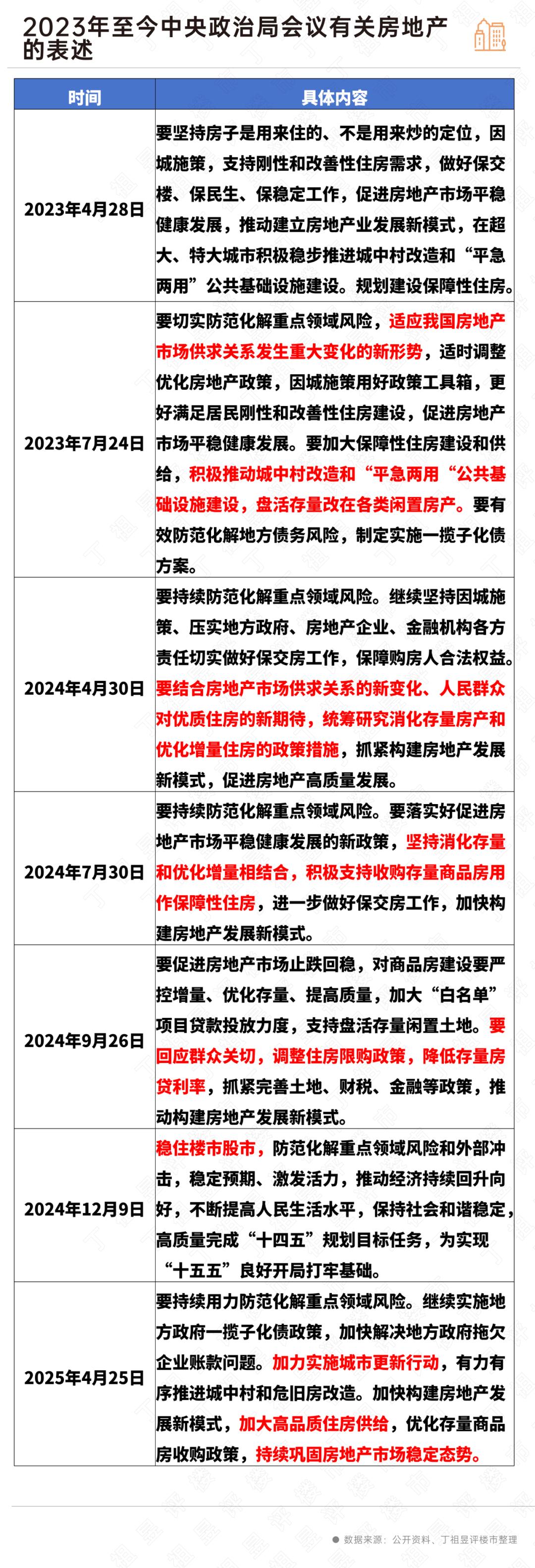
Core Viewpoint - The recent meeting of the Political Bureau emphasizes the need to stabilize the real estate market and accelerate urban renewal, with a focus on high-quality housing supply and optimizing existing property acquisition policies [1][2][10]. Group 1: Urban Renewal and Housing Supply - The meeting highlights the acceleration of urban renewal actions, particularly in transforming urban villages and dilapidated housing, aiming to stimulate demand through existing stock [2][3]. - The introduction of "high-quality housing supply" marks a significant shift in policy direction, aligning with the goal of constructing "good houses" by 2025, which will guide the transformation of the real estate sector [4][10]. - The strategy of leveraging existing stock to drive new demand is expected to alleviate high inventory pressures, with an estimated 2 billion square meters of property to be absorbed through urban renewal initiatives [3][5]. Group 2: Policy Optimization and Market Stability - The focus on optimizing existing property acquisition policies is seen as a core engine for stabilizing the market, with plans to convert existing properties into affordable housing [5][10]. - The real estate market is currently in an "L" shaped bottoming phase, necessitating continued efforts to stabilize and recover the market, with future policies being crucial [2][9]. - The meeting reiterates the importance of maintaining a stable market environment, with a combination of policy measures aimed at both supply and demand sides to support housing needs [10][11]. Group 3: Future Policy Directions - The 2025 real estate policy is expected to focus on three main goals: stabilizing expectations, preventing risks, and promoting transformation, with four key areas of emphasis [10][11]. - Policies will aim to enhance the quality of housing, support urban renewal, and ensure financial backing for real estate projects, particularly in major cities [10][11]. - The integration of financial support mechanisms and risk prevention strategies will be crucial in maintaining market stability and encouraging high-quality development in the sector [11].
方向符合预期,关注细则落地
HTSC· 2025-04-28 02:05
Investment Rating - The report maintains an "Overweight" rating for the real estate development and services sectors [6]. Core Insights - The recent political bureau meeting emphasized the need to "continuously consolidate the stability of the real estate market," focusing on urban village renovations, high-quality housing, and stock housing acquisition [2][4]. - The report indicates that the incremental policy window for the real estate industry is gradually opening, with a more proactive macroeconomic and fiscal policy environment expected to support market recovery, particularly in first-tier cities [2][3]. - The report highlights a significant year-on-year increase in transaction volume, with new and second-hand housing sales in 19 key cities rising by 18% in Q1 2025, indicating a positive trend in market stabilization [3]. Summary by Sections Policy Direction - The meeting's focus on urban renewal, stock housing acquisition, and high-quality housing supply aligns with previous predictions regarding the incremental policy window [4]. - The emphasis on urban renewal actions and the acceleration of urban village and dilapidated housing renovations signal strong governmental support for these initiatives [4]. Market Recovery - The report notes that while the market has shown signs of stabilization, particularly in sales volume, the foundation for price stability remains fragile, necessitating ongoing policy support [3]. - The report suggests that first-tier cities will exhibit greater policy elasticity, which could lead to a more pronounced recovery in the market and related stocks [2][5]. Investment Recommendations - The report recommends a focus on real estate stocks characterized by "good credit, good cities, and good products," particularly in first-tier cities [5]. - Specific stock recommendations include: - A-share developers: Chengdu Investment Holdings, Chengjian Development, Binjiang Group, New Town Holdings, China Merchants Shekou, and Jianfa Co [5][9]. - Hong Kong-listed developers: China Resources Land, China Overseas Development, Greentown China, Jianfa International Group, and Yuexiu Property [5][9]. - Property management companies: China Resources Vientiane Life, Greentown Service, China Overseas Property, Poly Property, China Merchants Jiyu, and Binjiang Service [5][9].