高市行情

Search documents
日银三月议息按兵不动-中东冲突-油价冲击对日本市场的影响
2026-03-22 14:35
Summary of Key Points from the Conference Call Industry Overview - The focus is on the Japanese economy and the impact of high oil prices and geopolitical tensions in the Middle East on monetary policy and market dynamics [1][2][3]. Core Insights and Arguments - **Monetary Policy Outlook**: The Bank of Japan (BOJ) is expected to maintain its current interest rate policy, with potential rate hikes in April or June 2026. The likelihood of a June hike is favored due to a dovish committee stance and historical caution from Governor Ueda [1][4][5]. - **Impact of High Oil Prices**: Rising oil prices are expected to weaken domestic demand in Japan, leading to a more cautious BOJ approach. Conversely, the U.S. Federal Reserve is experiencing a drop in rate cut expectations due to inflation pressures [1][3][5]. - **Economic Recovery Drivers**: The recovery in Japan is shifting from consumer spending to corporate capital expenditure, driven by the AI industry revolution, which is expected to sustain macroeconomic growth above potential levels over the next two years [1][8]. - **Yen Depreciation**: The yen's safe-haven status is diminished due to high oil prices, with a critical intervention point at 160. Short-term fluctuations are influenced by geopolitical tensions and U.S. monetary policy [1][12][13]. - **Consumption Tax Cut**: A proposed consumption tax cut in 2027 could lower CPI by approximately 1.5 percentage points and provide a short-term GDP boost of about 0.2 percentage points, but it raises concerns about Japan's long-term fiscal stability [1][7]. Additional Important Content - **Investor Sentiment**: There is a divergence in expectations between domestic and foreign investors regarding BOJ policy adjustments, with domestic investors leaning towards a June hike due to concerns over domestic demand [4][5]. - **Oil Price Scenarios**: Three potential scenarios for oil prices are outlined: stabilization and gradual decline, prolonged high prices, and further spikes. Each scenario presents different implications for Japan's economic growth and inflation [6]. - **Sectoral Impact of Oil Prices**: A 10% increase in oil prices could reduce corporate profits by 1% to 1.25%, with varying effects across sectors. The Nikkei 225 index is projected to decline by approximately 8.4% for every 10% rise in oil prices [15][16]. - **Market Outlook**: Despite the oil price shock, there remains optimism for the Japanese stock market due to ongoing positive momentum from government policies and foreign investment inflows [16][17][18]. - **Valuation Perspective**: The current valuation of the Japanese stock market is seen as offering medium to long-term investment opportunities, especially if corporate governance and policy improvements continue [18].
日本股市创历史新高
财联社· 2026-02-09 01:10
Core Viewpoint - The recent election results in Japan indicate that the ruling coalition led by Prime Minister Kishi Sanae has maintained control over the House of Representatives, which is expected to influence the financial markets positively, particularly in terms of the yen, Japanese stocks, and bonds [1][2]. Currency Market Impact - Following the election results, the yen experienced a short-term sell-off, dropping approximately 0.3% to 157.76 yen per dollar, marking its lowest level in over two weeks [3]. - The rise of Kishi Sanae as Japan's first female Prime Minister has previously led to significant stock market gains but also substantial sell-offs in Japanese bonds and the yen [2]. Economic Policy Expectations - Kishi has promised to implement aggressive fiscal and monetary policies to stimulate economic growth, raising concerns about potential overspending and increasing Japan's already high debt burden [4]. - Analysts predict that her decisive election victory will likely reinforce expectations for aggressive fiscal policies, leading to further short-term depreciation of the yen [5]. Stock Market Reaction - The Japanese stock market opened significantly higher, with the Nikkei 225 index reaching a new historical intraday high, reflecting strong investor confidence in Kishi's government [6][7]. - The recent performance of the Japanese stock market has been bolstered not only by domestic political developments but also by a rebound in U.S. stock markets, which saw significant gains [8]. Bond Market Concerns - The potential for increased government spending under Kishi's administration raises concerns among bond investors, particularly given Japan's already substantial debt load [9]. - Analysts suggest that Kishi's election victory could lead to upward pressure on Japanese government bond yields, as the market anticipates a revival of "Kishi trading" [10]. Balancing Fiscal Policies - Experts believe that Kishi will need to maintain a delicate balance between aggressive fiscal policies and fiscal discipline to manage the rising bond yields effectively [11].

亚太股市“全线反攻”!日股创历史新高,AH股齐涨
Ge Long Hui· 2025-10-20 06:11
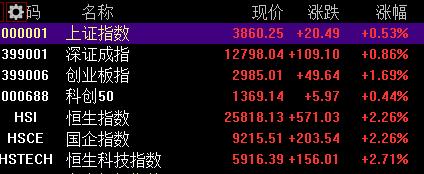
Market Performance - The A-share market saw all three major indices rise, with the ChiNext Index increasing by over 3% and the Shenzhen Component Index rising nearly 1% [2] - The total trading volume in the Shanghai and Shenzhen markets exceeded 1 trillion yuan, marking the 97th consecutive trading day above this threshold [2] - The Hang Seng Technology Index surged nearly 4%, while both the Hang Seng Index and the Hang Seng China Enterprises Index rose over 2% [2][3] Economic Indicators - China's GDP grew by 1.1% quarter-on-quarter in Q3, exceeding expectations, while the year-on-year growth rate was 4.8%, maintaining a leading position among major global economies [7] - The industrial added value for large-scale enterprises increased by 6.5% year-on-year, also surpassing market predictions [7] - Despite the positive economic indicators, the real estate sector continues to be a significant drag on the economy, with ongoing declines in housing prices [7] International Relations - Recent positive signals in China-U.S. trade relations were noted, with discussions between Chinese Vice Premier He Lifeng and U.S. Treasury Secretary Janet Yellen indicating a willingness to hold new trade talks [6][7] - This development is seen as a major breakthrough in alleviating recent trade tensions, boosting global market confidence [7] Japanese Market Dynamics - The Nikkei 225 index reached a historic high, surpassing 49,000 points for the first time, with an intraday increase of 3% [10] - Analysts suggest that the new leadership under Sanae Takaichi, who is expected to favor monetary easing and fiscal expansion, could further support the Japanese stock market [13][14] - Foreign investors, who had paused stock purchases, are reportedly re-entering the market, contributing to the upward momentum [14]
高市早苗刺激日股上涨?野村:短期上涨动力消退,后续关注这一指标
Hua Er Jie Jian Wen· 2025-10-10 03:56
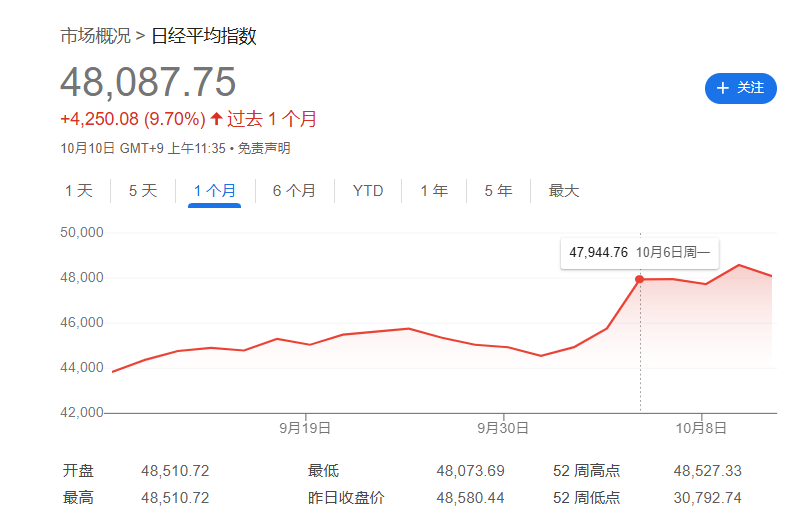
Core Viewpoint - The "Kishida Market" is experiencing a cooling trend after an initial surge following the election of Kishida Sema. The Nikkei 225 index saw a significant rise of over 4% at the beginning of the week, marking its largest single-day gain in months, but the momentum has since diminished, entering a consolidation phase [1][5]. Market Dynamics - The market's upward movement post-Kishida's victory was primarily driven by expectations of fiscal expansion rather than monetary easing. The sustainability of this "Kishida Market" hinges on the new government's ability to maintain high approval ratings and political stability; otherwise, a historical reversal pattern may reoccur [5][6]. - Investor sentiment reflects caution, with speculative investors like Commodity Trading Advisors (CTAs) having over 2 trillion yen in long positions in Japanese stocks, limiting further accumulation and shifting to a "wait-and-see" mode. Macro hedge funds have also paused their buying of Japanese stocks, indicating limited incremental capital in the short term [6][11]. Historical Context - Historical data suggests that stocks related to new government policies typically outperform the market in the weeks following elections, but often experience a reversal in the subsequent three months. Notable exceptions occurred during the administrations of Junichiro Koizumi and Shinzo Abe, where stable high approval ratings led to sustained stock performance [13][16]. - The report emphasizes that the future trajectory of "Kishida-themed stocks" will largely depend on the political landscape. If Kishida can form a stable government and maintain high support, these stocks may see continued upward momentum driven by foreign investors; conversely, political instability could lead to significant declines, particularly in high-volatility stocks [16].