
宽松货币政策

Search documents
螺纹钢市场周报:需求回升+库存下滑,螺纹期价冲高回调-20260320
Rui Da Qi Huo· 2026-03-20 08:51
1. Report Industry Investment Rating - Not provided in the document 2. Core View of the Report - The overall supply and demand of rebar have increased, and inventory has declined, with the bottom support moving up. It is recommended to conduct long - position trading above 3080 for the RB2605 contract, while paying attention to trading rhythm and risk control [9] - Considering the high international oil prices supporting furnace materials, along with the recovery of rebar's apparent demand and the decline in inventory limiting the callback space, it is suggested to consider buying slightly out - of - the - money call options when the futures price pulls back [58] 3. Summary by Relevant Catalogs 3.1 Weekly Key Points Summary 3.1.1 Market Review - As of March 20, the closing price of the rebar main contract was 3123 yuan/ton (-19 yuan/ton week - on - week), and the spot price of Zhongtian rebar in Hangzhou was 3280 yuan/ton (-10 yuan/ton week - on - week) [7] - Rebar production increased to 203.33 million tons (+8.03 million tons), year - on - year decrease of 22.88 million tons [7] - Apparent demand continued to increase to 208.09 million tons (+31.28 million tons), year - on - year decrease of 34.9 million tons [7] - Both factory and social inventories decreased. The total rebar inventory was 889.41 million tons (-4.76 million tons), year - on - year increase of 52.41 million tons [7] - The steel mill profit rate was 42.42%, a week - on - week increase of 1.29 percentage points and a year - on - year decrease of 10.83 percentage points [7] 3.1.2 Market Outlook - Macro aspect: Overseas, Israel said it would "comply" with the US President Trump's request to "suspend" subsequent air strikes on energy facilities; the Fed maintained the interest rate at 3.5% - 3.75% for the second consecutive time in the March 2026 FOMC meeting, and the market's expectation of interest rate cuts has significantly cooled. Domestically, the central bank requires to continue implementing a moderately loose monetary policy [9] - Cost aspect: The shipments of iron ore from Australia and Brazil increased, while the arrivals decreased. The inventory at domestic ports has reached an inflection point. With the increase in hot metal production, the iron ore inventory will continue to be consumed. High - grade powder and lump ore resources are relatively scarce, which still support the ore price. Mongolian coal customs clearance remains at a high level, the开工 of mines and coal washing plants continues to increase, and the clean coal inventory has declined. Geopolitical conflicts have pushed up oil prices and the energy sector [9] - Technical aspect: The RB2605 contract reached a high and then pulled back. The futures price is between the 5 - day and 20 - day moving average, and there is still technical support around 3100. The MACD indicator shows that DIFF and DEA are rebounding upwards, and the red bar is shrinking [9] 3.2 Futures and Spot Market - This week, the futures price of RB2605 reached a high and then pulled back. It was weaker than the RB2610 contract, and the spread on the 20th was - 28 yuan/ton, a week - on - week decrease of 5 yuan/ton [15] - On March 20, the Shanghai Futures Exchange's rebar warehouse receipt volume was 65,786 tons, a week - on - week increase of 16,135 tons. The net short position of the top 20 holders of rebar futures contracts was 56,092 lots, an increase of 48,862 lots compared with the previous week [21] - On March 20, the spot price of Hangzhou's third - grade 20mm HRB400 rebar was 3280 yuan/ton, a week - on - week decrease of 10 yuan/ton; the national average price was 3333 yuan/ton, a week - on - week decrease of 6 yuan/ton. This week, the spot price of rebar was stronger than the futures price, and the basis on the 20th was 157 yuan/ton, a week - on - week increase of 7 yuan/ton [25] 3.3 Upstream Market - On March 20, the price of 60.8% PB powder ore at Qingdao Port was 840 yuan/dry ton, a week - on - week decrease of 4 yuan/dry ton. The spot price of first - class metallurgical coke at Tianjin Port was 1560 yuan/ton, with no change week - on - week [30] - From March 9 - 15, 2026, the total arrivals at 47 Chinese ports were 23.17 million tons, a decrease of 3.805 million tons compared with the previous period; the total arrivals at 45 Chinese ports were 22.15 million tons, a decrease of 3.949 million tons; the total arrivals at six northern ports were 12.302 million tons, a decrease of 2.343 million tons. As of March 20, the inventory of imported iron ore at 47 ports was 178.1418 million tons, a decrease of 1.3314 million tons; the daily average port clearance volume was 3.3592 million tons, an increase of 0.359 million tons [34] - This week, the capacity utilization rate of coking plants increased to 72.83% (+0.44%), the daily average coke production was 507,600 tons (+30,000 tons), the coke inventory was 524,500 tons (-39,800 tons), the total coking coal inventory was 8.4718 million tons (+322,500 tons), and the available days of coking coal were 12.6 days (+0.41 days) [38] 3.4 Industry Situation 3.4.1 Supply Side - In January - February 2026, China's crude steel production was 160.34 million tons, a year - on - year decrease of 3.6%; the daily average crude steel production was 2.718 million tons, a month - on - month increase of 23.6%. From January - February, China's cumulative steel exports were 15.591 million tons, a year - on - year decrease of 8.1%; the cumulative steel imports were 0.827 million tons, a year - on - year decrease of 21.7% [42] - On March 20, the blast furnace opening rate of 247 steel mills was 79.78%, a week - on - week increase of 1.44 percentage points and a year - on - year decrease of 2.18 percentage points; the blast furnace iron - making capacity utilization rate was 85.53%, a week - on - week increase of 2.61 percentage points and a year - on - year decrease of 3.17 percentage points; the daily average hot metal production was 2.2815 million tons, a week - on - week increase of 0.695 million tons and a year - on - year decrease of 0.811 million tons. On March 19, the weekly rebar production of 139 building material production enterprises was 2.0333 million tons, an increase of 0.0803 million tons compared with the previous week and a decrease of 0.2288 million tons compared with the same period last year [45] - On March 19, the weekly rebar capacity utilization rate of 139 building material production enterprises was 44.57%, an increase of 1.75 percentage points compared with the previous week and a decrease of 5.02 percentage points compared with the same period last year. This week, the average opening rate of 94 independent electric arc furnace steel mills was 66.89%, a week - on - week increase of 9.55 percentage points and a year - on - year decrease of 5.04 percentage points [49] - On March 19, the in - factory inventory of rebar of 137 building material production enterprises was 2.362 million tons, a decrease of 0.0342 million tons compared with the previous week and an increase of 0.1716 million tons compared with the same period last year. The inventory of building steel in 35 major cities was 6.5321 million tons, a decrease of 0.0134 million tons compared with the previous week and an increase of 0.3525 million tons compared with the same period last year. The total rebar inventory was 8.8941 million tons, a month - on - month decrease of 0.0476 million tons and a year - on - year increase of 0.5241 million tons [52] 3.4.2 Demand Side - In January - February 2026, the national real estate development investment was 961.2 billion yuan, a year - on - year decrease of 11.1%. The housing construction area of real estate development enterprises was 5.35372 billion square meters, a year - on - year decrease of 11.7%; the new housing construction area was 50.84 million square meters, a decrease of 23.1%; the housing completion area was 63.2 million square meters, a decrease of 27.9% [55] - In January - February 2026, the national fixed - asset investment (excluding rural households) was 5.2721 trillion yuan, a year - on - year increase of 1.8%. Among them, private fixed - asset investment decreased by 2.6% year - on - year. From a month - on - month perspective, fixed - asset investment (excluding rural households) in February increased by 0.39% [55] 3.5 Options Market - Due to high international oil prices supporting furnace materials and the recovery of rebar's apparent demand and inventory decline limiting the callback space, it is recommended to consider buying slightly out - of - the - money call options when the futures price pulls back [58]
邦达亚洲:日本央行官员发表乐观言论 美元日元承压收跌
Xin Lang Cai Jing· 2026-02-27 13:21
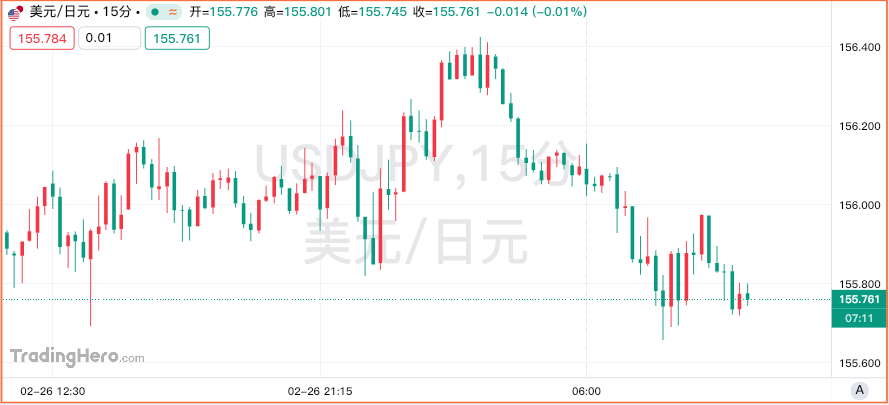
Group 1: Japan's Monetary Policy - Japanese Prime Minister Fumio Kishida expressed a desire to maintain an accommodative monetary policy, while the Bank of Japan's most hawkish committee member, Hajime Takata, called for an increase in the benchmark interest rate [1][6] - Takata suggested that the central bank should further adjust its policy, indicating a divergence between the central bank's internal support for aggressive policy normalization and the government's stance [1][6] Group 2: Gold Market Outlook - Bank of America Global Research predicts that gold prices could surpass $6,000 per ounce within the next 12 months due to uncertainties from changes in the Federal Reserve's leadership and economic risks from U.S. tariff policies [2][7] - The report acknowledges that gold prices may face short-term resistance as investors adjust to higher price levels, with a potential for a temporary decline before spring [2][7] - Analysts express caution regarding silver, indicating that its price movements are more complex, with a possibility of further short-term declines, but also the potential for silver to return to $100 per ounce [2][7] Group 3: Currency Market Movements - The gold price experienced slight gains, trading around 5,195, supported by ongoing geopolitical tensions and concerns over U.S. tariff uncertainties, although strong U.S. economic data limited its upward potential [3][8] - The Australian dollar saw a slight decline, trading around 0.7130, influenced by profit-taking and a stronger U.S. dollar due to favorable economic data and reduced expectations for Fed rate cuts [4][9] - The USD/JPY pair traded lower at approximately 155.90, affected by profit-taking and renewed expectations for Bank of Japan interest rate hikes, although a stronger dollar limited the decline [5][10]
东京通胀突然“踩刹车”,日本央行最怕的局面出现了?
Jin Shi Shu Ju· 2026-02-27 03:34
Core Viewpoint - Tokyo's inflation indicators have slowed to their lowest level in over a year, influenced by Prime Minister Sanna Takashi's utility subsidies aimed at reducing household energy costs, coinciding with the Bank of Japan's interest rate hike process [1][2]. Group 1: Inflation Data - The Tokyo Consumer Price Index (CPI), excluding fresh food, rose by 1.8% year-on-year, marking the smallest increase since October 2024 and slightly above economists' median forecast of 1.7% [1]. - An indicator that excludes energy and measures underlying inflation strength increased by 2.5%, still above the Bank of Japan's 2% target [1]. - Energy prices decreased by 9.2% year-on-year due to the government's three-month electricity and gas subsidy program, which began in January [1]. Group 2: Government Measures - The government estimates that the subsidy program will save an average household 7,300 yen (approximately $46.75) this quarter [1]. - The impact of utility subsidies and the base effect from last year's food price surge may lead to inflation falling below the 2% target in the first half of this year [2]. Group 3: Monetary Policy Implications - The slowdown in inflation may complicate Bank of Japan Governor Kazuo Ueda's justification for further interest rate hikes, especially after Prime Minister Takashi's recent nominations to the central bank board, which signal support for a loose monetary policy [3]. - Despite the inflation data, the Bank of Japan remains determined to raise the benchmark interest rate when the economic outlook justifies it, with a 69% probability of a rate hike in April according to overnight swap index pricing [6]. Group 4: Economic Indicators - Japan's Ministry of Economy, Trade and Industry reported a 2.2% month-on-month increase in factory output for January, below the market expectation of 5.5%, with a year-on-year increase of 2.3% [6]. - Retail sales in January increased by 4.1% month-on-month, exceeding market expectations [6].

国际金价新一轮上涨即将启动,耐心等待终有回报
Sou Hu Cai Jing· 2026-02-26 08:29
Core Viewpoint - The international gold price is expected to start a new round of increases, but it requires patience as the positive fundamentals need time to develop [3][16]. Geopolitical Situation - Recent discussions about a new round of talks between Ukraine, the U.S., and Russia are set for early March, which may temporarily suppress gold prices as the market adopts a wait-and-see approach [3][5]. - The ongoing tensions regarding Iran's nuclear program are crucial for supporting gold prices, with the U.S. imposing permanent sanctions and not allowing Iran to set expiration dates for these sanctions [5][11]. - The potential for U.S. military action against Iran could lead to increased oil prices, which may further drive global inflation, thus supporting gold prices [5][7]. Economic Policies and Market Sentiment - Trump's recent statements indicate a disregard for legal rulings on tariffs, which could heighten market uncertainty and increase demand for gold as a safe haven [9][11]. - The emphasis on maintaining low interest rates to stimulate the economy is a positive signal for gold, as lower rates typically lead to higher gold prices [11][16]. - The ongoing geopolitical tensions, particularly with Iran, are expected to persist, providing a long-term support for gold prices [11][16]. Market Conditions - Current market conditions show that supportive fundamentals for gold are gradually developing, and investors should remain patient as these factors have not yet fully materialized [13][14][16]. - Upcoming economic data, such as initial jobless claims, may not significantly impact gold prices, as the long-term upward trend remains intact [13][14].

国投白银LOF补偿方案启动 沪银走势小幅震荡
Jin Tou Wang· 2026-02-26 07:48
Group 1 - Silver futures are currently trading above 22,467, with a recent opening at 22,975 and a current price of 22,636, reflecting a 0.75% increase. The highest price reached was 23,394, while the lowest was 22,324, indicating a short-term oscillating trend in the market [1] - The compensation plan for Guotou Silver LOF has officially launched, impacting investor sentiment and fund flows, although its direct effect on silver prices is considered limited [1] - The International Monetary Fund (IMF) has indicated that turmoil surrounding broad tariffs in the U.S. may weaken an otherwise "strong" economy, which could influence silver price dynamics [1] Group 2 - The market's expectations for recent interest rate cuts have cooled, as Boston Fed President Susan Collins stated that maintaining current rates is appropriate given the resilient labor market and ongoing inflation pressures [2] - The Chicago Fed's Austan Goolsbee noted that inflation progress has stalled, with a current rate of 3% still above the Fed's 2% target, reinforcing the case for stable interest rates [1][2] - The silver market is currently observing a range between 22,260 and 23,280, with a broader range of 21,560 to 24,490, indicating limited upward momentum in the near term [3]
高盛:日本央行新委员提名或降低近期加息概率
Sou Hu Cai Jing· 2026-02-26 05:50
Core Viewpoint - The nomination of Asada Tohru and Sato Ayano to the central policy committee by the Japanese government reduces the likelihood of an interest rate hike in April or June [1] Group 1: Economic Policy Implications - Both nominees have historically advocated for aggressive fiscal expansion and accommodative monetary policy [1] - Their past statements suggest a cautious approach towards further interest rate increases [1] Group 2: Forecasts - Goldman Sachs maintains its baseline forecast for the next interest rate hike by the Bank of Japan to occur in July [1]
日本央行鹰派委员呼吁进一步加息 与首相鸽派提名形成对比
Ge Long Hui· 2026-02-26 02:45
Core Viewpoint - The divergence between the Bank of Japan's hawkish policy committee member Takeda and Prime Minister Kishida regarding monetary policy is becoming increasingly evident, with calls for further interest rate hikes amidst a backdrop of ongoing accommodative policies [1] Group 1: Monetary Policy - Takeda, a prominent member of the Bank of Japan, has called for further interest rate hikes, indicating a shift towards policy normalization as the inflation target appears to be nearly achieved [1] - This call for rate increases comes after Takeda's unexpected proposal for consecutive hikes during a recent policy meeting, marking his first public comments since then [1] - The internal conflict within the Bank of Japan is highlighted by Takeda's stance, contrasting with the government's preference for maintaining loose monetary policies, as evidenced by Kishida's recent appointments of two well-known supporters of such policies to the central bank [1]
每日核心期货品种分析-20260224
Guan Tong Qi Huo· 2026-02-24 12:23
Report Summary 1. Market Performance - As of the close on February 24, most domestic futures main contracts rose. Shanghai Silver rose over 12%, Lithium Carbonate rose over 10%, Container Shipping European Line and SC Crude Oil rose over 6%, Low-Sulfur Fuel Oil (LU) and Platinum rose over 5%, and Palladium and Butadiene Rubber rose over 4%. On the downside, Polysilicon fell over 4%, and Coke and Live Pigs fell over 2%. Stock index futures and treasury bond futures also showed varying degrees of increase [4][5]. 2. Core Views - The overall futures market showed a pattern of more rises than falls, and different varieties were affected by various factors such as supply and demand, policies, and geopolitical situations, with different short-term trends [4][5]. 3. Variety Analysis Copper - Shanghai Copper opened low and moved high, with a slight increase. The US customs policy changed, and the supply and demand of copper showed a marginal improvement expectation. With the downstream recovery, copper demand is expected to increase, and the short-term copper price is mainly volatile and strong [7]. Lithium Carbonate - Lithium Carbonate opened high and moved high, with a significant increase. Affected by seasonal and holiday factors, the supply was tight in the short term. The policy window period and positive price predictions stimulated the market, and the short-term trend was strong [8][9]. Crude Oil - OPEC+ members will maintain the production plan, US oil inventories decreased, and the winter storm may stimulate demand. The Iran - US negotiation situation is uncertain, and the short-term crude oil price is expected to be strong and volatile [10][11]. Asphalt - The asphalt supply and demand were weak, and the开工 rate and production were at a low level. The Venezuelan crude oil supply was restricted, and the price is expected to fluctuate with the crude oil price. It is recommended to take a reverse arbitrage strategy [12]. PP - The PP downstream开工率 decreased seasonally, the企业开工率 was at a low - to - neutral level, and the inventory was at a neutral level. The cost increased, and the supply - demand pattern improved limitedly. It is recommended to continue to narrow the L - PP spread [13][14]. Plastic - The plastic开工率 increased, the downstream开工率 decreased seasonally, and the inventory was at a neutral level. The new production capacity was put into operation, and the supply - demand pattern improved limitedly. Continue to narrow the L - PP spread [15]. PVC - The upstream calcium carbide price decreased, the PVC开工率 was at a neutral level, the inventory was high, and the real - time demand was weak. However, there are policy and maintenance expectations, and the price is expected to be volatile [16][17]. Coking Coal - Coking Coal opened high and moved low, with a decline. The import coal supply recovered, the domestic mine开工率 was low, and the downstream demand lacked incremental support. The short - term price is under pressure [18]. Urea - The urea futures opened high and moved high, and the spot price rose. The Indian tender supported the market sentiment. With the upcoming spring plowing season, the price is expected to be stable and strong, but the increase may be limited [19][20].
沪铜日报:等待下游复产,基本面边际改善预期-20260224
Guan Tong Qi Huo· 2026-02-24 11:20
Report Summary 1. Report Industry Investment Rating - Not provided in the report 2. Core View of the Report - The Shanghai copper market opened lower and moved higher today, with a slight intraday increase. The US customs will stop collecting tariffs on February 24th, while Trump announced a 10% import tariff on global goods for 150 days. Fundamentally, the upstream smelting load during the holiday was relatively normal. The production in January was 1.57 million tons more than expected, and it is estimated to return to normal in February. The estimated output of electrolytic copper in China in February will decrease by 3.58 million tons month - on - month, a decrease of 3.04%, and increase by 8.06% year - on - year. As of December 2025, the apparent consumption of copper was 1.3188 million tons, a month - on - month increase of 4.00%. The downstream factories have not fully resumed production, and the market trading activity is low. The social inventory of copper has accumulated significantly. UBS expects the Fed to continue its loose monetary policy, with two 25 - basis - point interest rate cuts expected by the end of September this year. The weakening of the US dollar is expected to boost non - ferrous metals. With the recovery of the downstream, copper demand will increase, and the short - term copper price will mainly fluctuate strongly [1]. 3. Summary by Relevant Catalogs 3.1. Market Analysis - **Futures**: Shanghai copper opened lower and moved higher, with a slight increase [1][3]. - **Spot**: The spot premium in East China was 200 yuan/ton, and in South China was - 150 yuan/ton. On February 23, 2026, the LME official price was $12,913/ton, and the spot premium was - $81/ton [3]. 3.2. Supply Side - As of February 14, the spot rough smelting fee (TC) was - $50.97/dry ton, and the spot refining fee (RC) was - 5.021 cents/pound [8]. 3.3. Fundamental Tracking - **Inventory**: SHFE copper inventory was 277,100 tons, an increase of 80,400 tons from the previous period. As of February 12, the copper inventory in Shanghai Free Trade Zone was 84,700 tons, a decrease of 6,400 tons from the previous period. LME copper inventory was 241,800 tons, an increase of 6,675 tons from the previous period. COMEX copper inventory was 600,400 short tons, an increase of 1,491 short tons from the previous period [11].
日本财政政策显效面临挑战
Xin Lang Cai Jing· 2026-02-23 21:43
Core Viewpoint - The recent election victory of Prime Minister Sanna Takichi's ruling coalition is expected to facilitate the implementation of his fiscal policies, although significant challenges remain regarding their effectiveness [1] Group 1: Election Outcome and Market Reaction - Takichi's ruling coalition won a decisive victory in the House of Representatives election, with the Liberal Democratic Party (LDP) securing over two-thirds of the seats, enhancing Takichi's influence within the party and government [1] - The market has reacted positively to Takichi's election, with stock prices reaching new highs, while the bond market and yen have experienced significant declines, indicating a "double whammy" effect [1] Group 2: Fiscal Policy Concerns - Market participants express concerns that Takichi's commitment to relaxing fiscal discipline has opened a "Pandora's box," leading to potential future declines in both the yen and bond values [2] - Japan's government debt is projected to reach a record high of 134.2 trillion yen by the end of 2025, exacerbated by ongoing population aging and increasing government expenditures [2] Group 3: Economic Policy Critique - Takichi's economic policy, dubbed "Sanna Economics," aims to stimulate long-term domestic demand through aggressive fiscal expansion, but faces challenges from rising prices and labor shortages [3] - Economists warn that blindly stimulating demand through fiscal policy may worsen cost-push inflation and increase financial market volatility, suggesting that structural reforms are necessary for sustainable growth [3]