
高等教育扩招

Search documents
奋进的女同学们:985硕士女生多了
3 6 Ke· 2025-10-29 00:08
Core Insights - The expansion of graduate enrollment in China's top universities (985 universities) reflects a significant trend in higher education, with graduate admissions surpassing undergraduate numbers in many institutions [1][4][6] - The gender ratio among new students at different educational levels shows a "V" shape, with a predominance of male students in undergraduate programs, a more balanced ratio in master's programs, and a return to a male-dominated ratio in doctoral programs [1][12][17] Group 1: Enrollment Trends - From 2019 to 2025, the majority of 985 universities have seen graduate enrollment (master's + doctoral) exceed undergraduate enrollment, with some universities like Fudan University and Shanghai Jiao Tong University showing a nearly threefold difference [4][6] - The national average growth rates for undergraduate, master's, and doctoral enrollments are approximately 2%, 5%, and 10% respectively, indicating a faster expansion at higher educational levels [3] - In 2023, the total number of undergraduate enrollments was 4.782 million, while graduate enrollments reached 1.302 million, highlighting a significant disparity in enrollment numbers [10] Group 2: Gender Ratio Dynamics - The gender ratio among undergraduate students in 985 universities remains skewed towards males, particularly in engineering and technology fields, where male students often outnumber female students by a ratio of 2:1 or more [12][17] - In contrast, the gender ratio for master's students shows a higher proportion of females compared to their undergraduate counterparts, indicating a shift in enrollment patterns at the graduate level [14] - The doctoral level again reflects a male-dominated trend, with many universities reporting a significant male majority among new doctoral students [17] Group 3: Policy and Future Outlook - The Chinese government is pushing for an increase in graduate enrollment as part of its educational reforms, with policies aimed at expanding the scale of quality undergraduate and graduate education [8] - Experts caution that without corresponding increases in educational resources, such as faculty and facilities, the quality of education may decline, potentially impacting graduates' competitiveness in the job market [9][11] - The trend of expanding graduate programs may lead to an oversupply of academic talent, with many graduates potentially finding themselves in jobs that do not require advanced degrees [11]

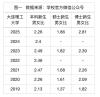
奋进的女同学们:985硕士女生多了!
经济观察报· 2025-10-28 10:15
Core Insights - The majority of 985 universities have seen their graduate (master's and doctoral) enrollment surpass that of undergraduate enrollment, with some institutions like Fudan University and Shanghai Jiao Tong University showing differences of more than double [2][7] - The gender ratio among new students at 985 universities exhibits a "V" shape fluctuation across undergraduate, master's, and doctoral levels, with a predominance of males in undergraduate programs and a higher proportion of females in master's programs [3][25] Enrollment Trends - From mid-August to the present, several 985 universities have released data on new student enrollment for 2025, reflecting trends in high-level education in China [2] - Since 2018, the enrollment growth rates for undergraduate, master's, and doctoral programs have been approximately 2%, 5%, and 10% respectively, indicating a faster expansion at higher education levels [6] - In 2020, the Ministry of Education planned to increase master's enrollment by 189,000, resulting in a significant year-on-year increase of 22.1% [6] Gender Ratio Dynamics - The gender ratio in undergraduate programs at 985 universities remains skewed towards males, particularly in engineering and technology fields, where male enrollment often exceeds two-thirds [3][17] - In master's programs, the proportion of female students has increased significantly compared to undergraduate levels, with some universities experiencing a reversal in gender ratios [19][22] - Doctoral programs again show a predominance of males, reinforcing the "V" shape trend in gender distribution across educational stages [25] Implications of Enrollment Expansion - The expansion of higher education is seen as crucial for talent development and human capital enhancement, but it has led to challenges such as resource shortages in graduate housing and large class sizes [4] - The enrollment growth in graduate programs is outpacing that of undergraduate programs, with some universities reporting graduate enrollments exceeding 10,000 [9][12] - Concerns have been raised about the quality of education being compromised due to rapid enrollment increases without corresponding resource allocation [13][14] Future Projections - The trend of expanding both undergraduate and graduate enrollments is expected to continue, with projections suggesting that by 2040, all candidates may have access to undergraduate education, and 30% may pursue graduate studies [14] - The current job market dynamics indicate a potential mismatch between the number of graduates and available positions, leading to concerns about the devaluation of degrees [14]

拆解985高校招生:硕博大扩招,男女比例V型分布
Jing Ji Guan Cha Bao· 2025-10-27 09:50
Core Viewpoint - The enrollment data from top Chinese universities (985 universities) indicates a significant trend towards expanding graduate programs, with graduate enrollment surpassing undergraduate enrollment in many institutions, reflecting a shift in higher education focus towards advanced degrees [1][4][6]. Enrollment Trends - From 2019 to 2025, the majority of 985 universities have seen graduate enrollment (master's and doctoral) exceed undergraduate enrollment, with some universities showing a difference of nearly three times [4][7]. - The enrollment growth rates for graduate programs are notably higher than those for undergraduate programs, with master's programs growing at approximately 5% and doctoral programs at around 10% annually [3][6]. Gender Ratio Dynamics - The gender ratio among new students in 985 universities shows a "V" shape fluctuation: undergraduate programs predominantly have more male students, while the proportion of female students increases at the master's level, only to decrease again at the doctoral level [1][12][17]. - In 2025, certain universities like Electronic Science and Technology University exhibit a male-to-female ratio of 3.53 in undergraduate programs, while the ratio for master's students is more balanced [13][15]. Policy and Future Outlook - The expansion of graduate programs is driven by national policies aimed at increasing the number of high-level talents, but there are concerns about the quality of education and resource allocation [2][9]. - Predictions suggest that by 2040, a significant portion of the population may have access to higher education, potentially leading to an oversupply of graduates in fields that do not require advanced degrees [11].
冯帅章:部分院校的专业设置与实际需求脱节
经济观察报· 2025-10-11 09:15
Core Viewpoint - The employment situation, particularly for young people, is a concern for society, but there is no need for excessive anxiety. The job market is relatively stable this year, with enterprises, graduates, and schools actively adjusting to the new employment landscape. Future attention should be paid to the quality rather than the quantity of higher education expansion [1][2][5][7]. Employment Market Overview - The number of college graduates is expected to reach a record high of 12.22 million by 2025, an increase of 430,000 from the previous year [2]. - As of August, the unemployment rate for urban labor aged 16-24 reached 18.9%, up 1.1 percentage points from July, marking a new high since the new standard was introduced in December 2023 [2]. - The overall employment market is stable compared to last year, with no significant fluctuations, which can be viewed as a positive sign in the current macroeconomic context [5][6]. Higher Education and Employment Quality - There is a need for significant adjustments in the professional settings of existing higher education institutions to align with actual market demands [7][8]. - Caution is advised regarding the expansion of higher education, emphasizing the importance of maintaining educational quality over merely increasing enrollment numbers [7][8]. Recommendations for Graduates - Graduates are encouraged to actively seek employment opportunities while considering market demands, rather than focusing solely on salary and job stability [9]. - Key strategies for students include solidifying their professional knowledge, embracing new technologies, and participating in internships to better understand market needs [9]. Flexible Employment Trends - The new flexible employment sector is divided into two categories: cloud-based and location-based. The latter, such as delivery and ride-sharing services, is approaching saturation due to local market demand limitations [12][13]. - The total number of platform workers in China has reached 247 million, accounting for 28.6% of the working-age population, with full-time and part-time workers being nearly equal [18]. Social Security and Policy Recommendations - There is a pressing need to enhance social security for flexible employment groups, particularly in light of an aging population [16]. - Policies should encourage platforms to assist flexible workers in securing social insurance, even if formal labor contracts are not in place [17][18].

冯帅章:部分院校的专业设置与实际需求脱节
Jing Ji Guan Cha Bao· 2025-10-11 08:12
Core Insights - The employment situation for recent graduates and flexible employment groups in China is under scrutiny due to increasing numbers in both categories, with 12.22 million graduates expected by 2025, an increase of 430,000 from the previous year [1] - The unemployment rate for urban youth aged 16-24 reached a new high of 18.9% in August 2023, up 1.1 percentage points from July [1] - The overall employment market is relatively stable this year, with adjustments being made by enterprises, graduates, and educational institutions to adapt to new employment conditions [2][3] Employment Trends - The number of recent graduates has been consistently high, leading to a normalization of media coverage regarding their employment pressures [2] - The long-term trend indicates a decline in the labor force population, suggesting that as long as the macroeconomic situation remains stable, employment conditions will also stabilize [3] Higher Education and Employment Quality - There is a need for significant adjustments in higher education curricula to align with market demands, as many current programs are disconnected from actual job market needs [3][4] - Caution is advised regarding the expansion of higher education, emphasizing quality over quantity to avoid diluting educational resources and reducing the competitiveness of graduates [3][4] Flexible Employment Dynamics - The flexible employment sector is divided into two categories: cloud-based (e.g., live streaming, short video creators) and location-based (e.g., delivery drivers, ride-hailing services) [7] - The location-based flexible employment market is nearing saturation, influenced by local population and economic factors, while cloud-based employment has greater potential for growth [7][12] Social Security and Policy Recommendations - There is a pressing need to enhance social security for flexible employment groups, particularly in light of an aging population [9][10] - Policies should encourage platforms to assist flexible workers in securing social insurance, even if formal employment contracts are not in place [11][12]