高频跟踪

Search documents
兼论后续出口走势展望:如何高频跟踪出口形势变化
Soochow Securities· 2025-06-18 12:31
Export Changes - Since Trump's administration, China's export structure has adjusted, with a decrease in the share of exports to the U.S. and an increase to ASEAN and Africa, while exports to the EU have rebounded after two years of decline[11] - In the first five months of 2025, China's exports to the U.S. accounted for approximately 11.9%, down 2.7 percentage points from 2024, while exports to ASEAN, Africa, and the EU increased to 17.8%, 5.6%, and 14.7% respectively[11] - By the end of 2024, China's export share of global exports was about 15.0%, rising to approximately 15.4% in Q1 2025, indicating a recovery in global market share[11] High-Frequency Tracking - Monitoring port cargo throughput can effectively reflect changes in China's export volume, showing a correlation with historical export trends[21] - South Korea's export growth is a key indicator of global demand, with a 5.4% increase recorded in early June 2025, suggesting a potential recovery in global demand[43] - Tracking the number of container ships from China to the U.S. provides insights into direct export trends, with a notable recovery in June but still weaker than March levels[43] Future Export Outlook - In an optimistic scenario, if the fentanyl tariffs are lifted and the exemption for reciprocal tariffs continues until the end of the year, the annual export growth rate could reach approximately 3.4%[57] - Conversely, under a baseline scenario, the annual export growth rate is expected to be around 2.1%, with risks of a decline in Q4 due to high base effects[57] - The end of the 90-day exemption period for tariffs on July 9, 2025, poses uncertainties for future export demand, as the U.S. may maintain its current tariff framework[54]
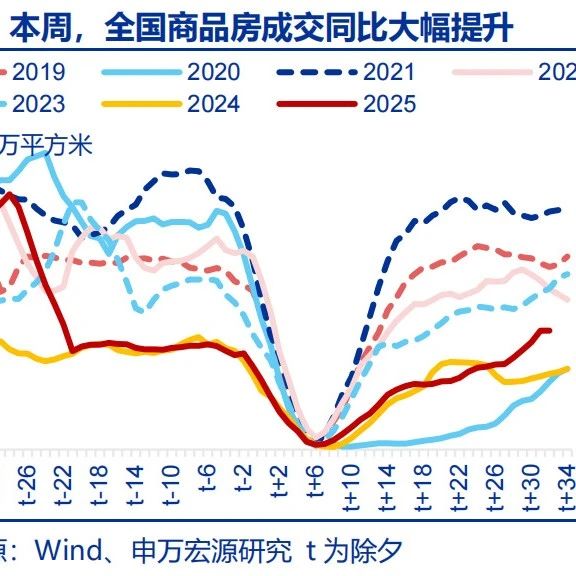
高频跟踪 | 地产成交热度攀升
申万宏源宏观· 2025-03-03 15:19
Industrial Production - Industrial production is showing signs of divergence, with downstream operations recovering while midstream and upstream sectors are experiencing slight declines. The operating rate of blast furnaces has decreased by 0.8 percentage points year-on-year to 2%, while the operating rate of PTA has dropped by 3.5% year-on-year [1][3][4] - In the automotive sector, the operating rate of semi-steel tires has significantly increased, up 3% year-on-year, indicating strong performance in this area [1][4] Construction Industry - The construction sector is facing weak performance, with asphalt operating rates falling by 5.8 percentage points year-on-year to -2.8%. Additionally, the national grinding operating rate and cement shipment rates are also below last year's levels, down 8.5 percentage points to 10.3% and 6% to 11.5% respectively [1][5][6] Demand Trends - There has been a substantial increase in new housing transactions, with a year-on-year rise of 50.8%. All tiers of cities are performing well, with first, second, and third-tier cities seeing increases of 64.9%, 41.7%, and 55.6% respectively [1][7] - Movie consumption remains high, with the number of viewers and box office revenue increasing by 132.8% and 149.6% year-on-year respectively. However, the intensity of human mobility is declining, with the national migration scale index down 7.6 percentage points to 6 [1][8][9] Price Trends - Agricultural product prices are generally declining, with vegetable prices dropping by 2.1% week-on-week. The prices of pork, eggs, and fruits have also decreased, albeit at a smaller rate [2][12] - The industrial product price index has continued to decline, with a week-on-week drop of 1.5%. Metal prices fell by 0.6%, while energy and chemical prices saw a more significant decrease of 2% [2][13]