
黄金内湾

Search documents
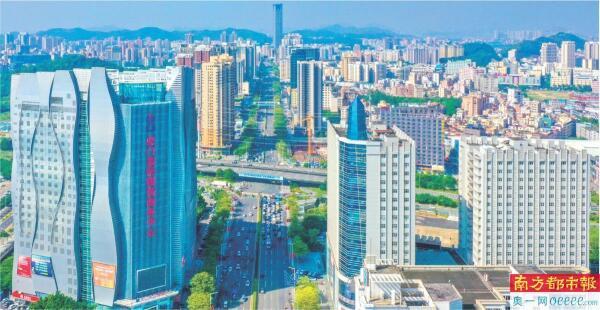
“迈向千亿镇 建设新虎门” 力争今年GDP增长5%
Nan Fang Du Shi Bao· 2026-02-08 23:13
Core Viewpoint - Humen aims to achieve the goal of becoming a "trillion-yuan town" during the 15th Five-Year Plan period, building on the solid foundation laid during the 14th Five-Year Plan, with a focus on high-quality development and economic growth [4][5][6]. Economic Performance - In 2025, Humen's GDP reached 788.11 billion yuan, with a year-on-year growth of 3.1%. The total fixed asset investment was 101.36 billion yuan, and the total import and export volume was 906.94 billion yuan, showing a strong growth rate of 30.4% [5][14]. - The industrial added value for the year was 204.33 billion yuan, and the total retail sales of consumer goods amounted to 359.53 billion yuan, reflecting a year-on-year increase of 2.3% [14]. Development Goals - Humen's goal for the 15th Five-Year Plan is to break through the 1 trillion yuan GDP mark, positioning itself as a key economic player [5][6]. - The town plans to implement a series of high-quality development initiatives, including the "Hundred Thousand Project" and new urbanization strategies, to support its economic ambitions [5][6]. Investment and Industry Development - Humen is focusing on enhancing investment quality and promoting industrial upgrades, with plans to maintain high levels of fixed asset investment and achieve double-digit growth in industrial and technological transformation investments [6][11]. - The town aims to strengthen its e-commerce sector and develop emerging industries such as low-altitude economy and intelligent manufacturing [11][12]. Infrastructure and Urban Development - Humen is committed to improving urban management and infrastructure, including the renovation of old neighborhoods and the construction of new public facilities to enhance living conditions [15][17]. - The town is also working on creating a high-quality living environment and optimizing public services to support its residents [17][18]. Regional Cooperation - Humen is actively participating in the development of the Greater Bay Area and the "Golden Bay" initiative, aiming to enhance regional collaboration and infrastructure connectivity [9][10]. - The town is focusing on integrating with the Shenzhen metropolitan area and collaborating with neighboring regions to boost economic growth and development [9][10].

经济第一大省定目标:用13年时间实现经济总量倍增
Di Yi Cai Jing· 2025-12-08 12:32
Group 1 - The core objective of Guangdong's economic plan is to achieve a doubling of its economic output by 2035, requiring an annual compound growth rate of approximately 5.5% over the next 13 years [1] - The plan emphasizes balanced growth, focusing on regional coordination and development, particularly between the Pearl River Delta and the less developed areas of Guangdong [2][3] - The concept of a "Golden Inner Bay" is highlighted, aiming to integrate high-energy cities around the Pearl River estuary to enhance economic synergy and address disparities between regions [3] Group 2 - The proposal includes the establishment of "Innovation and Technology Special Zones" to foster a modern industrial system, promoting flexibility in areas such as technology transfer and intellectual property [4] - Guangdong aims to transition towards new growth drivers by enhancing its manufacturing capabilities, particularly in high-tech sectors like artificial intelligence and robotics [5] - The plan outlines the development of eight strategic emerging industries, including low-altitude economy and smart economy, to reduce reliance on traditional sectors and enhance competitiveness [6][7] Group 3 - Despite its advantages, Guangdong faces challenges such as unbalanced development, difficulties in transitioning to new growth drivers, and the need for deeper integration of innovation and industrial chains [8] - The province's strong private sector is a key asset, but there are still bottlenecks in administrative processes and market reforms that need to be addressed for further economic potential [9]
城市24小时 | 大湾区又一“超级通道”,要来了?
Mei Ri Jing Ji Xin Wen· 2025-09-24 16:00
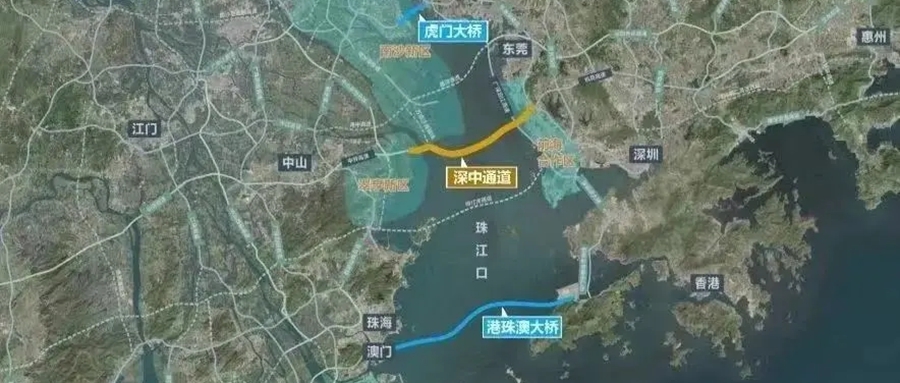
Group 1 - The Shenzhen-Zhuhai Channel project has made significant progress with the release of a public consultation for the preliminary research project, indicating a step forward in this major transportation infrastructure [1] - The project has a budget of 20.8 million yuan and aims to provide key technical support for the channel's inclusion in national planning [1] - The channel will connect Shenzhen and Zhuhai, featuring a dual eight-lane highway, high-speed rail with a design speed of 350 km/h, and intercity rail with a design speed of 200 km/h, potentially reducing travel time between the two cities to 30 minutes [1] Group 2 - The Shenzhen-Zhuhai Channel is positioned as a "middle ring" transportation route, enhancing connectivity within the Guangdong-Hong Kong-Macao Greater Bay Area and promoting industrial integration between the two sides of the Pearl River Estuary [2] - The channel's development is being accelerated, with the Guangdong Provincial Development and Reform Commission including it in the 2025 budget, and the Shenzhen government emphasizing its importance in local development plans [3] Group 3 - The anticipated completion of the Shenzhen-Zhuhai Channel is expected to significantly boost the transfer of industries from Shenzhen to the western side of the Pearl River, particularly benefiting Zhuhai [4] - The integration of Shenzhen's technological innovation resources with Zhuhai's manufacturing base is expected to create a collaborative model of "Shenzhen R&D + Zhuhai Manufacturing," facilitating the transformation of technological achievements and the integration of industrial chains [4]
广州南沙站预计2028年2月底竣工 1小时通达大湾区多个城市
Nan Fang Ri Bao Wang Luo Ban· 2025-09-15 07:44
Core Viewpoint - The announcement of the Guangzhou Nansha Station project, part of the Shenzhen to Jiangmen railway, highlights significant infrastructure development aimed at enhancing transportation connectivity in the Greater Bay Area, with a completion target set for February 29, 2028 [1] Group 1: Project Overview - The Nansha Station will cover an area of 120,000 square meters and is designed to be an important auxiliary station within Guangzhou's passenger transport hub, featuring a future plan of 14 platforms and 29 tracks, surpassing the scale of Guangzhou Baiyun Station [1] - The station will integrate high-level waiting areas for the Deep Jiang Railway and underground waiting areas for the Nansha Port Railway, improving space utilization and passenger experience [1] Group 2: Transportation Network Integration - Nansha Station will connect multiple railways including the Nansha Port Railway, Shenmou Railway, and the Guangzhou-Zhuhai-Macao High-Speed Railway, as well as metro lines 18, 15, and 4, creating a multi-layered transportation network in the Greater Bay Area [1] - The completion of Nansha Station is expected to significantly reduce travel time between major cities in the Greater Bay Area, achieving effective one-hour access to Shenzhen, Zhuhai, Foshan, Huizhou, Dongguan, Zhongshan, and Jiangmen [1]