A股市场发展

Search documents
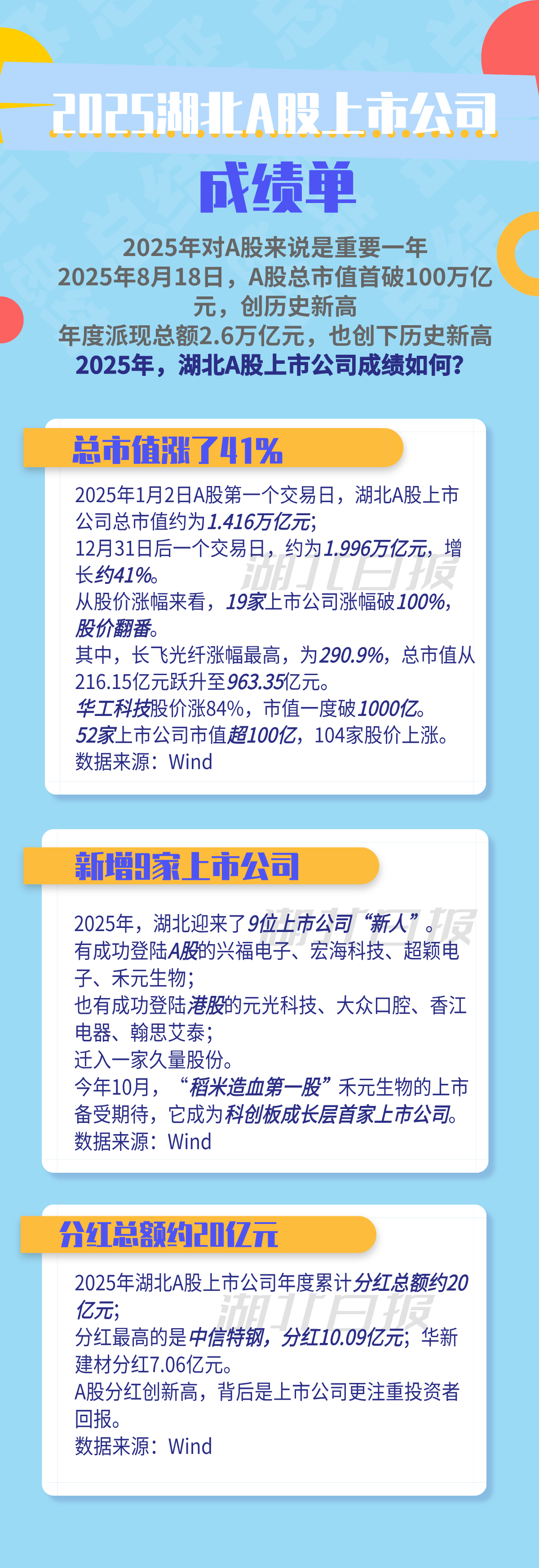
2025年A股收官,湖北上市公司表现如何?一图速览
Sou Hu Cai Jing· 2026-01-01 12:49
Core Insights - 2025 is a significant year for the A-share market, with the total market capitalization surpassing 100 trillion yuan for the first time on August 18, marking a historical high [6] - The total annual cash dividends reached 2.6 trillion yuan, also a record high, indicating a growing emphasis on investor returns by listed companies [6][9] Group 1: Market Performance - The total market capitalization of Hubei A-share listed companies increased by approximately 41%, from about 1.416 trillion yuan on January 2 to around 1.996 trillion yuan by December 31 [7][8] - Nineteen listed companies in Hubei saw their stock prices double, with Changfei Fiber achieving the highest increase of 290.9%, raising its market capitalization from 21.615 billion yuan to 96.335 billion yuan [8] Group 2: New Listings and Growth - In 2025, Hubei welcomed nine new listed companies, including Xinfeng Electronics, Honghai Technology, and He Yuan Biology, with the latter being the first to list on the Sci-Tech Innovation Board [9] - A total of 52 listed companies in Hubei have market capitalizations exceeding 10 billion yuan, and 104 companies experienced stock price increases [9] Group 3: Dividend Distribution - The cumulative dividend payout for Hubei A-share listed companies in 2025 was approximately 20 billion yuan, with CITIC Special Steel distributing the highest dividend of about 1.009 billion yuan and Huaxin Cement distributing around 706 million yuan [10]

这次真的不一样?
集思录· 2025-12-11 14:11
Core Viewpoint - The article discusses the strategic importance of the capital market in wealth redistribution and its role in addressing social stability and technological advancement, while highlighting the challenges faced by the Chinese stock market in achieving significant growth compared to global counterparts [1][2]. Group 1: Strategic Importance of Capital Markets - The capital market serves as a necessary reservoir for monetary resources, especially as the real estate sector is no longer a viable option for development [1]. - Wealth distribution through capital markets can help reduce the wealth gap, contributing to social stability [1]. - The historical context of the U.S. shows that capital markets play a crucial role in technological development [1]. Group 2: Challenges in the Chinese Stock Market - The Chinese stock market has not seen significant growth compared to other countries, with historical highs last recorded in October 2007 [1]. - Factors contributing to this stagnation include a lack of experience among investors, listed companies, and management, as well as insufficient urgency to develop the market [1]. - The article suggests that the current market dynamics may differ from the past due to a focus on creating a community of shared interests among investors [2]. Group 3: Perspectives on Wealth Redistribution - The notion that capital markets can effectively reduce wealth inequality is challenged, with arguments suggesting that the reality often leads to wealth concentration among a few [3][11]. - Historical data indicates that during previous bull markets, wealth was disproportionately gained by high-net-worth individuals, while smaller investors faced losses [8]. - The article emphasizes skepticism regarding the effectiveness of current policies aimed at boosting the stock market for the benefit of the general populace [8].

证监会主席吴清:A股实现了量的合理增长和质的有效提升
Zhong Guo Jing Ying Bao· 2025-12-06 09:02
Core Insights - The A-share market has been generally active this year, with market capitalization exceeding 100 trillion yuan since August, indicating reasonable quantitative growth and effective qualitative improvement [1] Group 1: Market Performance - The total assets of securities companies have reached 14.5 trillion yuan, with net assets approximately 3.3 trillion yuan [1] - The structure of the securities industry is continuously optimizing, exemplified by landmark cases such as the merger of Guotai Junan and Haitong, which has begun to realize the effect of 1+1>2 [1]

每6个中国人就有1名股民
财联社· 2025-10-09 12:03
Core Insights - The A-share market has undergone significant transformation over the past decade, with substantial growth in market size, trading activity, and investor structure [2][4]. Market Size Expansion - The total market capitalization of A-shares increased from approximately 62.75 trillion yuan in 2015 to 107.19 trillion yuan in 2025, marking a growth of over 70% and surpassing the one hundred trillion yuan milestone [5][6]. - The number of listed companies rose from 2,808 in 2015 to 5,167 in 2025, an increase of over 84%, with many new listings coming from emerging sectors such as technology, renewable energy, and pharmaceuticals [5][6]. Trading Activity Increase - As of October 9, 2025, the total trading volume reached 307 trillion yuan, exceeding the entire trading volume of 253 trillion yuan in 2015, reflecting a 121% increase [6][8]. - The average daily trading volume in 2025 was 16.6 billion yuan, a 60% increase from 10.4 billion yuan in 2015, indicating heightened market participation [6][7]. Investor Base Growth - The number of A-share investors grew from 99.11 million at the end of 2015 to over 240 million by 2025, representing a growth of over 140% [9][10]. - The investor structure has shifted from a predominance of retail investors to a more balanced mix, with institutional investors gaining a stronger foothold in the market [11][12]. Leverage Level Rationalization - The leverage level in the A-share market has stabilized, with the margin financing balance increasing from 1.17 trillion yuan in 2015 to 2.39 trillion yuan in 2025, while the proportion of margin financing to total market capitalization decreased from 4.27% to 2.49% [12][13]. Sectoral Restructuring - The market has transitioned from being dominated by traditional sectors like finance and energy to a focus on technology and emerging industries. The information technology sector's market capitalization grew from 5.55 trillion yuan in 2015 to 24.04 trillion yuan in 2025, increasing its market share from 9.97% to 19.76% [15][16]. - The financial sector's market share decreased from 22.98% in 2015 to 18.29% in 2025, while the real estate sector's share fell from 4.32% to 1.07% [15][16].