AI原生搜索

Search documents
元宝入侵微信这片自留地,是万不得已
Jing Ji Guan Cha Wang· 2026-02-04 05:18
Core Viewpoint - Tencent's WeChat has implemented a ban on Yuanbao red envelope links, which has received positive feedback from users, highlighting the platform's commitment to user experience and privacy [2] Group 1: Market Competition and User Engagement - Tencent's Yuanbao is attempting to replicate the success of WeChat red envelopes from 2015, investing 1 billion yuan to attract users during the critical Chinese New Year period [2] - Despite a peak in download numbers, Yuanbao's monthly active users (MAU) stand at approximately 41 million, significantly lower than competitors like Doubao and DeepSeek, which have MAUs of over 200 million and 150 million respectively [3] - The introduction of Yuanbao has disrupted WeChat's long-standing philosophy of minimal user disturbance, leading to user backlash against intrusive marketing tactics [2][3] Group 2: Strategic Positioning and AI Integration - The current landscape shows that traditional app user acquisition costs are high, and user retention rates are low, prompting companies to seek new growth engines, with AI being a key focus [4] - Competitors like ByteDance are integrating AI deeply into their ecosystems, creating specialized agents that enhance user experience, which poses a threat to Tencent's market position if Yuanbao does not quickly gain traction [4] - Tencent's strategy involves leveraging Yuanbao to enhance user retention by encouraging sharing within WeChat, contrasting with Alibaba's approach of streamlining user experience across its ecosystem [5] Group 3: User Retention Challenges - Historical data indicates that while red envelope marketing can drive initial user acquisition, it often fails to ensure long-term retention, leading to high uninstall rates [5] - For Yuanbao to succeed, it must address genuine user needs and provide unique value during the promotional period to avoid a decline in user engagement post-campaign [5]



喝点VC|a16z重磅分析:搜索进入“AI原生”时代,谁将主宰下一代搜索基础设施?
Z Potentials· 2025-12-06 05:27
Core Insights - The article discusses the transformation of AI search from traditional search engines to native AI search, highlighting the competitive landscape among various startups and the need for a new search architecture focused on AI [1][3][5]. Group 1: Historical Context - In the 1990s, various startups explored different methods of internet search, with Yahoo using a directory approach and Google later revolutionizing the field with its PageRank algorithm [1][2]. - The emergence of Google in 1998 marked a significant shift, as its algorithm quickly became the preferred method for navigating the internet, effectively solving the search problem for users [2]. Group 2: Current Landscape - The current search environment is undergoing a major shift, with numerous startups competing to create AI-native search systems that can index the web for AI applications [3][6]. - Traditional web search is primarily optimized for human users, often resulting in cluttered results filled with ads and redundant information, which can hinder the effectiveness of AI models [3][5]. Group 3: Emerging Trends - The article posits that deep research will become a dominant and monetizable form of agent-based search, as clients are willing to pay for high-quality research outputs [5][17]. - Many companies are opting to outsource their search capabilities to specialized service providers due to the high costs and complexities associated with maintaining search infrastructure [7][15]. Group 4: Technological Innovations - New search architectures are being developed to support AI agents, focusing on real-time data access and dynamic information retrieval, which enhances the capabilities of AI models [11][12]. - The introduction of Retrieval-Augmented Generation (RAG) and Test-Time Computation (TTC) allows models to access real-time information and improve their reasoning capabilities, transforming static models into dynamic reasoning systems [11][12]. Group 5: Use Cases - Deep research has emerged as a prominent use case for AI search APIs, enabling agents to conduct extensive research tasks that would take humans significantly longer to complete [17][19]. - AI search is also being utilized for CRM lead enrichment, automating the process of gathering and updating relevant information from various sources [19]. - Real-time access to technical documentation and code examples is crucial for coding agents, ensuring they reference the most current and relevant information [20]. Group 6: Competitive Dynamics - The competitive landscape is shifting towards API platforms, where user-facing products can leverage various search functionalities through single integrations [15][22]. - Companies are increasingly evaluating search providers based on the quality of results, API performance, and cost, leading to a diverse range of offerings in the market [22][23].



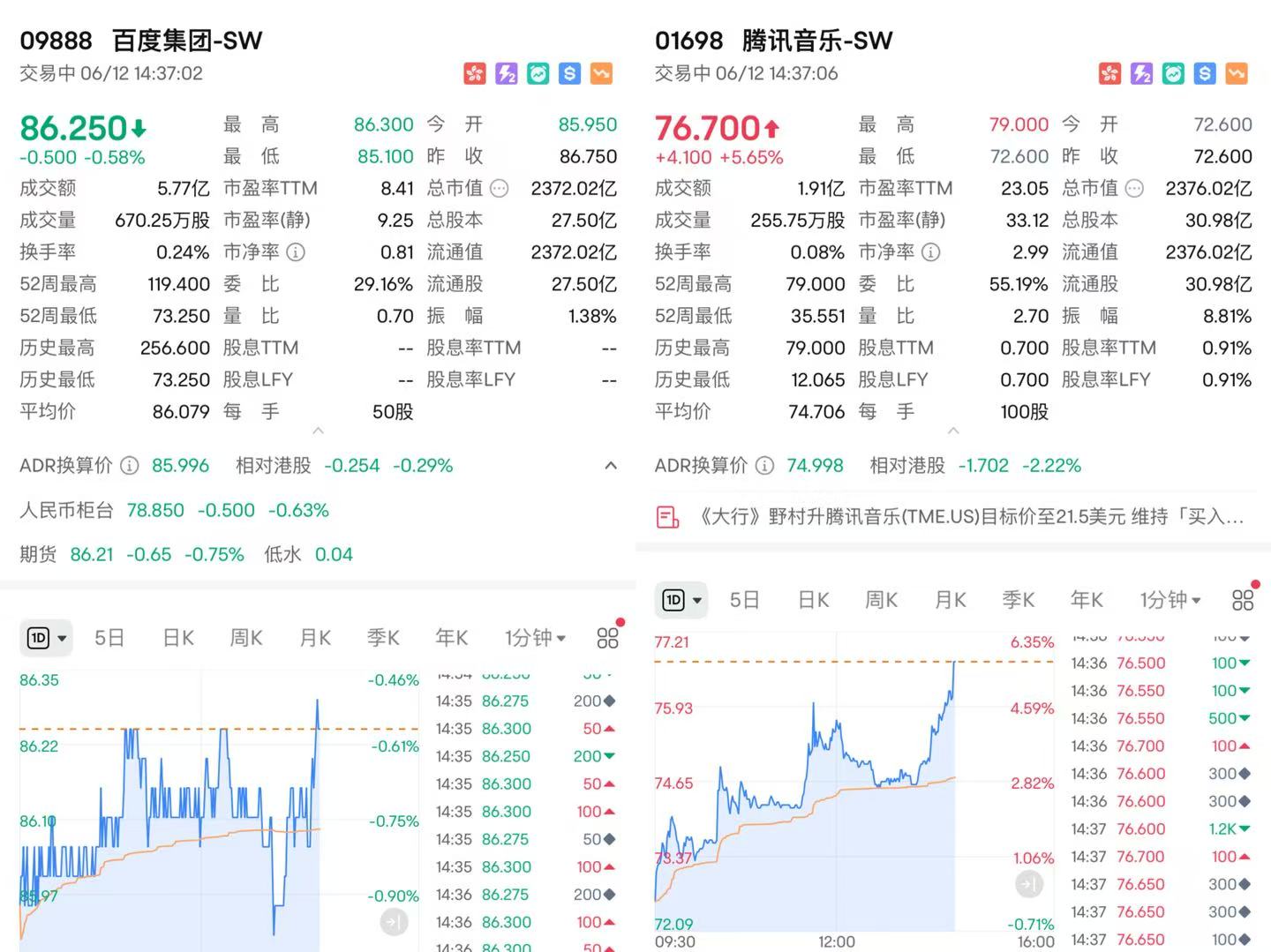
腾讯音乐市值一度超越百度!垂直龙头正在逆袭传统巨头
Di Yi Cai Jing· 2025-06-12 09:01
Core Viewpoint - The acquisition of Himalaya by Tencent Music signifies a deep restructuring of the internet traffic landscape and indicates a paradigm shift in internet investment logic [1][5]. Company Performance - Tencent Music's market capitalization briefly surpassed Baidu's, with Tencent Music closing at 232.8 billion HKD and Baidu at 235.96 billion HKD, reflecting a market gap of approximately 3 billion HKD [1]. - Tencent Music's market capitalization has increased by over 280% since its secondary listing, while Baidu's has decreased by over 60% [5]. - In Q1, Tencent Music's revenue was 7.36 billion RMB, with an 8.7% growth rate, while Baidu's revenue was 32.5 billion RMB, growing at only 3% [6][7]. Business Model Comparison - Tencent Music's core business is online music services, which saw a 15.9% revenue increase to 5.8 billion RMB in Q1, while Baidu's online marketing revenue decreased by 6% to 16 billion RMB [7]. - Tencent Music's revenue structure is shifting from reliance on live streaming to more stable subscription services, while Baidu's search advertising model is under pressure from emerging AI technologies [8][9]. Market Challenges - Tencent Music faces challenges from short video platforms like Douyin, which are reshaping music consumption and impacting user engagement [10]. - Baidu is transitioning towards AI, with its intelligent cloud business growing by 42% year-on-year, but these new ventures are still in the investment phase and contribute minimally to overall revenue [9][10]. International Expansion - Both companies are looking to international markets for growth, with Tencent Music investing in SM Entertainment for the Asian music market and Baidu expanding its autonomous driving services in the Middle East and Europe [10].