AI原生操作系统

Search documents
当AI走出屏幕:CES 2026与物理智能时代的来临
Jing Ji Guan Cha Wang· 2026-01-15 11:22
Core Insights - CES 2026 highlights the intersection of technology, geopolitics, and business strategy, showcasing emerging trends that shape the future of consumer technology and economic competition [1][2] Group 1: Artificial Intelligence as a Foundation - Artificial intelligence (AI) has become the cornerstone of innovations at CES 2026, driving advancements in various technologies and products [3] - New devices like laptops, smartphones, and wearables are increasingly integrating AI capabilities, enabling them to perform tasks independently without relying on cloud services [3] - Edge AI is emphasized, allowing AI algorithms to process data locally on devices, enhancing efficiency and privacy [4] - AI is evolving into a "digital agent" role, coordinating tasks across multiple devices and applications, with a focus on continuous, context-aware workflows [4] Group 2: Physical Artificial Intelligence Takes Center Stage - The concept of "physical AI" is introduced, referring to intelligent systems that perceive, decide, and execute actions in real environments [6] - Robotics is a key pillar of physical AI, with robots transitioning from conceptual designs to practical tools for collaboration in various sectors [7] - The integration of AI and robotics is evident in products like Boston Dynamics' Atlas, which showcases advanced capabilities for industrial applications [7][8] Group 3: Automotive Industry as AI Technology Pioneer - The automotive sector is increasingly merging with AI, with companies positioning themselves as technology leaders in the field [12] - Significant market opportunities are projected in the automotive industry, with a potential market value of $123 billion by 2032, reflecting an 85% growth from 2023 [12] - Companies like Ford and Nvidia are unveiling advanced autonomous driving systems, emphasizing the need for robust onboard computing resources [13][14] Group 4: Transition from Consumer Electronics to Social Infrastructure - AI is moving beyond traditional consumer electronics boundaries, becoming integral to social infrastructure, including transportation, energy systems, and smart homes [17] - The narrative at CES 2026 indicates a shift from novelty consumer products to large-scale industrial deployments of AI [17] - Collaboration among various systems and platforms is essential for effective AI implementation in real-world environments [18]
CES2026丨中科创达发布滴水OS 2.0 Pre以AI原生重构智能汽车交互体验
Zhong Guo Qi Che Bao Wang· 2026-01-09 03:29
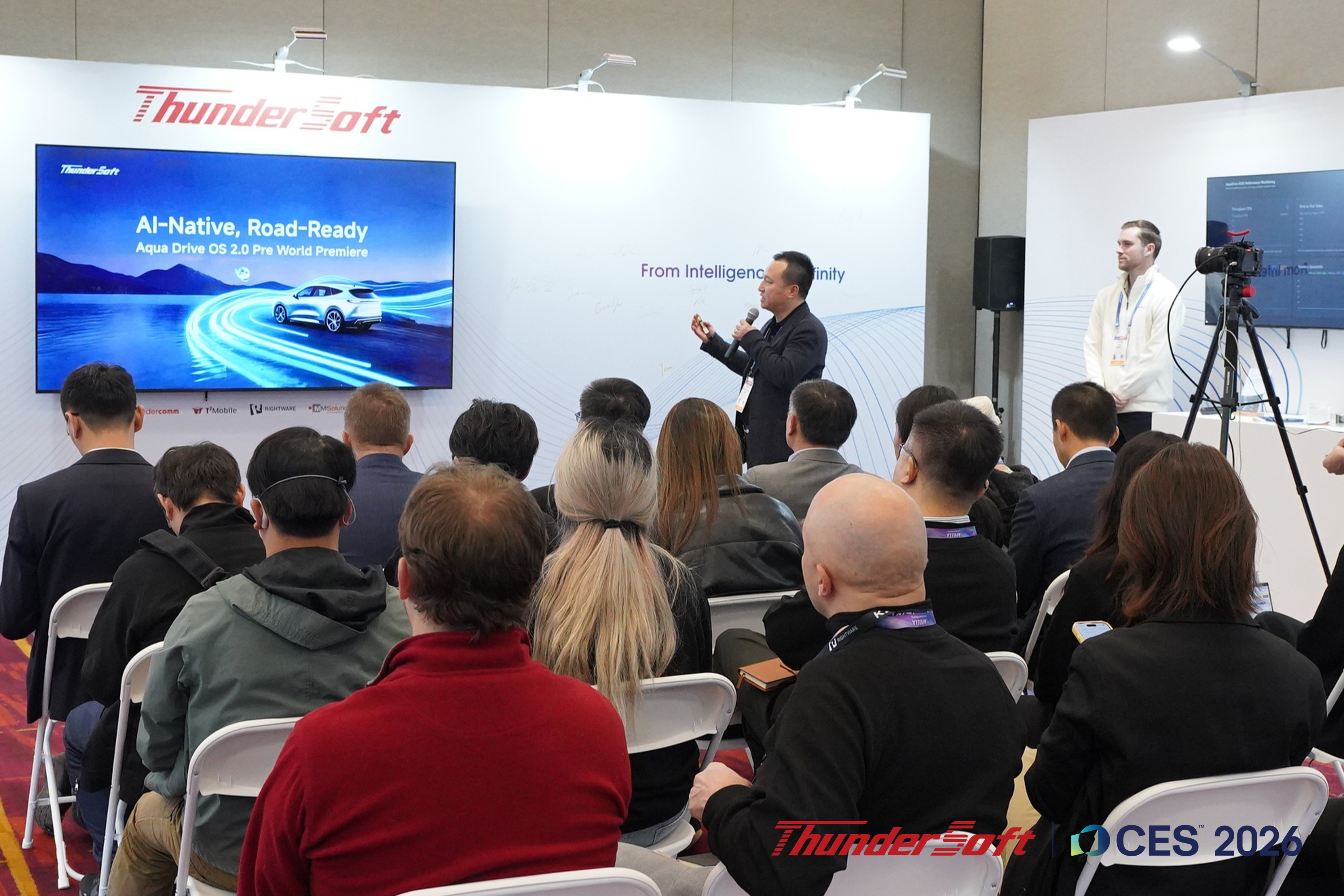
Core Viewpoint - The article highlights the launch of the new AI-native vehicle operating system, Drip Water OS 2.0 Pre, by Zhongke Chuangda at CES 2026, emphasizing its three core advantages: integrated experience, AI-native capabilities, and accelerated mass production [1][11]. Group 1: Integrated Experience - Drip Water OS 2.0 Pre adopts a user-centered design philosophy, innovatively integrating the central control screen with panoramic views to enhance both driving safety and information richness [3][8]. - The system features the "Smart Dome Integrated Reality" HMI, which combines lane-level maps, surrounding reality, and panoramic images into a single display, providing a more intuitive and efficient information presentation [3][8]. - It offers a dual-screen 3D rendering function that covers various driving scenarios, delivering an immersive visual experience with over 6.5 million high-precision model renderings and real-time lighting effects [3][8]. Group 2: AI-Native Capabilities - Drip Water OS 2.0 Pre is designed as a fully AI-native operating system, embedding AI capabilities from the ground up to create proactive intelligent travel experiences [8][11]. - The system utilizes a verified edge-cloud AI architecture, ensuring millisecond-level response times (≤500ms) to meet real-time interaction needs during driving [8][10]. - It integrates AI perception and decision-making capabilities to create an intelligent agent matrix that covers the entire driving cycle, transforming the cabin into a proactive travel partner [8][9]. Group 3: Interaction and User Experience - The system features an AI UI-driven "boundaryless interaction" model, allowing users to issue commands through natural language without manual input, enhancing operational efficiency [9][10]. - The generative HMI empowers personalized experiences in the smart cabin, transitioning from passive responses to proactive sensing and emotional resonance [9][10]. Group 4: Accelerated Mass Production - Drip Water OS 2.0 Pre addresses common industry challenges related to resource utilization and development efficiency, enhancing chip adaptability and cross-domain collaboration [10][11]. - The system has achieved comprehensive compatibility with mainstream chip platforms, significantly reducing adaptation and debugging cycles for automotive manufacturers [10]. - It collaborates with numerous global automotive ecosystem partners to enrich system functionalities and support manufacturers in creating differentiated next-generation smart vehicles [10][11].


中科创达(300496):端侧AI浪潮下的OS龙头 开启新一轮成长周期
Xin Lang Cai Jing· 2025-12-16 04:35
Core Viewpoint - The company, Zhongke Chuangda, is positioned as a leading global provider of intelligent operating systems, benefiting significantly from AI-driven industrial transformation through its unique "operating system + edge intelligence" strategy [1] Group 1: Business Segments - Intelligent Software: The business revenue for the intelligent software segment reached 841 million yuan in H1 2025, reflecting a year-on-year growth of 10.52% [2] - Intelligent Automotive: The intelligent automotive segment achieved revenue of 1.189 billion yuan in H1 2025, with a year-on-year increase of 7.85% [3] - Intelligent IoT: The intelligent IoT segment experienced a remarkable revenue growth of 136% year-on-year in H1 2025, driven by the rapid expansion of edge AI applications [3] Group 2: Market Trends and Projections - The global smartphone market is expected to see a moderate recovery, with a projected year-on-year growth of 1% in shipments by 2025, driven by the increasing penetration of AI features [1] - The global automotive generative AI market is anticipated to grow at a CAGR of 23.8% from 2025 to 2034, indicating a strong growth trajectory for the intelligent automotive sector [2] - The global edge AI market is forecasted to grow from 321.9 billion yuan in 2025 to 1.2 trillion yuan by 2029, with a CAGR of 39.6% [3] Group 3: Globalization and Strategic Initiatives - The company reported overseas revenue of 1.558 billion yuan in H1 2025, marking an impressive year-on-year growth of 81.41%, showcasing the effectiveness of its "globalization + localization" strategy [3] - The company is set to launch its AI-native vehicle operating system, Drip OS, in 2025, which supports a full-chip platform and large model access, indicating a strategic move to capture the growing demand for integrated automotive solutions [2] Group 4: Financial Projections - The company is expected to achieve revenues of 7.314 billion yuan, 9.415 billion yuan, and 11.436 billion yuan for the years 2025, 2026, and 2027, respectively, with year-on-year growth rates of 35.8%, 28.7%, and 21.5% [4] - The projected net profit attributable to the parent company is forecasted to be 578 million yuan, 746 million yuan, and 964 million yuan for the years 2025, 2026, and 2027, reflecting growth rates of 41.9%, 29.0%, and 29.3% [4]
服务器OS迎来智能化升级时代,AI如何“for system”?丨ToB产业观察
Tai Mei Ti A P P· 2025-08-15 03:38
Core Insights - The impact of AI on server operating systems is mutual, necessitating advancements in both AI applications and operating systems to support them effectively [2][3] Group 1: Market Trends and Predictions - The global AI server market is projected to exceed $120 billion by 2025, indicating a significant shift in the role of operating systems from passive tools to active power management centers [3] - The demand for heterogeneous computing is reshaping the foundational logic of server operating systems, requiring compatibility with various hardware types such as CPU, GPU, DPU, FPGA, and ASIC [3][4] Group 2: Technical Challenges - Server operating systems face several challenges, including the need for full architecture compatibility and dynamic resource scheduling to support AI model training [3][4] - Performance bottlenecks and cluster stability are critical issues, particularly with the training of trillion-parameter models that require terabyte-level memory and face cumulative failure rates in large clusters [3][4] Group 3: Evolution of Operating Systems - Operating systems are evolving from simple tools to intelligent agents capable of smart resource allocation and management [4][5] - Two main technical directions are emerging: one involves using large models to create operating system kernels, while the other focuses on upgrading existing kernels through intelligent adaptations [4][5] Group 4: Data Privacy and Security - AI applications in sensitive fields like healthcare and finance demand stringent data privacy and security measures, prompting operating systems to enhance their security frameworks [5][6] Group 5: Ecosystem Integration - The fragmentation of software and hardware ecosystems poses significant challenges for server operating systems, necessitating improved compatibility and optimization across diverse computing resources [5][6] - The establishment of alliances, such as the Longxi Intelligent Computing Infrastructure Alliance, aims to enhance compatibility and collaboration among AI chip manufacturers, server vendors, and operating system developers [9][10] Group 6: Future Directions - The future of server operating systems lies in their ability to integrate AI capabilities, transforming them into intelligent operational assistants that can preemptively address issues and enhance system stability [8][9] - The concept of AI-native operating systems is gaining traction, requiring a reconfiguration of existing systems to better support AI environments [6][7]